


Association between dopamine and cerebral autoregulation in preterm neonates
- PMID: 32005034
- PMCID: PMC7223955
- DOI: 10.1038/s41390-020-0790-0
Association between dopamine and cerebral autoregulation in preterm neonates
Abstract
Background: To test the hypothesis that dopamine is associated with impaired cerebral autoregulation (ICA) in a dose-dependent fashion.
Methods: Non a priori designed secondary analysis of a prospectively enrolled cohort study subjects <12 h of life between 240 and 296 weeks gestation. Cerebral saturations (rScO2) and mean arterial blood pressure (MAP) were continuously monitored every 30 s for 96 h. ICA was defined by a 10 min epoch rScO2-MAP correlation coefficient of >0.5.
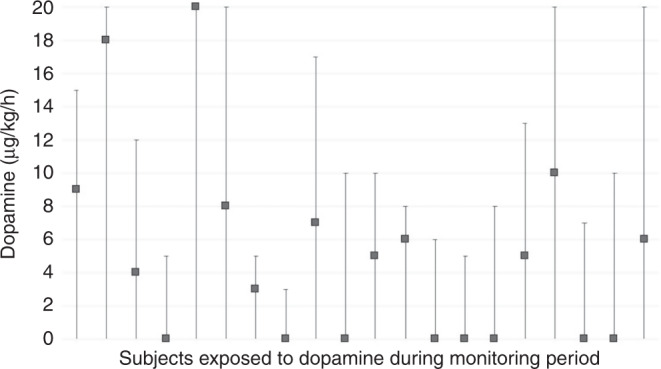
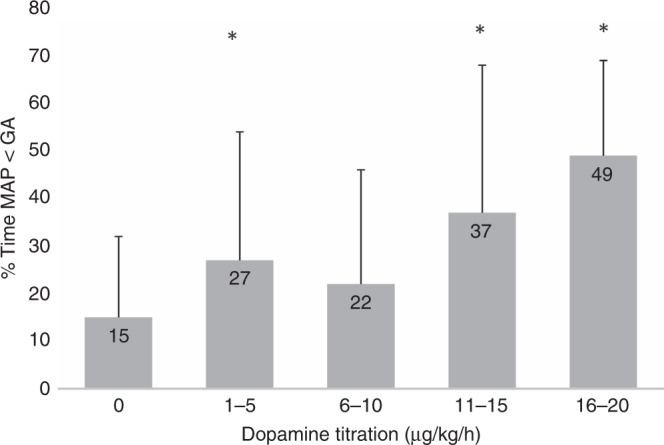
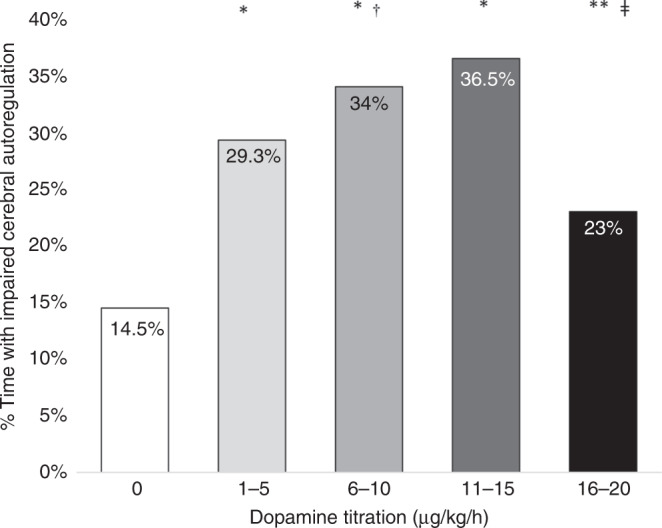
Results: Twenty-three of 61 subjects (38%) required dopamine. Time spent with ICA was 23% in dopamine-exposed subjects vs. 14% in those not exposed (p = 0.0001). On the epoch level, time spent with ICA was 15%, 29%, 34%, 37%, and 23% in epochs with dopamine titration of 0, 1-5, 6-10, 11-15, and 16-20 μg/kg/min, respectively. Using mixed-effect modeling, ICA for each dopamine titration was significantly higher than unexposed times when controlling for gestation, presence of a patent ductus arteriosus, day of life, MAP less than gestational age, and illness severity score (p < 0.02).
Conclusions: Dopamine exposure during the first 96 h was associated with ICA. Time periods with ICA increased with dopamine exposure in a dose-dependent fashion peaking at a concentration of 11-15 μg/kg/min.
Conflict of interest statement
The authors declare no competing interests.
Figures
References
-
- Eriksen VR. Rational use of dopamine in hypotensive newborns: improving our understanding of the effect on cerebral autoregulation. Dan. Med. J. 2017;64:B5388. - PubMed
Publication types
MeSH terms
Substances
LinkOut - more resources
Full Text Sources
Miscellaneous
