


When money talks: Judging risk and coercion in high-paying clinical trials
- PMID: 32005037
- PMCID: PMC6994245
- DOI: 10.1371/journal.pone.0227898
When money talks: Judging risk and coercion in high-paying clinical trials
Abstract
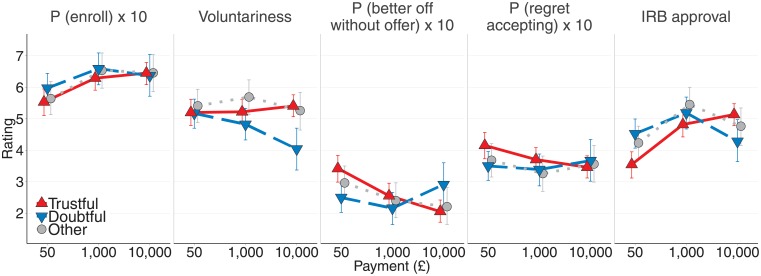
Millions of volunteers take part in clinical trials every year. This is unsurprising, given that clinical trials are often much more lucrative than other types of unskilled work. When clinical trials offer very high pay, however, some people consider them repugnant. To understand why, we asked 1,428 respondents to evaluate a hypothetical medical trial for a new Ebola vaccine offering three different payment amounts. Some respondents (27%) used very high pay (£10,000) as a cue to infer the potential risks the clinical trial posed. These respondents were also concerned that offering £10,000 was coercive- simply too profitable to pass up. Both perceived risk and coercion in high-paying clinical trials shape how people evaluate these trials. This result was robust within and between respondents. The link between risk and repugnance may generalize to other markets in which parties are partially remunerated for the risk they take and contributes to a more complete understanding of why some market transactions appear repugnant.
Conflict of interest statement
The authors have declared that no competing interests exist.
Figures
References
-
- Nussbaum MC. “Whether from reason Or prejudice”: Taking money for bodily services. The Journal of Legal Studies. 1998;27(S2):693–723. 10.1086/468040 - DOI
-
- AFP. Man who died in French drug trial had ‘unprecedented’ reaction, say experts. The Guardian. 2016. Retrieved from https://www.theguardian.com/science/2016/mar/07/french-drug-trial-man-de...
Publication types
MeSH terms
Substances
LinkOut - more resources
Full Text Sources
Medical
