


Defining cognitive and functional profiles in schizophrenia and affective disorders
- PMID: 32005199
- PMCID: PMC6995055
- DOI: 10.1186/s12888-020-2459-y
Defining cognitive and functional profiles in schizophrenia and affective disorders
Abstract
Background: Neurocognitive dysfunction is a common symptom of various major psychiatric disorders, including schizophrenia, major depressive disorder (MDD), and bipolar I disorder (BD). In this study, we investigated whether cognitive profiles and daily skill functioning could effectively differentiate between patients with schizophrenia, MDD, and BD.
Method: In this cross-sectional study, we recruited a total of 63 patients with schizophrenia, 55 patients with MDD, 43 patients with BD, and 92 healthy control subjects. We evaluated participants' cognitive functions and functional capacity using the Brief Assessment of Cognition in Schizophrenia (BACS) and the UCSD Performance-based Skills Assessment, Brief Version (UPSA-B), respectively. Multivariate analysis of covariance was then adopted to determine inter-group differences in BACS and UPSA-B performance.
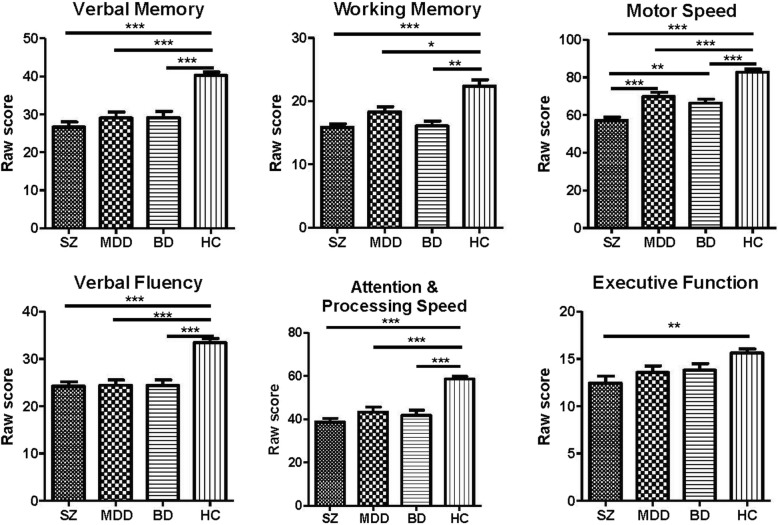
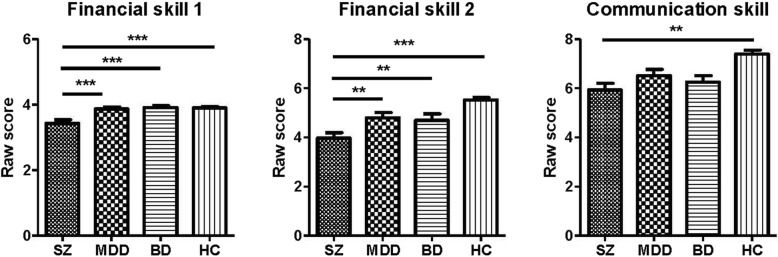
Results: The BACS was capable of differentiating patients with a major psychiatric disorder (schizophrenia, MDD, and BD) from healthy subjects. Furthermore, schizophrenia patients had poorer motor speed performance than patients with affective disorders. The UPSA-B, particularly the financial portion, was able to distinguish schizophrenia patients from other groups. However, we did not observe any differences in UPSA-B performance between patients with mood disorders and the healthy controls. No significant difference between patients with BD and those with MDD were observed in either cognitive function or in functional capacity. The performances of the BACS and the UPSA-B were positively correlated, particularly in the MDD group.
Conclusion: Considering overall performance, the BACS and the UPSA-B characterize different endophenotyping profiles in the aforementioned four participant groups. Therefore, the results support the need for comprehensive assessments that target both cognitive function and functional capacity for patients with major psychiatric disorders.
Keywords: Daily skill functioning; Depression; Mania; Neurocognitive tests; Schizophrenia.
Conflict of interest statement
The authors declare that they have no competing interests.
Figures
References
-
- Bourne C, Aydemir O, Balanza-Martinez V, Bora E, Brissos S, Cavanagh JT, Clark L, Cubukcuoglu Z, Dias VV, Dittmann S, et al. Neuropsychological testing of cognitive impairment in euthymic bipolar disorder: an individual patient data meta-analysis. Acta Psychiatr Scand. 2013;128(3):149–162. doi: 10.1111/acps.12133. - DOI - PubMed
Publication types
MeSH terms
Grants and funding
LinkOut - more resources
Full Text Sources
Medical
