


Sleep and Athletic Performance: Impacts on Physical Performance, Mental Performance, Injury Risk and Recovery, and Mental Health
- PMID: 32005349
- PMCID: PMC9960533
- DOI: 10.1016/j.jsmc.2019.11.005
Sleep and Athletic Performance: Impacts on Physical Performance, Mental Performance, Injury Risk and Recovery, and Mental Health
Abstract
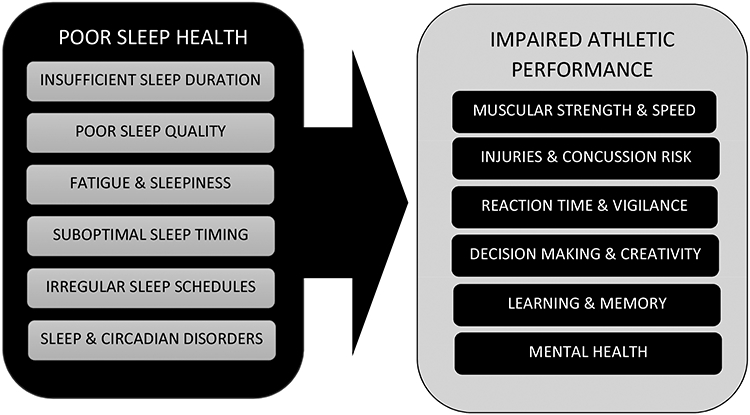
Research has characterized the sleep of elite athletes and attempted to identify factors associated with athletic performance, cognition, health, and mental well-being. Sleep is a fundamental component of performance optimization among elite athletes, yet only recently embraced by sport organizations as an important part of training and recovery. Sleep plays a crucial role in physical and cognitive performance and is an important factor in reducing risk of injury. This article aims to highlight the prevalence of poor sleep, describe its impacts, and address the issue of sport culture surrounding healthy sleep.
Keywords: Insomnia; Performance; Sleep; Sport.
Copyright © 2019 Elsevier Inc. All rights reserved.
Conflict of interest statement
Disclosure Dr M.A. Grandner has received grants from Jazz Pharmaceuticals, National Institutes of Health, Nexalin Technology, and Kemin Foods. He has performed consulting activities for Fitbit, Natrol, Casper, Curaegis, Thrive, Pharmavite, SPV, NightFood, and Merck. This work was supported by R01MD011600 and an Innovation Grant from the National Collegiate Athletics Association.
Figures
References
-
- Abbiss CR, & Laursen PB (2005). Models to explain fatigue during prolonged endurance cycling. Sports medicine, 35(10), 865–898. - PubMed
-
- Abedelmalek S, Souissi N, Chtourou H, Denguezli M, Aouichaoui C, Ajina M, … & Tabka Z (2013). Effects of partial sleep deprivation on proinflammatory cytokines, growth hormone, and steroid hormone concentrations during repeated brief sprint interval exercise. Chronobiology international, 30(4), 502–509. - PubMed
-
- Achten J, & Jeukendrup AE (2003). Heart rate monitoring. Sports medicine, 33(7), 517–538. - PubMed
-
- Adler M In today’s world, the well-rested lose respect. (2009). Morning edn. Washington, DC: National Public Radio.
-
- Ahbab S, Ataoğlu HE, Tuna M, Karasulu L, Çetin F, Temiz LÜ , & Yenigün M (2013). Neck circumference, metabolic syndrome and obstructive sleep apnea syndrome; evaluation of possible linkage. Medical science monitor: international medical journal of experimental and clinical research, 19, 111. - PMC - PubMed
Publication types
MeSH terms
Grants and funding
LinkOut - more resources
Full Text Sources
Medical
