Review
. 2020 Mar;225(2):467-480.
doi: 10.1007/s00429-019-02001-9. Epub 2020 Jan 31.

Investigating learning-related neural circuitry with chronic in vivo optical imaging

Affiliations
Review

Investigating learning-related neural circuitry with chronic in vivo optical imaging

Christian R Lee et al. Brain Struct Funct. 2020 Mar.

Abstract

Fundamental aspects of brain function, including development, plasticity, learning, and memory, can take place over time scales of days to years. Chronic in vivo imaging of neural activity with cellular resolution is a powerful method for tracking the long-term activity of neural circuits. We review recent advances in our understanding of neural circuit function from diverse brain regions that have been enabled by chronic in vivo cellular imaging. Insight into the neural basis of learning and decision-making, in particular, benefit from the ability to acquire longitudinal data from genetically identified neuronal populations, deep brain areas, and subcellular structures. We propose that combining chronic imaging with further experimental and computational innovations will advance our understanding of the neural circuit mechanisms of brain function.

Keywords: Computation; GECIs; Imaging; Learning; Neural circuits; Plasticity; Sensory processing.


Figures
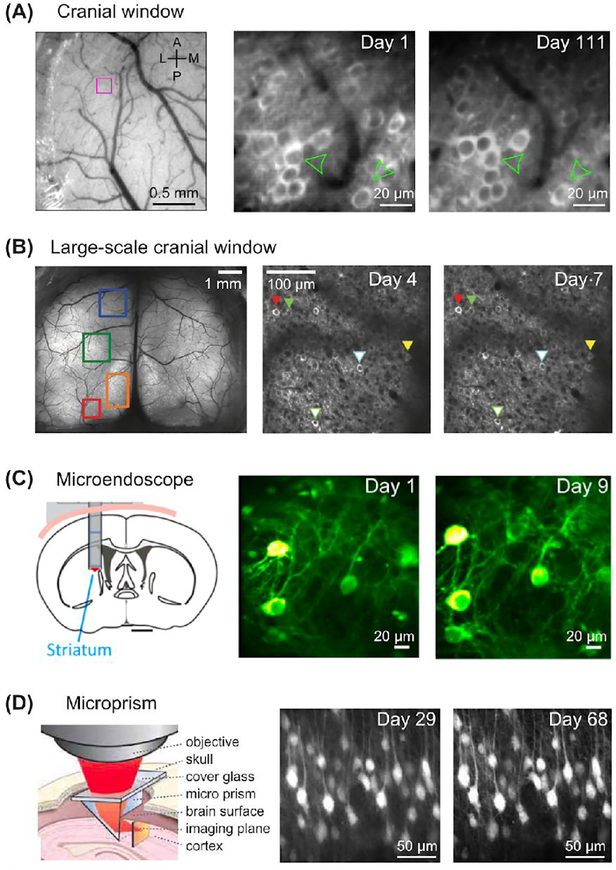
Figure 1.
Figure 1.
Chronic imaging approaches for tracking neuronal activity using two-photon imaging of genetically encoded calcium indicators (GECIs). A. Left: Top view of the cerebral cortex through a cranial window implanted above the dura mater. Right: layer 2/3 cortical neurons expressing YC3.60 followed over 111 days. Adapted from Margolis, Lütcke et al. (2012) (Margolis et al 2012). B. Left: Top view of cortex through a large-scale “Crystal Skull” cranial window. Right: Chronic imaging of one of many optically accessible cortical neuronal populations expressing GCaMP6s. Adapted from Kim et al. (2016) (Kim et al. 2016). C. Left: Deep brain structures can be imaged through an implanted GRIN lens. Right: Neurons in striatum expressing GCaMP6s. Note that neurons were followed for a longer time period than shown here. Adapted from Bocarsly, Jiang et al. (2015) (Bocarsly et al. 2015). D. Left: Axially oriented brain structures can be imaged through a prism implanted facing the side of the area of interest. A microprism can also be used for deeper brain structures. Right: Neurons in neocortex expressing GCaMP3 imaged over multiple weeks. Apical dendrites are visible in the x-z plane. Note that the original image was cropped for display. Adapted from Andermann et al. (2013) (Andermann et al. 2013).
Figure 2.
Figure 2.
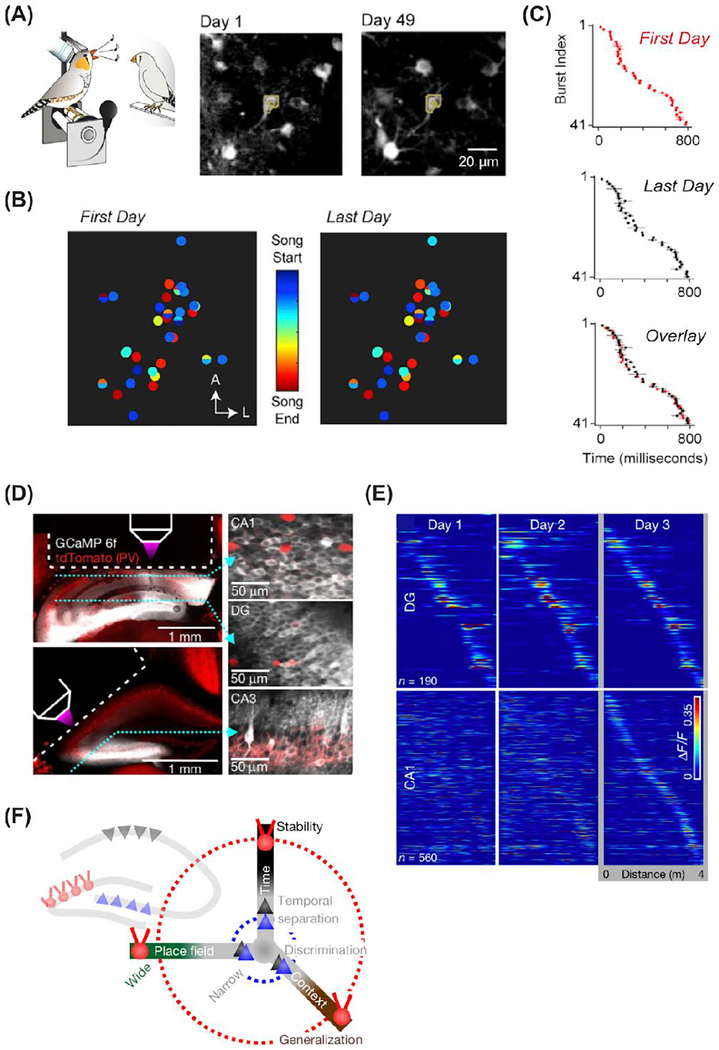
Stability and flexibility of behavior-related neuronal population activity measured with chronic imaging. A. Example of stability in songbird experiment. Two-photon images of neurons expressing GCaMP6f tracked over 49 days. B. Comparison of song timing maps for a population of neurons. C. Stability of burst index measures. A-C adapted from Katlowitz et al. (2018) (Katlowitz et al. 2018). D. Subregion-specific stability in hippocampus. Chronic imaging of CA1, DG, and CA3 sub-regions. E. Heat maps of neuronal calcium signals across three days showing higher stability for DG than CA1. F. Schematic of differences in stability, width, and generalization for CA1, DG, and CA3. D-E adapted from Hainmueller and Bartos (2018) (Hainmueller and Bartos 2018).
Figure 3.
Figure 3.
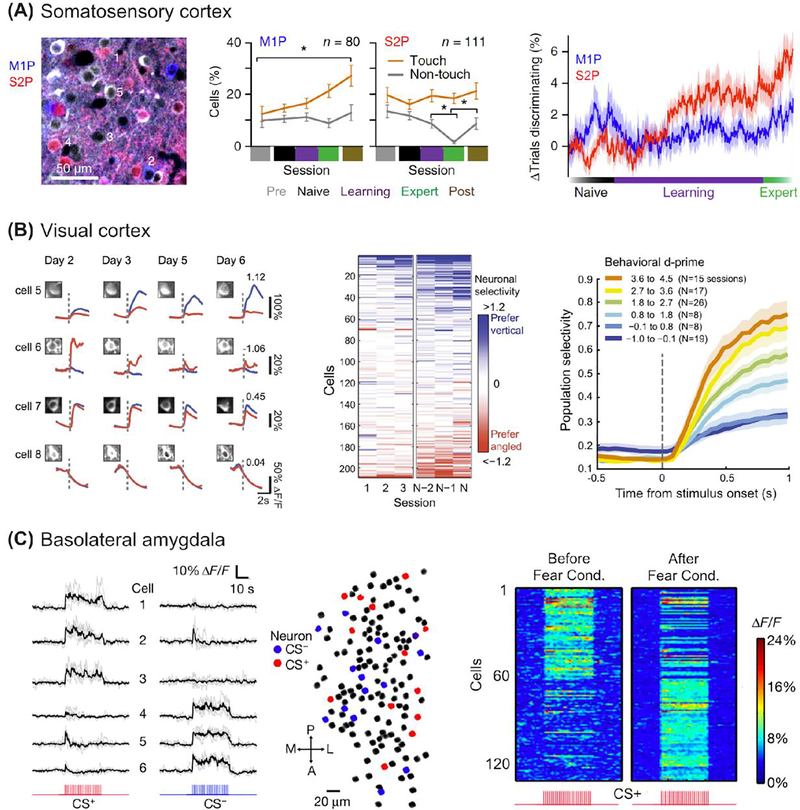
Learning-related changes in neuronal population activity measured with chronic cellular imaging. A. Projection neurons in primary somatosensory cortex (S1) show distinct learning-related activity during performance of a tactile discrimination task. Left: Identification of M1-projecting (M1P) and S2-projecting (S2P) neurons via retrograde tracers. Middle: The fraction of neurons classified as touch or non-touch as a function of Naive, Learning, and Expert behavioral phases. Right: The change in discrimination accuracy of M1P and S2P neurons for Go and NoGo tactile stimuli (P100 vs. P1200 textures) through learning. Adapted from (Chen et al. 2015a). B. Neurons in primary visual cortex (V1) show diverse learning-related activity during performance of a visual discrimination task. Left: Example calcium signals from four neurons across four imaging sessions in response to a vertical, rewarded stimulus (blue) or an angled, non-rewarded stimulus (red). Middle: Selectivity of neurons across the first three and last three training sessions. Right: Neuronal population selectivity as a function of learning. Each curve depicts the time course of selectivity at a range of behavioral d’. Adapted from (Poort et al. 2015). C. Neurons in basolateral amygdala change selectivity with auditory fear conditioning. Calcium signals of cells responsive to two different auditory tones (CS+ or CS−) before pairing the conditioned stimulus (CS+) with a foot shock using a fear conditioning paradigm. Right, Cell population responses in an example mouse to the CS+ tone before and after fear conditioning. A, anterior; L, lateral; M, medial; P, posterior. Adapted from (Grewe et al. 2017).

References

    1. Akassoglou K, Merlini M, Rafalski VA, et al. (2017) Imaging of CNS Injury and Disease. J Neurosci Off J Soc Neurosci 37:10808–10816. - PMC - PubMed
    1. Alivisatos AP, Chun M, Church GM, et al. (2015) A National Network of Neurotechnology Centers for the BRAIN Initiative. Neuron 88:445–448. - PMC - PubMed
    1. Andermann ML, Gilfoy NB, Goldey GJ, et al. (2013) Chronic cellular imaging of entire cortical columns in awake mice using microprisms. Neuron 80:900–913. - PMC - PubMed
    1. Bando Y, Sakamoto M, Kim S, et al. (2019) Comparative Evaluation of Genetically Encoded Voltage Indicators. Cell reports 26:802–813.e4. - PMC - PubMed
    1. Barretto RPJ, Messerschmidt B, Schnitzer MJ (2009) In vivo fluorescence imaging with high-resolution microlenses. Nat methods 6:511–512. - PMC - PubMed

LinkOut - more resources