BioMagResBank (BMRB) as a Resource for Structural Biology
- PMID: 32006287
- PMCID: PMC8064287
- DOI: 10.1007/978-1-0716-0270-6_14
BioMagResBank (BMRB) as a Resource for Structural Biology
Abstract
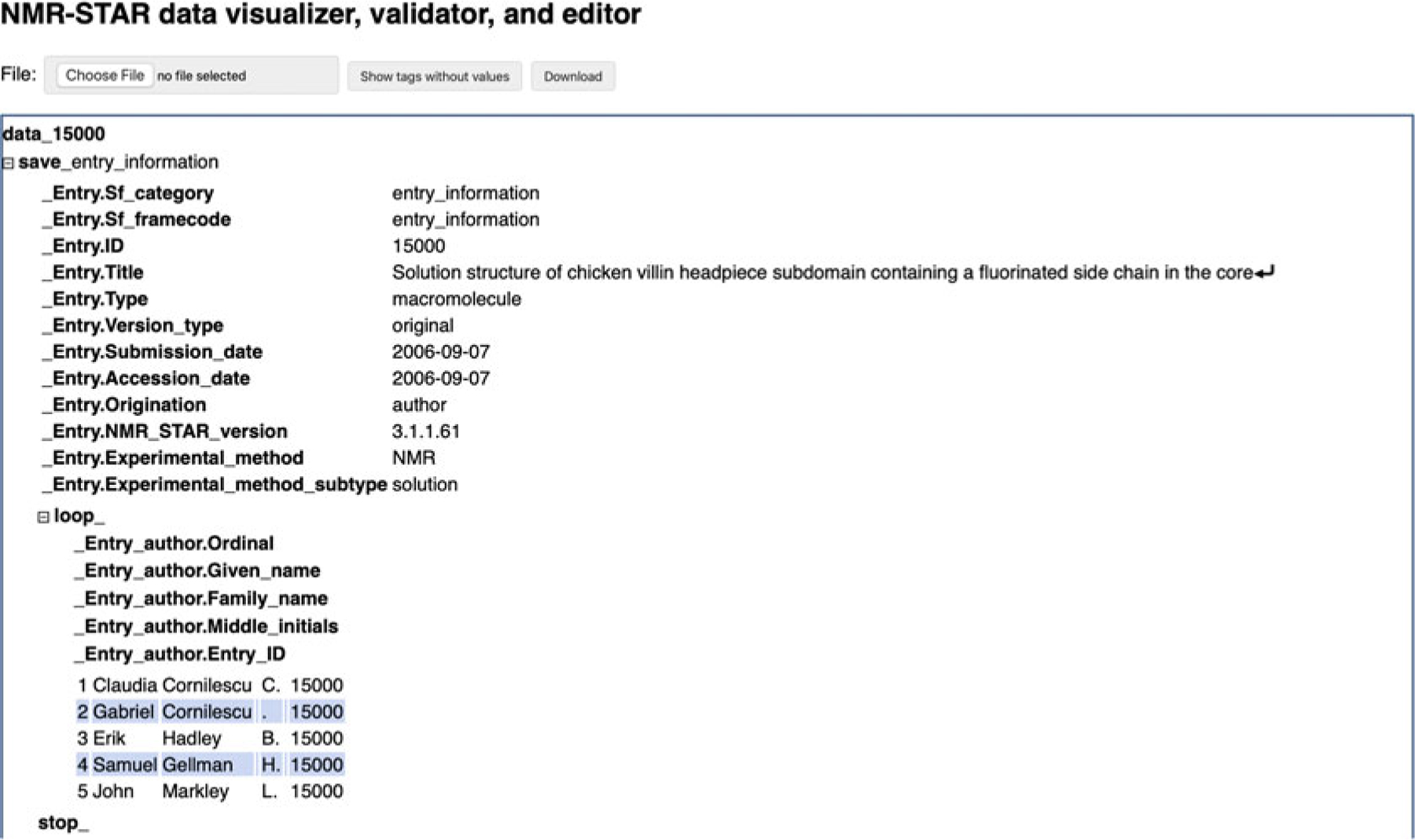
The Biological Magnetic Resonance Data Bank (BioMagResBank or BMRB), founded in 1988, serves as the archive for data generated by nuclear magnetic resonance (NMR) spectroscopy of biological systems. NMR spectroscopy is unique among biophysical approaches in its ability to provide a broad range of atomic and higher-level information relevant to the structural, dynamic, and chemical properties of biological macromolecules, as well as report on metabolite and natural product concentrations in complex mixtures and their chemical structures. BMRB became a core member of the Worldwide Protein Data Bank (wwPDB) in 2007, and the BMRB archive is now a core archive of the wwPDB. Currently, about 10% of the structures deposited into the PDB archive are based on NMR spectroscopy. BMRB stores experimental and derived data from biomolecular NMR studies. Newer BMRB biopolymer depositions are divided about evenly between those associated with structure determinations (atomic coordinates and supporting information archived in the PDB) and those reporting experimental information on molecular dynamics, conformational transitions, ligand binding, assigned chemical shifts, or other results from NMR spectroscopy. BMRB also provides resources for NMR studies of metabolites and other small molecules that are often macromolecular ligands and/or nonstandard residues. This chapter is directed to the structural biology community rather than the metabolomics and natural products community. Our goal is to describe various BMRB services offered to structural biology researchers and how they can be accessed and utilized. These services can be classified into four main groups: (1) data deposition, (2) data retrieval, (3) data analysis, and (4) services for NMR spectroscopists and software developers. The chapter also describes the NMR-STAR data format used by BMRB and the tools provided to facilitate its use. For programmers, BMRB offers an application programming interface (API) and libraries in the Python and R languages that enable users to develop their own BMRB-based tools for data analysis, visualization, and manipulation of NMR-STAR formatted files. BMRB also provides users with direct access tools through the NMRbox platform.
Keywords: Analysis; BMRB; BioMagResBank; Data formats; Deposition; NMR data; NMR spectra; NMR-STAR; PDB; Python; R; Retrieval; Search; Structures; Time-domain data; Visualization.
Figures
References
MeSH terms
Substances
Grants and funding
LinkOut - more resources
Full Text Sources