


Increased global cognition correlates with increased thalamo-temporal connectivity in response to targeted cognitive training for recent onset schizophrenia
- PMID: 32007346
- PMCID: PMC7299776
- DOI: 10.1016/j.schres.2020.01.020
Increased global cognition correlates with increased thalamo-temporal connectivity in response to targeted cognitive training for recent onset schizophrenia
Abstract
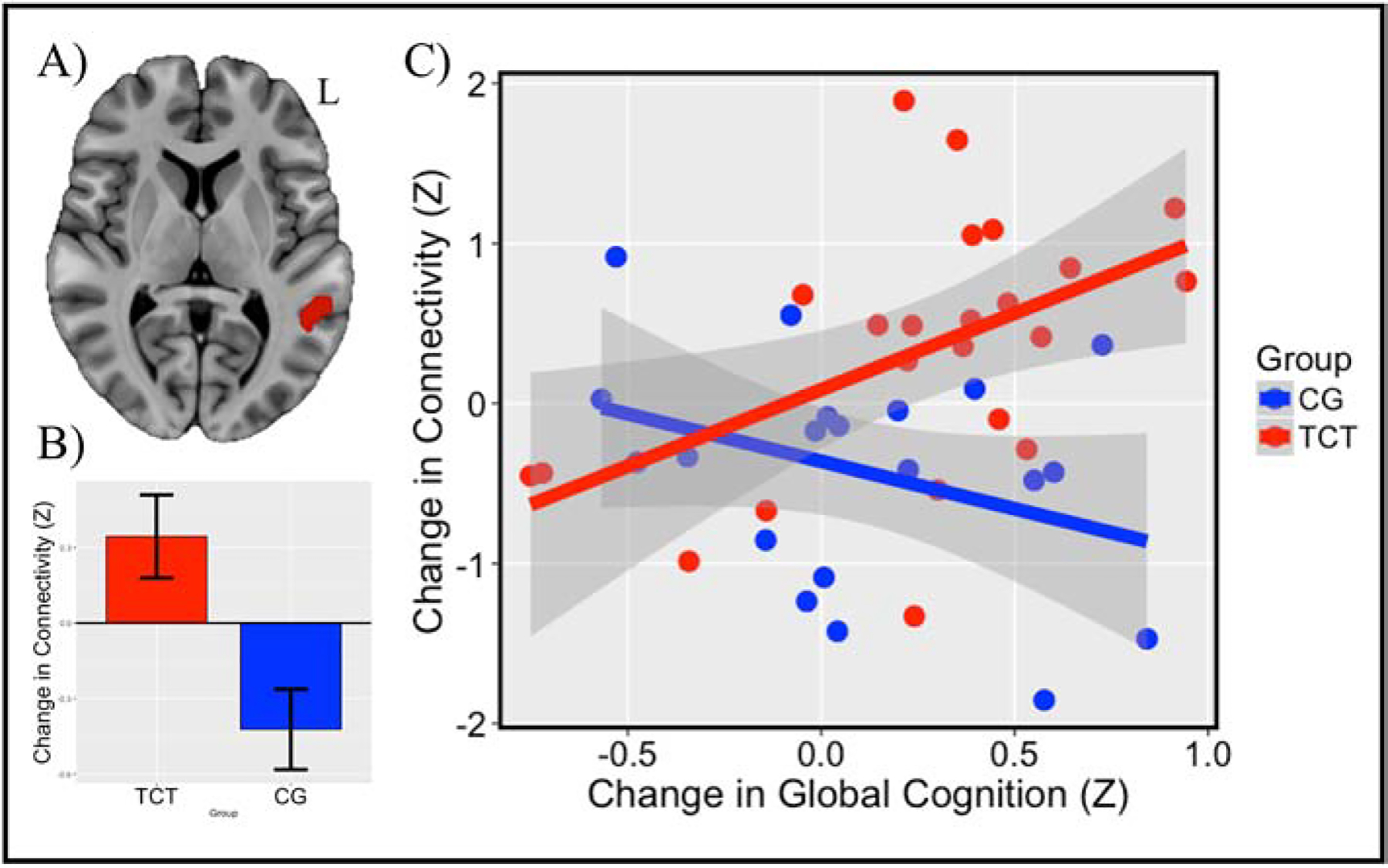
Patients with schizophrenia exhibit disrupted thalamocortical connections that relate to aspects of symptoms and deficits in cognition. Targeted cognitive training (TCT) of the auditory system in schizophrenia has been shown to improve cognition, but its impact on thalamocortical connectivity is not known. Here we examined thalamocortical connections that may be neuroplastic in response to TCT using a region of interest (ROI) approach. Participants were randomly assigned to either 40 h of TCT (N = 24) or an active control condition (CG; N = 20). Participants underwent resting state fMRI and cognitive testing both before and after training. Changes in thalamocortical connectivity were measured in 15 ROIs derived from a previous study comparing a large sample of schizophrenia subjects with healthy controls. A significant group by time interaction was observed in a left superior temporal ROI which was previously found to exhibit thalamocortical hyper-connectivity in patients with schizophrenia. Changes in this ROI reflected thalamic connectivity increases in the TCT group, while the CG group showed decreases. Additionally, the relationship between connectivity change and change in global cognition showed a slope difference between groups, with increases in thalamo-temporal connectivity correlating with improvements in global cognition in TCT. No significant relationships were observed with changes in clinical symptoms or functioning. These findings demonstrate that TCT may influence intrinsic functional connections in young individuals with schizophrenia, such that improvements in cognition correspond to compensatory increases in connectivity in a temporal region previously shown to exhibit thalamic hyper-connectivity.
Keywords: Cognition; Cognitive training; Connectivity; Schizophrenia; Thalamus.
Copyright © 2020 Elsevier B.V. All rights reserved.
Conflict of interest statement
Declaration of competing interest SV has served as a paid consultant to Posit Science Inc. In the past three years, DHM has received compensation as a consultant for Boehringer-Ingelheim, Amgen, and Hoffmann-LaRoche. The other authors declare no conflict of interest.
Figures
References
-
- Adcock R Alison, Corby Dale, Melissa Fisher, Stephanie Aldebot, Alexander Genevsky, Gregory V Simpson, Srikantan Nagarajan, and Sophia Vinogradov. 2009. “When Top-down Meets Bottom-up: Auditory Training Enhances Verbal Memory in Schizophrenia.” Schizophrenia Bulletin 35 (6): 1132–41. 10.1093/schbul/sbp068. - DOI - PMC - PubMed
-
- Anticevic Alan, Cole Michael W., Repovs Grega, Murray John D., Brumbaugh Margaret S., Winkler Anderson M., Savic Aleksandar, Krystal John H., Pearlson Godfrey D., and Glahn David C.. 2014. “Characterizing Thalamo-Cortical Disturbances in Schizophrenia and Bipolar Illness.” Cerebral Cortex 24 (12): 3116–30. 10.1093/cercor/bht165. - DOI - PMC - PubMed
-
- Anticevic Alan, Michael W Cole Grega Repovs, Murray John D, Brumbaugh Margaret S, Winkler Anderson M, Savic Aleksandar, Krystal John H, Pearlson Godfrey D, and Glahn David C. 2013. “Characterizing Thalamo-Cortical Disturbances in Schizophrenia and Bipolar Illness.” Cerebral Cortex (New York, N.Y. : 1991), no. 1 (July): 1–15. 10.1093/cercor/bht165. - DOI - PMC - PubMed
-
- Anticevic Alan, Haut Kristen, Murray John D., Repovs Grega, Yang Genevieve J., Diehl Caroline, McEwen Sarah C., et al. 2015. “Association of Thalamic Dysconnectivity and Conversion to Psychosis in Youth and Young Adults at Elevated Clinical Risk.” JAMA Psychiatry 72 (9): 882–91. 10.1001/jamapsychiatry.2015.0566. - DOI - PMC - PubMed
