


Selenium-associated DNA methylation modifications in placenta and neurobehavioral development of newborns: An epigenome-wide study of two U.S. birth cohorts
- PMID: 32007686
- PMCID: PMC7722519
- DOI: 10.1016/j.envint.2020.105508
Selenium-associated DNA methylation modifications in placenta and neurobehavioral development of newborns: An epigenome-wide study of two U.S. birth cohorts
Abstract
Background/aim: Selenium (Se) levels in pregnancy have been linked to neurobehavioral development of the offspring. DNA methylation is a potential mechanism underlying the impacts of environmental exposures on fetal development; however, very few studies have been done elucidating the role of DNA methylation linking prenatal Se and child neurobehavior. We aimed to investigate the associations between placental Se concentration and epigenome-wide DNA methylation in two U.S. cohorts, and to assess the association between Se-related DNA methylation modifications and newborns' neurobehavior.
Methods: We measured placental Se concentrations in 343 newborns enrolled in the New Hampshire Birth Cohort Study and in 141 newborns in the Rhode Island Child Health Study. Genome-wide placental DNA methylation was measured by HumanMethylation450 BeadChip, and newborn neurobehavioral development was assessed by the NICU Network Neurobehavioral Scales (NNNS). We meta-analyzed the associations between placental Se concentration and DNA methylation in each cohort, adjusting for covariates. We also fit multiple linear regression and ordinal logistic regression for methylation and newborn NNNS summary scores.
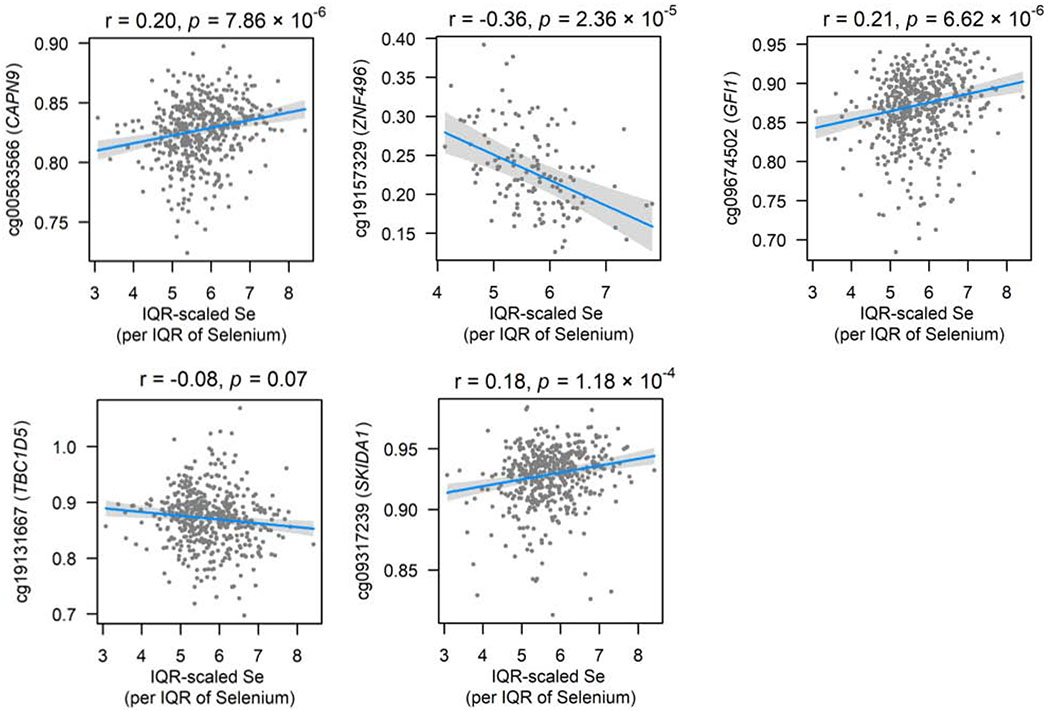
Results: We identified five Se-related differentially methylated CpG sites. Among them was cg09674502 (GFI1), where selenium concentration was positively associated with methylation (β-coefficient = 1.11, FDR-adjusted p-value = 0.045), and where we observed that a one percent methylation level increase was associated with a 15% reduced odds of higher muscle tone in the arms, legs and trunk of newborns, (OR [95% Confidence Interval, CI] = 0.85 [0.77, 0.95]). We also observed for each interquartile range (IQR) increase in selenium concentration in the placenta, there was 1.76 times greater odds of higher hypotonicity (OR [95% CI] = 1.76 [1.12, 2.82]).
Conclusions: Placental selenium concentration was inversely associated with muscle tone of newborns, and hypermethylation of GFI1 could be a potential mechanism underlying this association.
Keywords: DNA methylation; Muscle tone; NNNS; Neurobehavior; Placenta; Selenium.
Copyright © 2020 The Authors. Published by Elsevier Ltd.. All rights reserved.
Conflict of interest statement
Declaration of Competing Interest The authors declare that they have no known competing financial interests or personal relationships that could have appeared to influence the work reported in this paper.
Figures



References
-
- Al-Saleh I, Al-Rouqi R, Obsum CA, Shinwari N, Mashhour A, Billedo G, Al-Sarraj Y, Rabbah A, 2015. Interaction between cadmium (Cd), selenium (Se) and oxidative stress biomarkers in healthy mothers and its impact on birth anthropometric measures. International Journal of Hygiene and Environmental Health 218, 66–90. 10.1016/j.ijheh.2014.08.001 - DOI - PubMed
-
- Arai Y, Hayakawa K, Arai D, Ito R, Iwasaki Y, Saito K, Akutsu K, Takatori S, Ishii R, Hayashi R, Izumi S-I, Sugino N, Kondo F, Horie M, Nakazawa H, Makino T, Hirosawa M, Shiota K, Ohgane J, 2015. Putative Epimutagens in Maternal Peripheral and Cord Blood Samples Identified Using Human Induced Pluripotent Stem Cells. BioMed Research International 2015, 1–13. 10.1155/2015/876047 - DOI - PMC - PubMed
-
- Arai Y, Ohgane J, Yagi S, Ito R, Iwasaki Y, Saito K, Akutsu K, Takatori S, Ishii R, Hayashi R, Izumi S-I, Sugino N, Kondo F, Horie M, Nakazawa H, Makino T, Shiota K, 2011. Epigenetic assessment of environmental chemicals detected in maternal peripheral and cord blood samples. J. Reprod. Dev 57, 507–517. - PubMed
Publication types
MeSH terms
Substances
Grants and funding
LinkOut - more resources
Full Text Sources
Medical
