


The Factor Structure of Cognitive Functioning in Cognitively Healthy Participants: a Meta-Analysis and Meta-Analysis of Individual Participant Data
- PMID: 32008158
- PMCID: PMC7089912
- DOI: 10.1007/s11065-019-09423-6
The Factor Structure of Cognitive Functioning in Cognitively Healthy Participants: a Meta-Analysis and Meta-Analysis of Individual Participant Data
Abstract
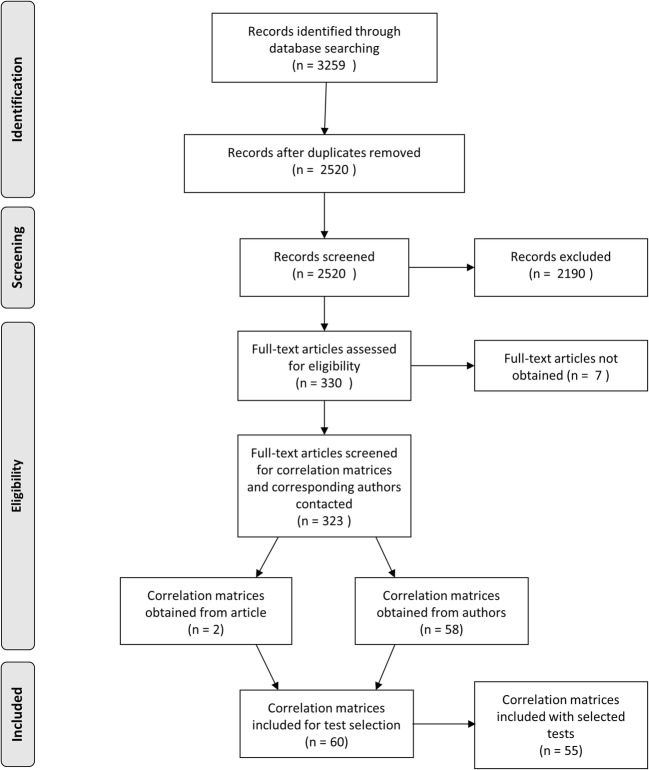
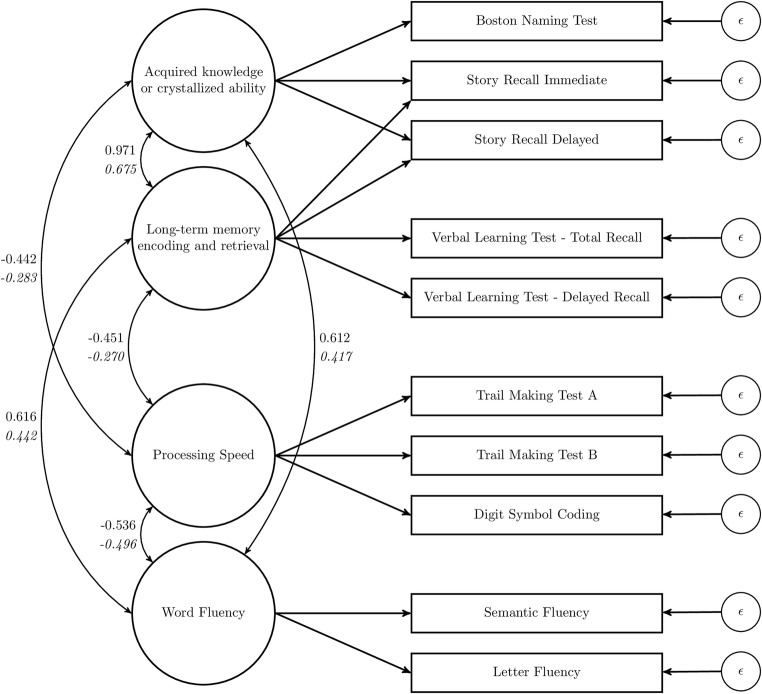
Many neuropsychologists are of the opinion that the multitude of cognitive tests may be grouped into a much smaller number of cognitive domains. However, there is little consensus on how many domains exist, what these domains are, nor on which cognitive tests belong to which domain. This incertitude can be solved by factor analysis, provided that the analysis includes a broad range of cognitive tests that have been administered to a very large number of people. In this article, two such factor analyses were performed, each combining multiple studies. However, because it was not possible to obtain complete multivariate data on more than the most common test variables in the field, not all possible domains were examined here. The first analysis was a factor meta-analysis of correlation matrices combining data of 60,398 healthy participants from 52 studies. Several models from the literature were fitted, of which a version based on the Cattell-Horn-Carroll (CHC) model was found to describe the correlations better than the others. The second analysis was a factor analysis of the Advanced Neuropsychological Diagnostics Infrastructure (ANDI) database, combining scores of 11,881 participants from 54 Dutch and Belgian studies not included in the first meta-analysis. Again, the model fit was better for the CHC model than for other models. Therefore, we conclude that the CHC model best characterizes both cognitive domains and which test belongs to each domain. Therefore, although originally developed in the intelligence literature, the CHC model deserves more attention in neuropsychology.
Keywords: Cattell-horn-Carroll model; Clinical neuropsychology; Cognitive functioning; Factor analysis; Meta-analysis of individual participant data; Meta-analytic SEM; Neuropsychological tests.
Figures


References
-
- *Andrejeva, N., Knebel, M., Dos Santos, V., Schmidt, J., Herold, C. J., Tudoran, R., ... & Gorenc-Mahmutaj, L. (2016). Neurocognitive deficits and effects of cognitive reserve in mild cognitive impairment. Dementia and Geriatric Cognitive Disorders, 41(3–4), 199–209. 10.1159/000443791 - PubMed
Publication types
MeSH terms
Grants and funding
LinkOut - more resources
Full Text Sources
