


Antihypertensive Effectiveness of Perindopril Arginine and Indapamide Single-Pill Combination According to Body Mass Index: Findings from the FORSAGE Study
- PMID: 32008207
- PMCID: PMC7237592
- DOI: 10.1007/s40119-020-00162-x
Antihypertensive Effectiveness of Perindopril Arginine and Indapamide Single-Pill Combination According to Body Mass Index: Findings from the FORSAGE Study
Abstract
Introduction: Overweight and obesity are increasing worldwide and are associated with an increased risk for cardiovascular disease (CVD). The aim of this study was to examine the burden of CVD risk factors among normal weight, overweight, and obese subjects with hypertension, and to evaluate the effectiveness of switching to a single-pill combination (SPC) of perindopril arginine/indapamide for blood pressure (BP) control in overweight and obese subjects treated in routine clinical practice.
Methods: FORSAGE was a 3-month, multicenter, observational, open-label study conducted in Russian patients with uncontrolled arterial hypertension under previous antihypertensive therapy. Subjects were switched to the full-dose perindopril arginine 10 mg/indapamide 2.5 mg SPC. BP was assessed at 2 weeks, 1 month, and 3 months, and serum creatinine and general health status at 3 months. The present post hoc analysis of the FORSAGE study results explored the effectiveness of perindopril arginine/indapamide SPC in patients with arterial hypertension with regard to baseline body mass index (BMI): normal (< 25 kg/m2), overweight (25 ≤ BMI < 30 kg/m2), and obese (≥ 30 kg/m2).
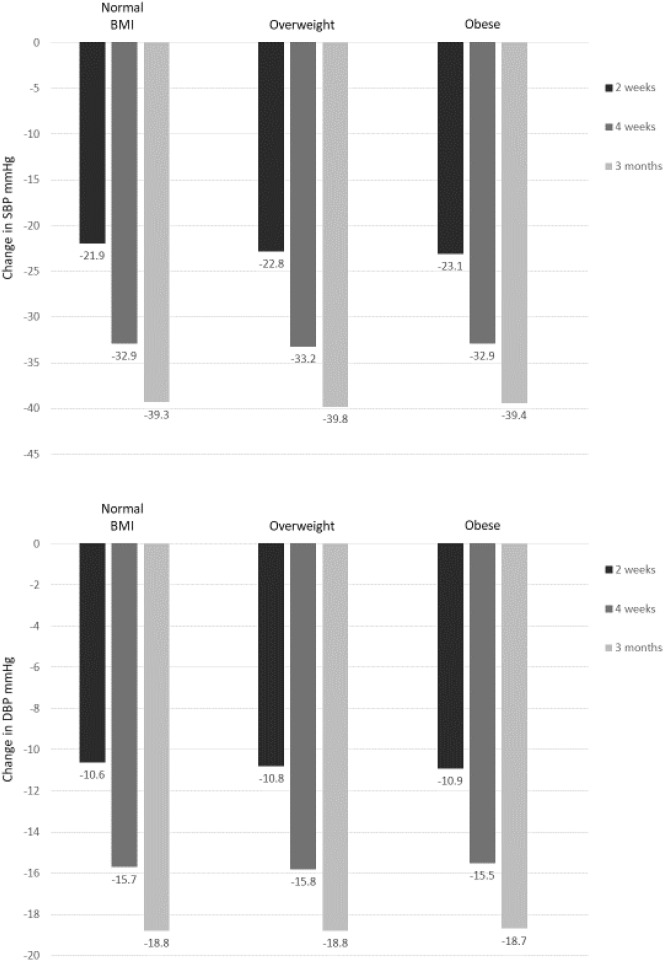
Results: A total of 1969 patients were recruited, but BMI data were available for 1963 patients, two-thirds of whom were women. The distribution of BMI groups was as follows: < 25 kg/m2 (16.7%), overweight (48.7%), and obese (34.7%). Overweight or obese patients had more concomitant diseases such as diabetes mellitus or history of stroke, higher BP levels, serum cholesterol and creatinine, and lower glomerular filtration rates. Switching to perindopril arginine/indapamide SPC was associated with a statistically significant reduction in BP as early as the second week of treatment. At 3 months, systolic blood pressure (SBP)/diastolic blood pressure (DBP) had decreased significantly by 39.3/18.8 mmHg in the normal BMI group, 39.8/18.8 mmHg in overweight, and 39.4/18.7 mmHg in obese groups. The magnitude of the BP reduction was independent of BMI. Achievement of target BP (< 140/90 mmHg) was good in all groups, but lower in obese subjects (70.9%) than in overweight subjects (78.1%) or those with a normal BMI (81.8%) (P < 0.0001 for both comparisons).
Conclusions: In subjects with uncontrolled BP on existing antihypertensive therapy, switching to perindopril arginine 10 mg/indapamide 2.5 mg was associated with statistically significant decreases in BP and higher rates of target BP achievement in all BMI groups, including more than 70% of overweight and obese patients.
Trial registration: ISRCTN ID, ISRCTN14315146 (retrospectively registered 18/11/2019).
Keywords: Blood pressure target; Body mass index; Indapamide; Obesity; Perindopril arginine; Quality of life; Single-pill combinations.
Figures
References
-
- Li YT, Wang HH, Liu KQ, Lee GK, Chan WM, Griffiths SM, et al. Medication adherence and blood pressure control among hypertensive patients with coexisting long-term conditions in primary care settings: a cross-sectional analysis. Medicine (Baltimore). 2016;95:e3572. doi: 10.1097/MD.0000000000003572. - DOI - PMC - PubMed
LinkOut - more resources
Full Text Sources
