


An integrative analysis of genome-wide association study and regulatory SNP annotation datasets identified candidate genes for bipolar disorder
- PMID: 32009227
- PMCID: PMC6995798
- DOI: 10.1186/s40345-019-0170-z
An integrative analysis of genome-wide association study and regulatory SNP annotation datasets identified candidate genes for bipolar disorder
Abstract
Background: Bipolar disorder (BD) is a complex mood disorder. The genetic mechanism of BD remains largely unknown.
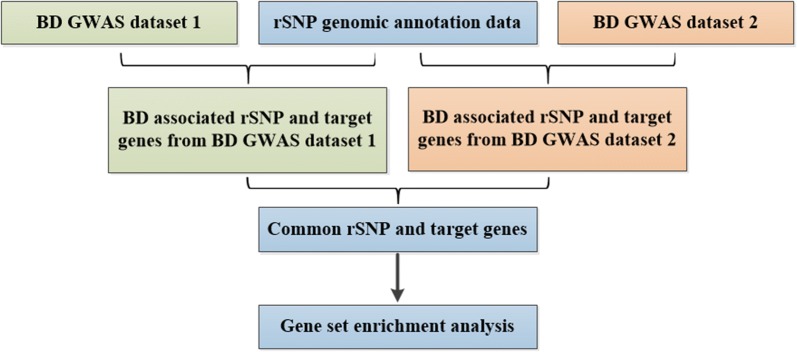
Methods: We conducted an integrative analysis of genome-wide association study (GWAS) and regulatory SNP (rSNP) annotation datasets, including transcription factor binding regions (TFBRs), chromatin interactive regions (CIRs), mature microRNA regions (miRNAs), long non-coding RNA regions (lncRNAs), topologically associated domains (TADs) and circular RNAs (circRNAs). Firstly, GWAS dataset 1 of BD (including 20,352 cases and 31,358 controls) and GWAS dataset 2 of BD (including 7481 BD patients and 9250 controls) were integrated with rSNP annotation database to obtain BD associated SNP regulatory elements and SNP regulatory element-target gene (E-G) pairs, respectively. Secondly, a comparative analysis of the two datasets results was conducted to identify the common rSNPs and also their target genes. Then, gene sets enrichment analysis (FUMA GWAS) and HumanNet-XC analysis were conducted to explore the functional relevance of identified target genes with BD.
Results: After the integrative analysis, we identified 52 TFBRs target genes, 44 TADs target genes, 55 CIRs target genes and 21 lncRNAs target genes for BD, such as ITIH4 (Pdataset1 = 6.68 × 10⁻⁸, Pdataset2 = 6.64 × 10⁻⁷), ITIH3 (Pdataset1 = 1.09 × 10⁻⁸, Pdataset2 = 2.00 × 10⁻⁷), SYNE1 (Pdataset1 = 1.80 × 10⁻⁶, Pdataset2 = 4.33 × 10⁻⁹) and OPRM1 (Pdataset1 = 1.80 × 10⁻⁶, Pdataset2 = 4.33 × 10⁻⁹).
Conclusion: We conducted a large-scale integrative analysis of GWAS and 6 common rSNP information datasets to explore the potential roles of rSNPs in the genetic mechanism of BD. We identified multiple candidate genes for BD, supporting the importance of rSNP in the development of BD.
Keywords: Bipolar disorder; Genome-wide association studies; Regulatory SNP.
Conflict of interest statement
The authors declare that they have no competing interests.
References
Grants and funding
- 81472925/the National Natural Scientific Foundation of China
- 81673112/the National Natural Scientific Foundation of China
- 81703177/the National Natural Scientific Foundation of China
- 2016YFE0119100/the Key projects of international cooperation among governments in scientific and technological innovation
- 2017JZ024/the Natural Science Basic Research Plan in Shaanxi Province of China
LinkOut - more resources
Full Text Sources
Miscellaneous
