


Virulence and antibiotic resistance profile of avian Escherichia coli strains isolated from colibacillosis lesions in central of Algeria
- PMID: 32009764
- PMCID: PMC6925048
- DOI: 10.14202/vetworld.2019.1840-1848
Virulence and antibiotic resistance profile of avian Escherichia coli strains isolated from colibacillosis lesions in central of Algeria
Abstract
Background and aim: Avian pathogenic Escherichia coli cause extensive mortality in poultry flocks, leading to extensive economic losses. To date, in Algeria, little information has been available on virulence potential and antibiotics resistance of avian E. coli isolates. Therefore, the aim of this study was the characterization of virulence genes and antibiotic resistance profile of Algerian E. coli strains isolated from diseased broilers.
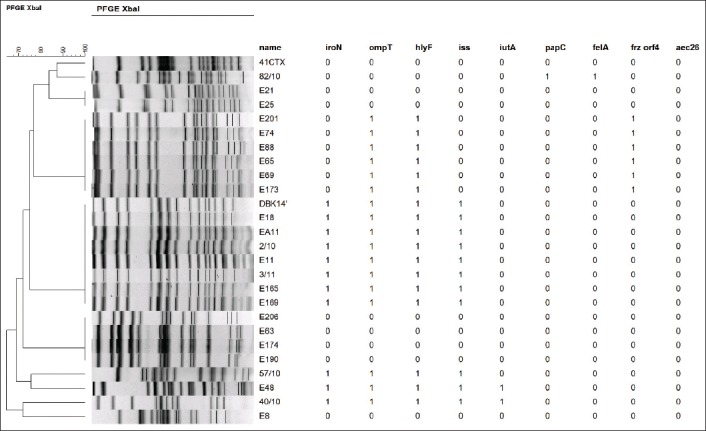
Materials and methods: In this study, 43 avian E. coli strains isolated from chicken colibacillosis lesions at different years were analyzed to determine their contents in 10 virulence factors by polymerase chain reaction, antimicrobial susceptibility to 22 antibiotics belonging to six different chemical classes and genomic diversity by pulsed-field gel electrophoresis (PFGE).
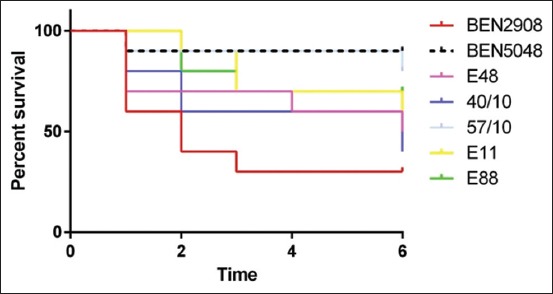
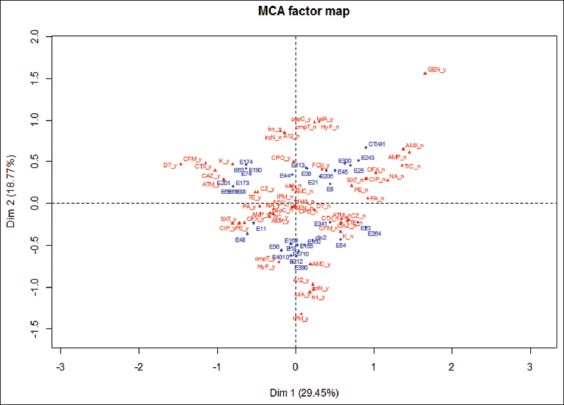
Results: Mainly E. coli isolates (58.1%) carried two at six virulence genes and the most frequent virulence gene association detected were ompT (protectin), hlyF (hemolysin) with 55.8% (p<0.001), and iroN, sitA (iron acquisition/uptake systems), and iss (protectin) with 41.8% (p<0.001). Some strains were diagnosed as virulent according to their virulence gene profile. Indeed, 23.25% of the isolates harbored iroN, ompT, hlyF, iss, and sitA combination, 14% ompT, hlyF, and frzorf4 (sugar metabolism), and 11,6% iroN, hlyF, ompT, iss, iutA (iron acquisition/uptake systems), and frz orf4. The chicken embryo lethality assay performed on five isolates confirmed the potential virulence of these strains. All isolates submitted to PFGE analysis yielded different genetic profiles, which revealed their diversity. Overall, 97.2% of the isolates were resistant to at least one antibiotic and 53.5% demonstrated multi-antimicrobial resistance to three different antimicrobial classes. The highest resistance levels were against nalidixic acid (83.4%), amoxicillin and ampicillin (83.3%), ticarcillin (80.5%), pipemidic acid (75%), and triméthoprim-sulfamethoxazole (66.6%). For beta-lactam class, the main phenotype observed belonged to broad-spectrum beta-lactamases. However, extended-spectrum beta-lactamase associated with three at six virulence factors was also detected in 13 isolates. Two of them were attested virulent as demonstrated in the embryo lethality test which constitutes a real public threat.
Conclusion: It would be imperative in avian production to discourage misuse while maintaining constant vigilance guidelines and regulations, to limit and rationalize antimicrobial use.
Keywords: antibiotic resistance; avian Escherichia coli; extended-spectrum beta-lactamase; virulence.
Copyright: © Meguenni, et al.
Figures
References
-
- Kaci A. La filière avicole algérienne àl'ère de la libéralisation économique. Cah. Agric. 2015;24(3):151–160.
-
- Dho-Moulin M, Fairbrother J.M. Avian pathogenic Escherichia coli (APEC) Vet. Res. 1999;30(2-3):299–316. - PubMed
-
- Clermont O, Olier M, Hoede C, Diancourt L, Brisse S, Keroudean M, Glodt J, Picard B, Oswald E, Denamur E. Animal and human pathogenic Escherichia coli strains share common genetic backgrounds. Infect. Genet. Evol. 2011;11(3):654–662. - PubMed
LinkOut - more resources
Full Text Sources