


Influence of Neighboring Clonal-Colonies on Aflatoxin Production by Aspergillus flavus
- PMID: 32010096
- PMCID: PMC6974465
- DOI: 10.3389/fmicb.2019.03038
Influence of Neighboring Clonal-Colonies on Aflatoxin Production by Aspergillus flavus
Abstract
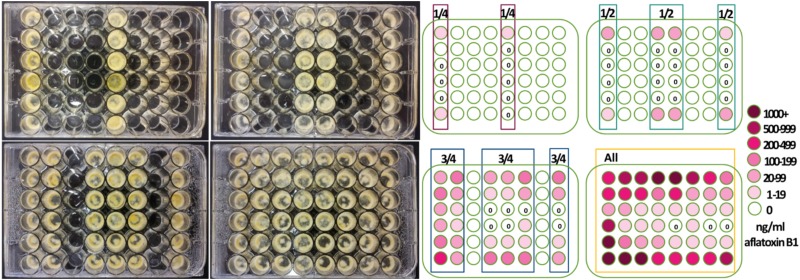
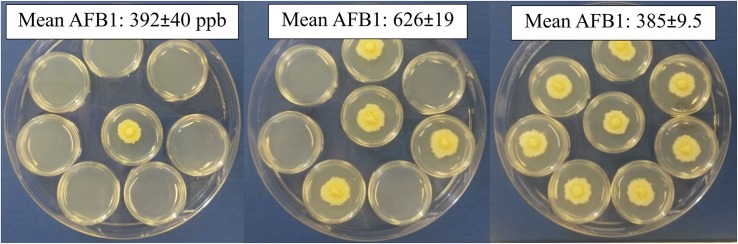
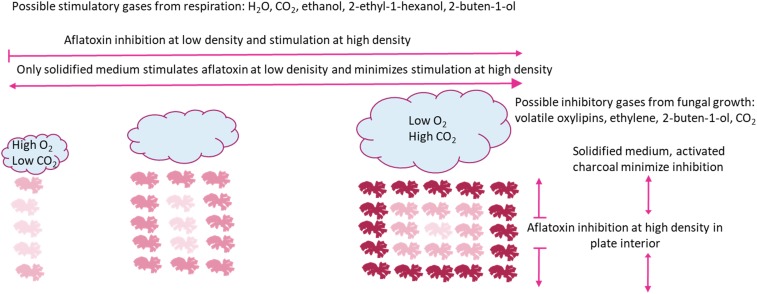
Aspergillus flavus is an ascomycete fungus that infects and contaminates corn, peanuts, cottonseed, and treenuts with acutely toxic and carcinogenic aflatoxins. The ecological function of aflatoxin production is not well understood; though not phytotoxic, aflatoxin may be involved in resisting oxidative stress responses from infection or drought stress in plants. Observation of aflatoxin stimulation in 48-well plates in response to increasing inoculated wells sparked an investigation to determine if A. flavus volatiles influence aflatoxin production in neighboring colonies. Experiments controlling several culture conditions demonstrated a stimulation of aflatoxin production with increased well occupancy independent of pH buffer, moisture, or isolate. However, even with all wells inoculated, aflatoxin production was less in interior wells. Only one isolate stimulated aflatoxin production in a large Petri-dish format containing eight small Petri dishes with shared headspace. Other isolates consistently inhibited aflatoxin production when all eight Petri dishes were inoculated with A. flavus. No contact between cultures and only shared headspace implied the fungus produced inhibitory and stimulatory gases. Adding activated charcoal between wells and dishes prevented inhibition but not stimulation indicating stimulatory and inhibitory gases are different and/or gas is inhibitory at high concentration and stimulatory at lower concentrations. Characterizing stimulatory and inhibitory effects of gases in A. flavus headspace as well as the apparently opposing results in the two systems deserves further investigation. Determining how gases contribute to quorum sensing and communication could facilitate managing or using the gases in modified atmospheres during grain storage to minimize aflatoxin contamination.
Keywords: Aspergillus flavus; aflatoxin; quorum sensing; volatile chemical; volatile sensing.
Copyright © 2020 Sweany and Damann.
Figures
References
-
- Abbas H. K., Weaver M. A., Zablotowicz R. M., Horn B. W., Shier W. T. (2005). Relationships between aflatoxin production and sclerotia formation among isolates of Aspergillus section Flavi from the Mississippi Delta. Eur. J. Plant Pathol. 112 283–287.
-
- Atehnkeng J., Ojiambo P. S., Donner M., Ikotun T., Sikora R. A., Cotty P. J., et al. (2008). Distribution and toxigenicity of Aspergillus species isolated from maize kernels from three agro-ecological zones in Nigeria. Int. J. Food Microbiol. 122 74–84. 10.1016/j.ijfoodmicro.2007.11.062 - DOI - PubMed
LinkOut - more resources
Full Text Sources
