Review
. 2020 Jan 15:10:3096.
doi: 10.3389/fimmu.2019.03096. eCollection 2019.

IL-17A in Psoriasis and Beyond: Cardiovascular and Metabolic Implications

Affiliations
Review

IL-17A in Psoriasis and Beyond: Cardiovascular and Metabolic Implications

Esther von Stebut et al. Front Immunol. .

Abstract

Interleukin 17A (IL-17A) is one of the currently known six members of the IL-17 cytokine family and is implicated in immune responses to infectious pathogens and in the pathogenesis of inflammatory autoimmune diseases like psoriasis. Psoriatic skin is characterized by high expression of IL-17A and IL-17F, which act on immune and non-immune cell types and strongly contribute to tissue inflammation. In psoriatic lesions, IL-17A, IL-17E, and IL-17F are involved in neutrophil accumulation, followed by the formation of epidermal micro abscesses. IL-17A together with other Th17 cytokines also upregulates the production of several chemokines that are implicated in psoriasis pathogenesis. IL17A-targeting antibodies show an impressive clinical efficacy in patients with psoriasis. Studies have reported an improvement of at least 75% as measured by the psoriasis area and severity index (PASI) in >80% of patients treated with anti-IL-17A therapy. Psoriasis skin manifestations, cardiovascular as well as metabolic disease in psoriasis appear to share pathogenic mechanisms evolving around IL-17A and its proinflammatory role. Thus, anti-IL-17A therapy not only improves skin manifestations of psoriasis, but also cardiovascular inflammation as well as metabolic factors and different domains of psoriatic arthritis (PsA) including peripheral arthritis, enthesitis, dactylitis, and axial involvement. This review summarizes the biological role of IL-17A, before reviewing currently available data on its role in the physiology and pathophysiology of the skin, as well as the cardiovascular and the metabolic system. In conclusion, clinical recommendations for patients with moderate to severe psoriasis based on the current available data are given.

Keywords: IL-17A; cardiovascular; comorbidities; diabetes; psoriasis.


Figures

Figure 1
Figure 1
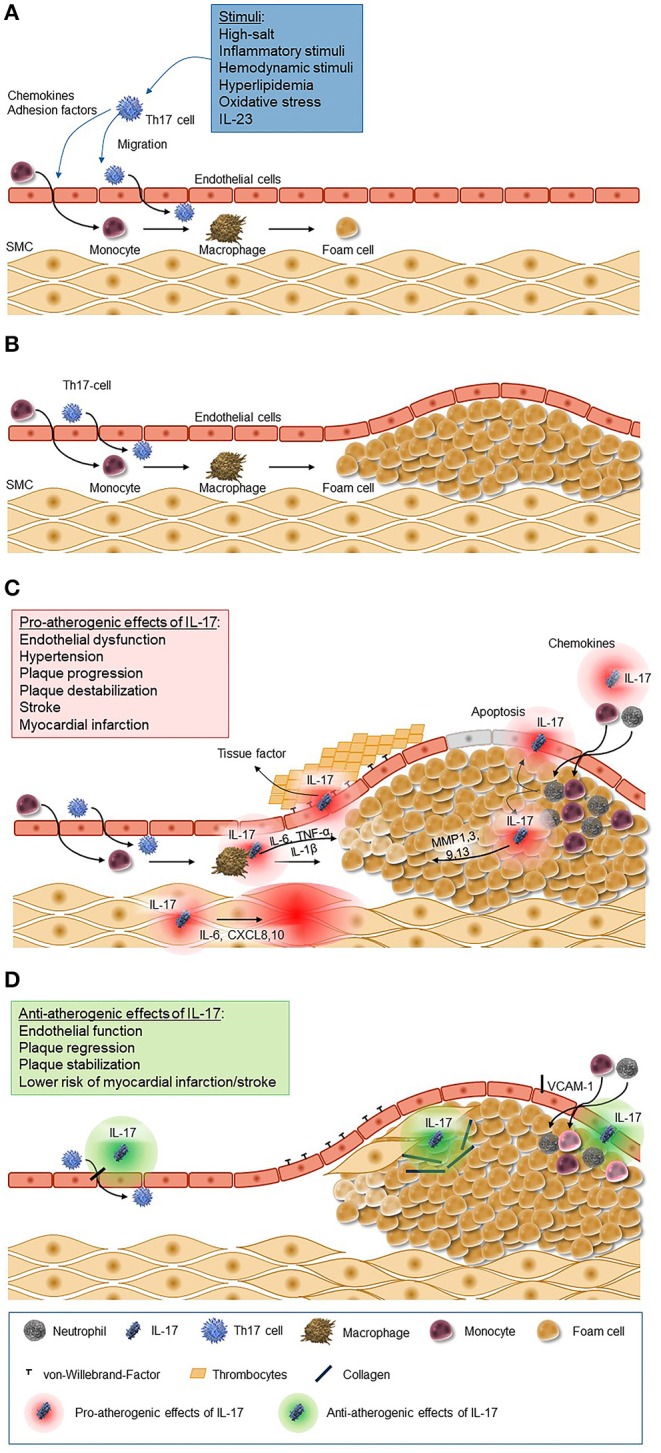
Pro-atherogenic and anti-atherogenic effects of IL-17. (A) Chemokines and adhesion factors are secreted by Th17 cells and cells of the innate immune system in response to a variety of stimuli (e.g., inflammatory stimuli, hemodynamic stimuli, and hyperlipidemia). These chemokines trigger migration and differentiation of monocytes and Th17 cells through the epithelium, which leads to the activation of macrophages and macrophage-mediated foam cell formation. (B) Foam cells accumulate to plaques as a key process of atherosclerosis. (C) IL-17 induces the release of chemokines leading to the recruitment of neutrophils and monocytes to the atherosclerotic lesion and their transformation to macrophages and foam cells and accumulation in fatty streaks. Further it stimulates macrophages to produce inflammatory cytokines such as IL-6, TNF-α, and IL-1β, matrix metalloproteinase from fibroblasts, endothelial cells, and epithelial cells, and it induces apoptosis of vascular endothelial cells. The increased secretion of endothelium-mediated von-Willebrand-factor promotes platelets adhesion and aggregation. (D) IL-17, however, also has antiatherogenic effects as it stimulates the proliferation of smooth muscle cells and the production of collagen and inhibits the expression of adhesion molecules. CXCL, C-X-C motif chemokine ligand; IL, interleukin; MMP, matrix metallopeptidase; SMC, smooth muscle cells; VCAM, vascular cell adhesion molecule.
Figure 2
Figure 2
The integrated role of IL-17 in the cytokine- and inflammation-related regulatory network of insulin signaling. In general, inflammation reduces insulin sensitivity and insulin receptor signaling via IRS-1 by a myriad of different mediators. Cellular glucose disposal needs glucose transport via specific glucose transporters such as GLUT4 in adipose tissue and in striated muscle. Activation of the NFκB and the JNK pathway via different lipids and cytokines such as IL-6 and IL-17 (but also TNF, IL-1, and others) decrease insulin signaling. Lipids and cytokines are known to activate certain types of kinases that cause an inhibitory phosphorylation of IRS-1. Phosphorylation takes place at the wrong sites leading to less effective insulin signaling. Stress pathways such as hypoxia, ROS, ER activation, lipids, fatty acids, and cytokines are all integrated with insulin signaling via inhibitory mechanisms by JNK activation. Taken together, inflammation and stress always induce insulin resistance by common mechanisms. JNK represents the central kinase connecting stress and inflammation with insulin signaling. ACT1, nuclear factor-kappa-B activator; AKT, protein kinase AKT; ER, endoplasmic reticulum; Glut4, glucose transporter-4; GSK3, glycogen synthase kinase-3; IKK, I-kappa-B-kinase; IRS, insulin receptor substrate; JNK, Janus kinase; MAPK, mitogen-activated protein kinase; PDK1, pyruvate dehydrogenase kinase-1; NFκB, nuclear factor-kappa-B; PI3K, phosphoinositol-3-kinase; ROS, reactive oxygen species; SEFIR, similar expression to FGFR1; SHP2, tyrosine phosphatase SHP2; SOCS, suppressor of cytokine signaling; STAT3, signal transducer and activator of transcription-3; TRAF6, TNF receptor-associated factor-6 [Figure modified according to Straub (121) and Reich (137)].
Figure 3
Figure 3
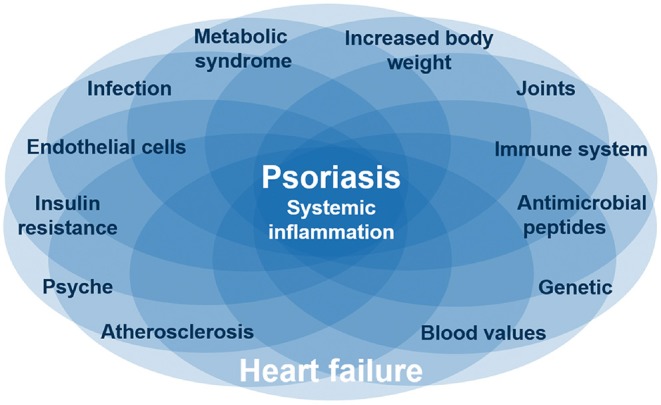
Common pathways for psoriasis, cardiovascular disease, and metabolic syndrome. Several diseases like psoriasis and heart failure are based on systematic inflammation, which is linked by IL-17, one of the main and causative proinflammatory cytokines in psoriasis. These inflammatory diseases are associated with certain interacting factors like obesity and depression. The complex interaction between inflammatory diseases and different factors is reflected by individual organ manifestations of the same inflammatory disease. Nevertheless, it is still unclear which factors are originating from the inflammation or are causing the inflammation.

Similar articles

Cited by

References

    1. Prodanovich S, Ma F, Taylor JR, Pezon C, Fasihi T, Kirsner RS. Methotrexate reduces incidence of vascular diseases in veterans with psoriasis or rheumatoid arthritis. J Am Acad Dermatol. (2005) 52:262–7. 10.1016/j.jaad.2004.06.017 - DOI - PubMed
    1. Ludwig RJ, Herzog C, Rostock A, Ochsendorf FR, Zollner TM, Thaci D, et al. . Psoriasis: a possible risk factor for development of coronary artery calcification. Br J Dermatol. (2007) 156:271–6. 10.1111/j.1365-2133.2006.07562.x - DOI - PubMed
    1. Kristensen SL, Ahlehoff O, Lindhardsen J, Erichsen R, Lamberts M, Khalid U, et al. . Inflammatory bowel disease is associated with an increased risk of hospitalization for heart failure: a Danish Nationwide Cohort study. Circ Heart Fail. (2014) 7:717–22. 10.1161/CIRCHEARTFAILURE.114.001152 - DOI - PubMed
    1. Listing J, Kekow J, Manger B, Burmester GR, Pattloch D, Zink A, et al. . Mortality in rheumatoid arthritis: the impact of disease activity, treatment with glucocorticoids, TNFalpha inhibitors and rituximab. Ann Rheum Dis. (2015) 74:415–21. 10.1136/annrheumdis-2013-204021 - DOI - PMC - PubMed
    1. Egeberg A, Skov L, Joshi AA, Mallbris L, Gislason GH, Wu JJ, et al. . The relationship between duration of psoriasis, vascular inflammation, and cardiovascular events. J Am Acad Dermatol. (2017) 77:650–6.e653. 10.1016/j.jaad.2017.06.028 - DOI - PMC - PubMed

MeSH terms