Diagnostic yield and agreement on fine-needle specimens from solid pancreatic lesions : comparing the smear technique to liquid-based cytology
- PMID: 32010748
- PMCID: PMC6976322
- DOI: 10.1055/a-1038-4103
Diagnostic yield and agreement on fine-needle specimens from solid pancreatic lesions : comparing the smear technique to liquid-based cytology
Abstract
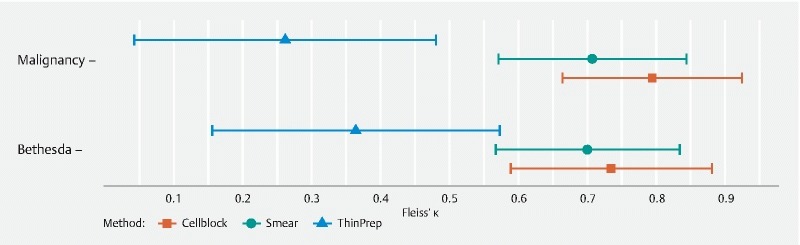
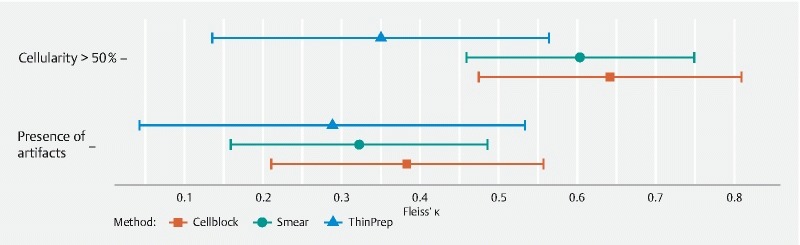
Background and study aims The traditional "smear technique" for processing and assessing endoscopic ultrasound-guided fine-needle aspiration (EUS-FNA) is sensitive to artifacts. Processing and evaluation of specimens collected in a liquid medium, liquid-based cytology (LBC) may be a solution. We compared the diagnostic value of EUS-FNA smears to LBC in pancreatic solid lesions in the absence of rapid on-site evaluation (ROSE). Patients and methods Consecutive patients who required EUS-FNA of a solid pancreatic lesion were included in seven hospitals in the Netherlands and followed for at least 12 months. Specimens from the first pass were split into two smears and a vial for LBC (using ThinPrep and/or Cell block). Smear and LBC were compared in terms of diagnostic accuracy for malignancy, sample quality, and diagnostic agreement between three cytopathologists. Results Diagnostic accuracy for malignancy was higher for LBC (82 % (58/71)) than for smear (66 % (47/71), P = 0.04), but did not differ when smears were compared to ThinPrep (71 % (30/42), P = 0.56) or Cell block (62 % (39/63), P = 0.61) individually. Artifacts were less often present in ThinPrep (57 % (24/42), P = 0.02) or Cell block samples (40 % (25/63), P < 0.001) than smears (76 % (54/71)). Agreement on malignancy was equally good for smears and LBC (ĸ = 0.71 versus ĸ = 0.70, P = 0.98), but lower for ThinPrep (ĸ = 0.26, P = 0.01) than smears. Conclusion After a single pass, LBC provides higher diagnostic accuracy than the conventional smear technique for EUS-FNA of solid pancreatic lesions in the absence of ROSE. Therefore, LBC, may be an alternative to the conventional smear technique, especially in centers lacking ROSE.
Conflict of interest statement
Competing interests None
Figures
References
-
- Rahib L, Smith B D, Aizenberg R et al. Projecting cancer incidence and deaths to 2030: the unexpected burden of thyroid, liver, and pancreas cancers in the United States. Cancer Res. 2014;74:2913–2921. - PubMed
-
- Siegel R L, Miller K D, Jemal A. Cancer statistics, 2018. CA Cancer J Clin. 2018;68:7–30. - PubMed
-
- Ducreux M, Cuhna A S, Caramella C et al. Cancer of the pancreas: ESMO Clinical Practice Guidelines for diagnosis, treatment and follow-up. Ann Oncol. 2015;26:v56–68. - PubMed
LinkOut - more resources
Full Text Sources