Review
. 2020 Feb 3;130(2):565-574.
doi: 10.1172/JCI129197.

Opportunities and challenges in using real-world data for health care

Affiliations
Review

Opportunities and challenges in using real-world data for health care

Vivek A Rudrapatna et al. J Clin Invest. .

Abstract

Real-world data (RWD) continue to emerge as a new source of clinical evidence. Although the best-known use case of RWD has been in drug regulation, RWD are being generated and used by many other parties, including biopharmaceutical companies, payors, clinical researchers, providers, and patients. In this Review, we describe 21 potential uses for RWD across the spectrum of health care. We also discuss important challenges and limitations relevant to the translation of these data into evidence.


Conflict of interest statement

Conflict of interest: AJB is a cofounder of and consultant to Personalis and NuMedii; consultant to Samsung, Geisinger Health, Mango Tree Corp., Regenstrief Institute, and, in the recent past, 10x Genomics and Helix; shareholder in Personalis; and minor shareholder in Apple, Facebook, Google, Microsoft, Sarepta, 10x Genomics, Amazon, Biogen, CVS, Illumina, Snap, Sutro, and several other non–health-related companies and mutual funds. He has received honoraria and travel reimbursement for invited talks from Genentech, Roche, Pfizer, Merck, Lilly, Mars, Siemens, Optum, AbbVie, Westat, and many academic institutions, medical or disease-specific foundations and associations, and health systems. AJB receives royalty payments through Stanford University for several patents (US20160018413, WO2013169751, US2013039918, US20130080068, US20130116931, US20130090909, US20120101736, WO2011094731, and US20130071408) and other disclosures licensed to NuMedii and Personalis. AJB’s research has been funded by Northrop Grumman (as the prime on an NIH contract), Genentech, and, in the recent past, L’Oréal and Progenity.

Figures

Figure 1
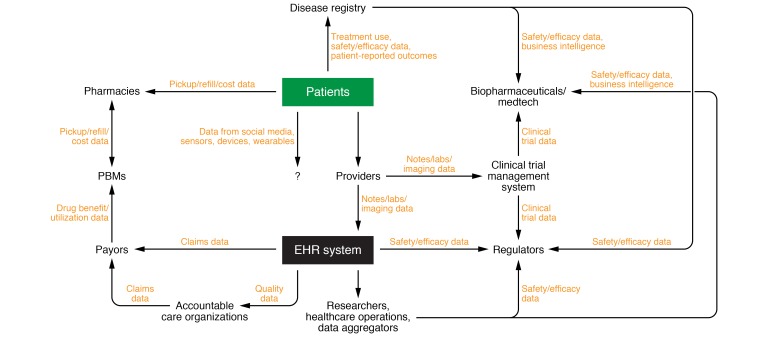
Figure 1. Participants in the health care ecosystem that generate and consume health care data.
Patients (and the communities they constitute) are the fundamental source of all clinical data. Much of the clinical data they generate emanates from clinic visits with health care providers. They also generate data from the pharmacies they purchase treatments from, the registries they participate in, and their use of modern/evolving technologies such as social media and wearables. In the setting of a traditional or telehealth-based encounter, clinical data in the form of laboratory test results, imaging, and notes are all generated and housed with an EHR system. These data may be repackaged and sent to managed care organizations and health care payors to facilitate reimbursement. These payors also transmit data relevant to drug benefits to pharmacy benefit managers (PBMs), who negotiate payment for drugs dispensed in pharmacies. Quality data from the EHR are also used by accountable care organizations (ACOs) to support certain quality-based reimbursement schemes. EHR data are also consumed by clinical researchers, individuals who oversee health care operations, and data aggregators. The latter deidentify and repackage these data for consumption by a variety of parties, including biopharmaceutical companies and regulators, as relevant for monitoring of treatment safety and efficacy, among other uses. Although most patient data represent a form of RWD, some patient data are collected in the setting of controlled trials. Although data from cardiac devices (e.g., pacemakers/cardioverter-defibrillators) and glucose meters occasionally end up in the EHR, data from consumer wearables and sensors and social media are currently not integrated into EHR systems. However, these data are increasingly being studied for their potential utility in health care, and may be integrated in the future. Adapted with permission from Datavant (58).

References

    1. FDA. Framework for FDA’s Real-World Evidence Program. 2018. http://www.fda.gov/media/120060/download Accessed December 5, 2019.
    1. Berger M, et al. A framework for regulatory use of real-world evidence. http://healthpolicy.duke.edu/sites/default/files/atoms/files/rwe_white_p... Updated September 13, 2017. Accessed December 5, 2019.
    1. Craig P, et al. Using natural experiments to evaluate population health interventions: new Medical Research Council guidance. J Epidemiol Community Health. 2012;66(12):1182–1186. doi: 10.1136/jech-2011-200375. - DOI - PMC - PubMed
    1. FDA. FDA’s Sentinel Initiative. http://www.fda.gov/safety/fdas-sentinel-initiative Updated October 18, 2019. Accessed December 5, 2019.
    1. FDA. MedWatch: The FDA Safety Information and Adverse Event Reporting Program. http://www.fda.gov/safety/medwatch-fda-safety-information-and-adverse-ev... Updated December 2, 2019. Accessed December 5, 2019.

Publication types