


Classification and Regression Tree and Computer Adaptive Testing in Cardiac Rehabilitation: Instrument Validation Study
- PMID: 32012065
- PMCID: PMC7055848
- DOI: 10.2196/12509
Classification and Regression Tree and Computer Adaptive Testing in Cardiac Rehabilitation: Instrument Validation Study
Abstract
Background: There is a need for shorter-length assessments that capture patient questionnaire data while attaining high data quality without an undue response burden on patients. Computerized adaptive testing (CAT) and classification and regression tree (CART) methods have the potential to meet these needs and can offer attractive options to shorten questionnaire lengths.
Objective: The objective of this study was to test whether CAT or CART was best suited to reduce the number of questionnaire items in multiple domains (eg, anxiety, depression, quality of life, and social support) used for a needs assessment procedure (NAP) within the field of cardiac rehabilitation (CR) without the loss of data quality.
Methods: NAP data of 2837 CR patients from a multicenter Cardiac Rehabilitation Decision Support System (CARDSS) Web-based program was used. Patients used a Web-based portal, MyCARDSS, to provide their data. CAT and CART were assessed based on their performances in shortening the NAP procedure and in terms of sensitivity and specificity.
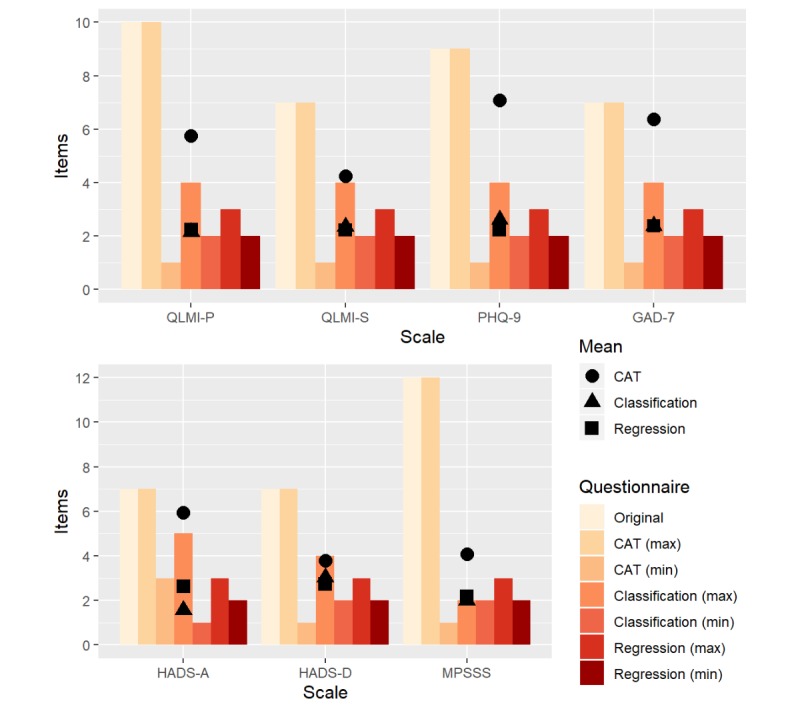
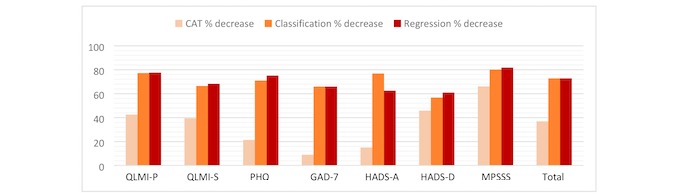
Results: With CAT and CART, an overall reduction of 36% and 72% of NAP questionnaire length, respectively, was achieved, with a mean sensitivity and specificity of 0.765 and 0.817 for CAT, 0.777 and 0.877 for classification trees, and 0.743 and 0.40 for regression trees, respectively.
Conclusions: Both CAT and CART can be used to shorten the questionnaires of the NAP used within the field of CR. CART, however, showed the best performance, with a twice as large overall decrease in the number of questionnaire items of the NAP compared to CAT and the highest sensitivity and specificity. To our knowledge, our study is the first to assess the differences in performance between CAT and CART for shortening questionnaire lengths. Future research should consider administering varied assessments of patients over time to monitor their progress in multiple domains. For CR professionals, CART integrated with MyCARDSS would provide a feedback loop that informs the rehabilitation progress of their patients by providing real-time patient measurements.
Keywords: cardiac rehabilitation; computing methodologies; internet; mHealth; needs assessment; psychometrics.
©Linda Peute, Thom Scheeve, Monique Jaspers. Originally published in the Journal of Medical Internet Research (http://www.jmir.org), 30.01.2020.
Conflict of interest statement
Conflicts of Interest: None declared.
Figures
References
-
- Chien T, Wu H, Wang W, Castillo R, Chou W. Reduction in patient burdens with graphical computerized adaptive testing on the ADL scale: tool development and simulation. Health Qual Life Outcomes. 2009 May 5;7:39. doi: 10.1186/1477-7525-7-39. https://hqlo.biomedcentral.com/articles/10.1186/1477-7525-7-39 - DOI - PMC - PubMed
-
- Chien T, Wang W, Huang S, Lai W, Chow JC. A web-based computerized adaptive testing (CAT) to assess patient perception in hospitalization. J Med Internet Res. 2011 Aug 15;13(3):e61. doi: 10.2196/jmir.1785. https://www.jmir.org/2011/3/e61/ - DOI - PMC - PubMed
-
- Ma S, Chien T, Wang H, Li Y, Yui M. Applying computerized adaptive testing to the Negative Acts Questionnaire-Revised: Rasch analysis of workplace bullying. J Med Internet Res. 2014 Feb 17;16(2):e50. doi: 10.2196/jmir.2819. https://www.jmir.org/2014/2/e50/ - DOI - PMC - PubMed
-
- de Beurs DP, de Vries AL, de Groot MH, de Keijser J, Kerkhof A. Applying computer adaptive testing to optimize online assessment of suicidal behavior: a simulation study. J Med Internet Res. 2014 Sep 11;16(9):e207. doi: 10.2196/jmir.3511. https://www.jmir.org/2014/9/e207/ - DOI - PMC - PubMed
-
- Zimmerman R, Balasubramani G, Nowalk M, Eng H, Urbanski L, Jackson M, Jackson L, McLean H, Belongia E, Monto A, Malosh R, Gaglani M, Clipper L, Flannery B, Wisniewski SR. Classification and Regression Tree (CART) analysis to predict influenza in primary care patients. BMC Infect Dis. 2016 Sep 22;16(1):503. doi: 10.1186/s12879-016-1839-x. https://bmcinfectdis.biomedcentral.com/articles/10.1186/s12879-016-1839-x - DOI - PMC - PubMed
Publication types
MeSH terms
LinkOut - more resources
Full Text Sources
Medical
Research Materials
Miscellaneous
