


E-Learning to Improve Suicide Prevention Practice Skills Among Undergraduate Psychology Students: Randomized Controlled Trial
- PMID: 32012076
- PMCID: PMC7003118
- DOI: 10.2196/14623
E-Learning to Improve Suicide Prevention Practice Skills Among Undergraduate Psychology Students: Randomized Controlled Trial
Abstract
Background: Despite increasing evidence of the effectiveness of digital learning solutions in higher vocational education, including the training of allied health professionals, the impact of Web-based training on the development of practical skills in psychiatry and psychology, in general, and in suicide prevention, specifically, remains largely understudied.
Objective: This study aimed to determine the effectiveness of an electronic learning (e-learning) module on the adherence to suicide prevention guidelines, knowledge of practical skills, and provider's confidence to have a conversation about suicidal behavior with undergraduate psychology students.
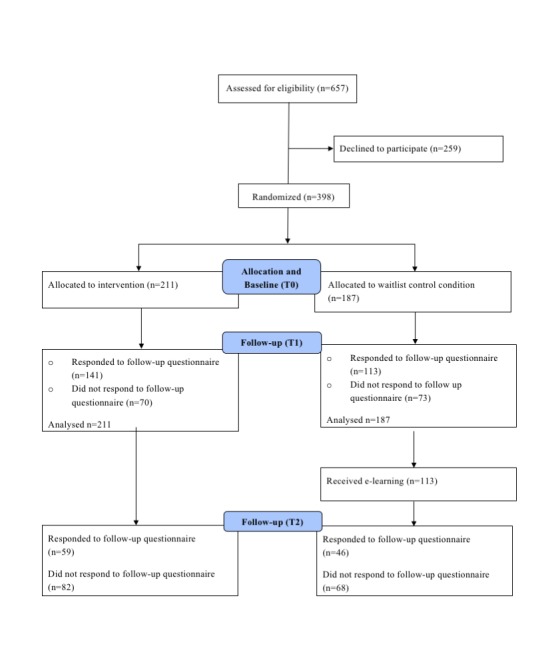
Methods: The e-learning module, comprising video recordings of therapist-patient interactions, was designed with the aim of transferring knowledge about suicide prevention guideline recommendations. The program's effects on guideline adherence, self-evaluated knowledge, and provider's confidence were assessed using online questionnaires before the program (baseline and at 1 month [T1] and 3 months after baseline). The eligible third- and fourth-year undergraduate psychology students were randomly allocated to the e-learning (n=211) or to a waitlist control condition (n=187), with access to the intervention after T1.
Results: Overall, the students evaluated e-learning in a fairly positive manner. The intention-to-treat analysis showed that the students in the intervention condition (n=211) reported higher levels of self-evaluated knowledge, provider's confidence, and guideline adherence than those in the waitlist control condition (n=187) after receiving the e-learning module (all P values<.001). When comparing the scores at the 1- and 3-month follow-up, after both groups had received access to the e-learning module, the completers-only analysis showed that the levels of knowledge, guideline adherence, and confidence remained constant (all P values>.05) within the intervention group, whereas a significant improvement was observed in the waitlist control group (all P values<.05).
Conclusions: An e-learning intervention on suicide prevention could be an effective first step toward improved knowledge of clinical skills. The learning outcomes of a stand-alone module were found to be similar to those of a training that combined e-learning with a face-to-face training, with the advantages of flexibility and low costs.
Keywords: digital learning; e-learning; randomized controlled trial; skills training; suicide prevention; undergraduate students.
©Marie-Louise J Kullberg, Joanne Mouthaan, Maartje Schoorl, Derek de Beurs, Robin Maria Francisca Kenter, Ad JFM Kerkhof. Originally published in JMIR Mental Health (http://mental.jmir.org), 22.01.2020.
Conflict of interest statement
Conflicts of Interest: None declared.
Figures
References
-
- de Beurs DP, Hooiveld M, Kerkhof AJ, Korevaar JC, Donker GA. Trends in suicidal behaviour in Dutch general practice 1983-2013: a retrospective observational study. BMJ Open. 2016 May 10;6(5):e010868. doi: 10.1136/bmjopen-2015-010868. http://bmjopen.bmj.com/cgi/pmidlookup?view=long&pmid=27165647 bmjopen-2015-010868 - DOI - PMC - PubMed
-
- StatLine - CBS. [2018-11-16]. The deceased; suicide (residents), various characteristics. https://opendata.cbs.nl/statline/#/CBS/nl/dataset/7022gza/table?ts=15423... .
-
- Biddle L, Cooper J, Owen-Smith A, Klineberg E, Bennewith O, Hawton K, Kapur N, Donovan J, Gunnell D. Qualitative interviewing with vulnerable populations: individuals' experiences of participating in suicide and self-harm based research. J Affect Disord. 2013 Mar 5;145(3):356–62. doi: 10.1016/j.jad.2012.08.024.S0165-0327(12)00593-9 - DOI - PubMed
LinkOut - more resources
Full Text Sources
