Review
. 2020 Jan 28;9(2):316.
doi: 10.3390/cells9020316.

Impact of Adaptive Thermogenesis in Mice on the Treatment of Obesity

Affiliations
Review

Impact of Adaptive Thermogenesis in Mice on the Treatment of Obesity

Marianela Bastías-Pérez et al. Cells. .

Abstract

Obesity and associated metabolic diseases have become a priority area of study due to the exponential increase in their prevalence and the corresponding health and economic impact. In the last decade, brown adipose tissue has become an attractive target to treat obesity. However, environmental variables such as temperature and the dynamics of energy expenditure could influence brown adipose tissue activity. Currently, most metabolic studies are carried out at a room temperature of 21 °C, which is considered a thermoneutral zone for adult humans. However, in mice this chronic cold temperature triggers an increase in their adaptive thermogenesis. In this review, we aim to cover important aspects related to the adaptation of animals to room temperature, the influence of housing and temperature on the development of metabolic phenotypes in experimental mice and their translation to human physiology. Mice studies performed in chronic cold or thermoneutral conditions allow us to better understand underlying physiological mechanisms for successful, reproducible translation into humans in the fight against obesity and metabolic diseases.

Keywords: adaptive thermogenesis; ambient temperature and body temperature; basal metabolic rate; brown adipose tissue; chronic cold; obesity; thermoneutrality.


Conflict of interest statement

The authors declare no conflict of interest.

Figures
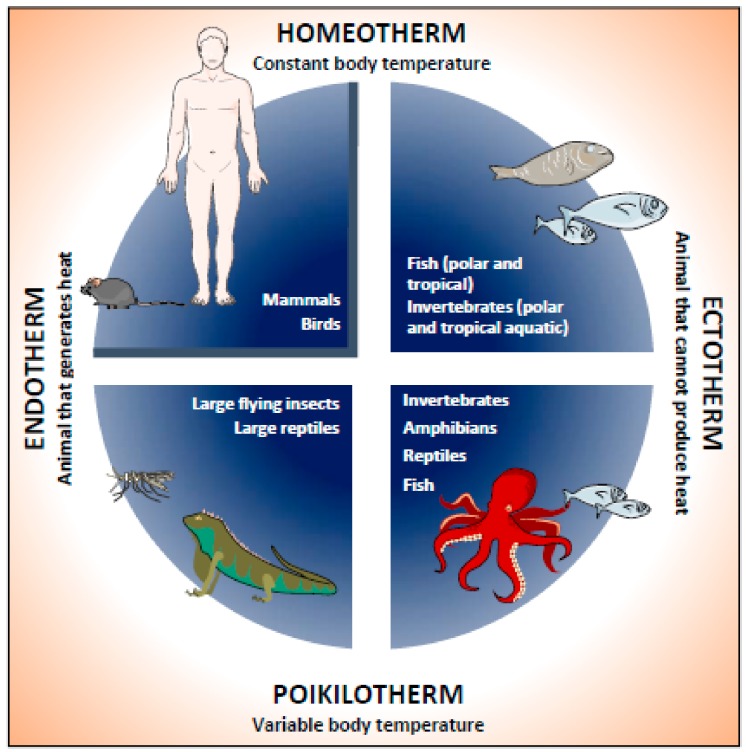
Figure 1
Figure 1
Classification of animals according to their body temperature and adaptation to room temperature. Animals are classified according to their way of acquiring body heat and their ability to adapt to room temperature. Endothermic animals can produce heat endogenously. Ectothermal animals cannot produce their own heat, so they rely on ambient temperature. In addition, animals can be classified into homeotherms that can keep their body temperature constant, or poikilotherms that have a variable body temperature. Humans and mice are mammals that are classified as homeothermal endotherms. However, when subjected to an ambient temperature well below their thermoneutrality, they experience physiological responses that trigger adaptive thermogenesis.
Figure 2
Figure 2
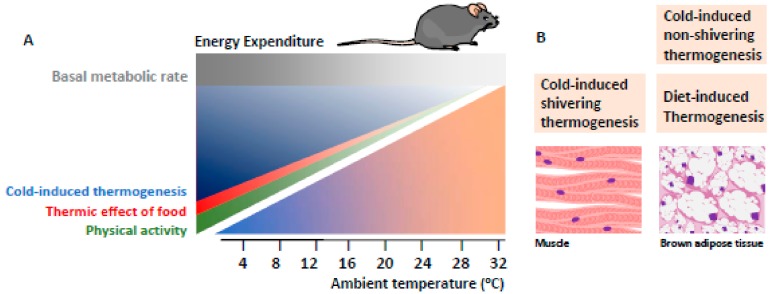
Cellular energy used in adaptive thermogenesis. (A) The total energy expenditure of the mouse can be divided into four components: basal metabolic rate, physical activity (green), the thermal effect of food (red) and cold-induced thermogenesis (blue). At room temperature (20–22 °C) more than one third of the total energy expenditure is cold-induced thermogenesis, which is required to maintain body temperature. (B) The energy used for cold-induced thermogenesis is mainly produced by skeletal muscle shivering and BAT thermogenesis.
Figure 3
Figure 3
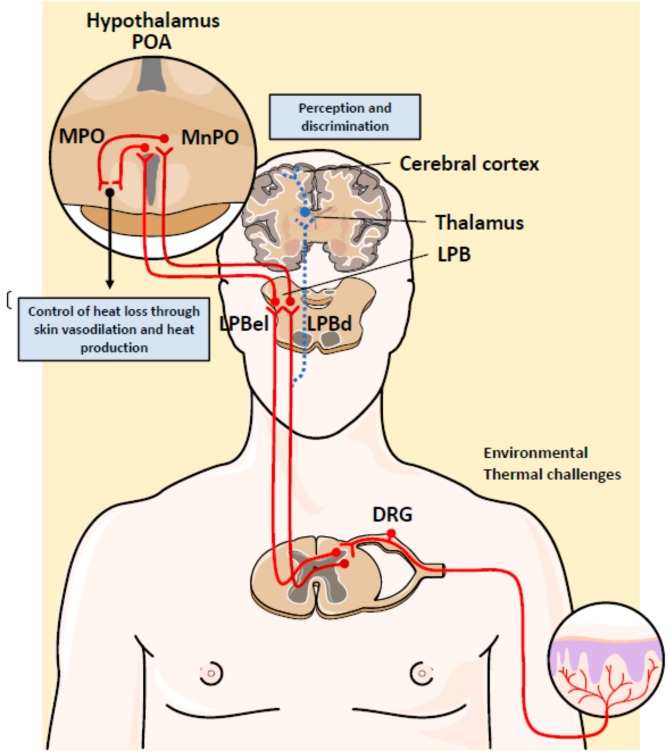
Hypothalamic thermoregulatory network that controls body temperature in mammals. The hypothalamic neurons of the preoptic area (POA) and the posterior hypothalamic area function as a body thermostat to maintain a stable body temperature. The ascending temperature information ends in two anatomically distinct areas of the lateral parabrachial nucleus (LPB): the lateral and dorsal external LPB (LPBel and LPBd, respectively). Heat and cold have been shown to activate cFOS expression in LPBd and LPBel, respectively. Altogether, this sophisticated thermoregulatory network highlights the importance of maintaining body temperature during an environmental temperature challenge. DRG, dorsal root ganglia; MPO, medial preoptic subnucleus; MnPO, median preoptic subnucleus.
Figure 4
Figure 4
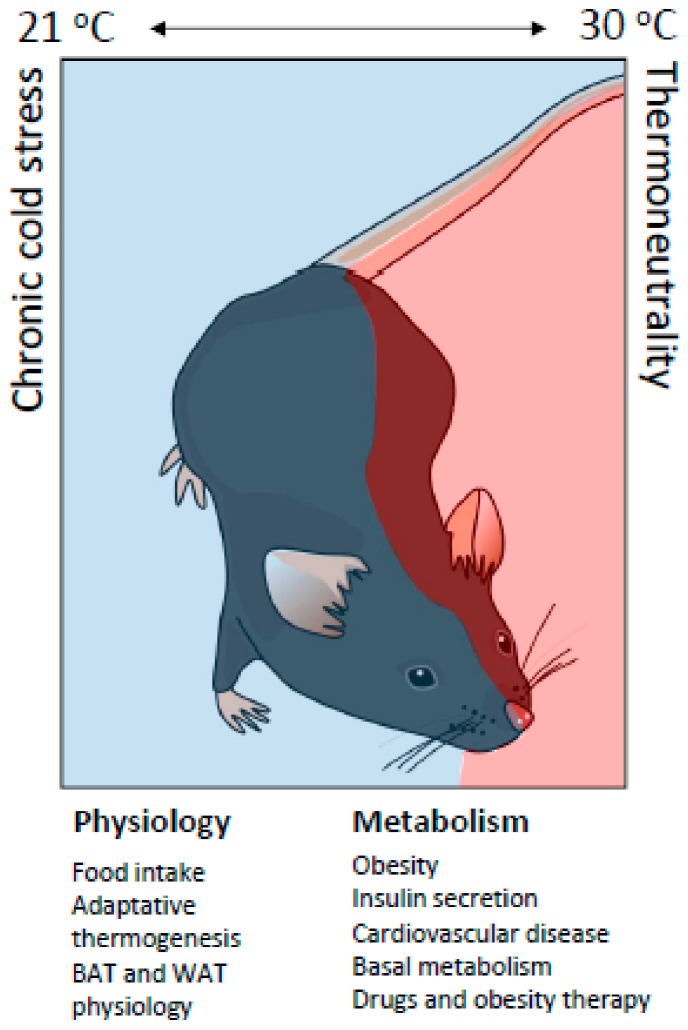
Metabolic and physiological differences in mice under chronic cold or at thermoneutrality. Mouse models used to study metabolic diseases are influenced by environmental temperature. Mice show differences in the metabolic phenotype when housed at a standard temperature (21 °C) vs. thermoneutrality (30 °C). Mice at standard temperatures are subjected to chronic cold. This triggers controlled hypothermia where energy expenditure is affected by changes in physiology (food intake, BAT and WAT physiology and an increase in adaptive thermogenesis) and in metabolism (basal metabolism, adaptive thermogenesis, diet efficiency, insulin secretion, adipose tissue physiology, inflammation at adipocyte and vascular levels, and the effect of drugs and therapies against obesity).

References

    1. Lovegrove B.G. The evolution of endothermy in Cenozoic mammals: A plesiomorphic-apomorphic continuum. Biol. Rev. 2011;87:128–162. doi: 10.1111/j.1469-185X.2011.00188.x. - DOI - PubMed
    1. Bennett A., Ruben J. Endothermy and activity in vertebrates. Science. 1979;206:649–654. doi: 10.1126/science.493968. - DOI - PubMed
    1. Pörtner H.O. Climate Variability and the Energetic Pathways of Evolution: The Origin of Endothermy in Mammals and Birds. Physiol. Biochem. Zoöl. 2004;7:959–981. - PubMed

    1. Wu C.-W., Storey K.B. Life in the cold: Links between mammalian hibernation and longevity. Biomol. Concepts. 2016;7:41–52. doi: 10.1515/bmc-2015-0032. - DOI - PubMed
    1. Bouma H.R., Verhaag E.M., Otis J.P., Heldmaier G., Swoap S.J., Strijkstra A.M., Henning R.H., Carey H.V. Induction of torpor: Mimicking natural metabolic suppression for biomedical applications. J. Cell. Physiol. 2012;227:1285–1290. doi: 10.1002/jcp.22850. - DOI - PubMed

Publication types