Review
. 2020 Jan 29;10(2):195.
doi: 10.3390/biom10020195.

Copper Ions and Parkinson's Disease: Why Is Homeostasis So Relevant?

Affiliations
Review

Copper Ions and Parkinson's Disease: Why Is Homeostasis So Relevant?

Marco Bisaglia et al. Biomolecules. .

Abstract

The involvement of copper in numerous physiological processes makes this metal ion essential for human life. Alterations in copper homeostasis might have deleterious consequences, and several neurodegenerative disorders, including Parkinson's disease (PD), have been associated with impaired copper levels. In the present review, we describe the molecular mechanisms through which copper can exert its toxicity, by considering how it can interfere with other cellular processes known to play a role in PD, such as dopamine metabolism, oxidative stress, and α-synuclein aggregation. The recent experimental evidence that associates copper deficiency and the formation of superoxide dismutase 1 (SOD1) aggregates with the progression of PD is also discussed together with its therapeutic implication. Overall, the recent discoveries described in this review show how either copper deficiency or excessive levels can promote detrimental effects, highlighting the importance of preserving copper homeostasis and opening unexplored therapeutic avenues in the definition of novel disease-modifying drugs.

Keywords: Parkinson’s disease; SOD1; copper; dopamine; α-synuclein.


Conflict of interest statement

The authors declare no conflict of interest.

Figures
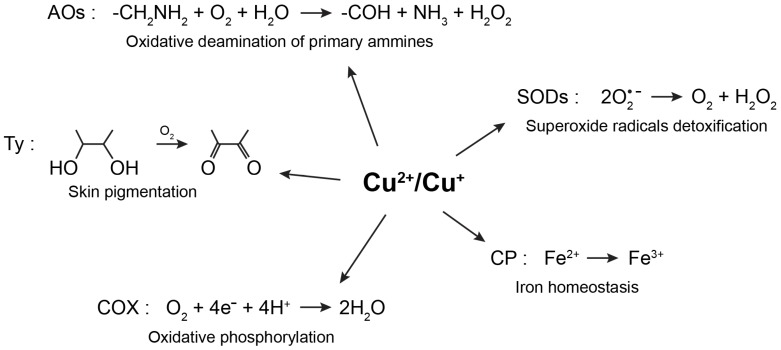
Figure 1
Figure 1
Physiological processes involving the redox activity of copper. Copper is often found as a cofactor in the active sites of enzymes with oxidoreductase activities. AOs—amine oxidases; COX—cytochrome c oxidase; CP—ceruloplasmin; Ty—tyrosinase; SODs—superoxide dismutases.
Figure 2
Figure 2
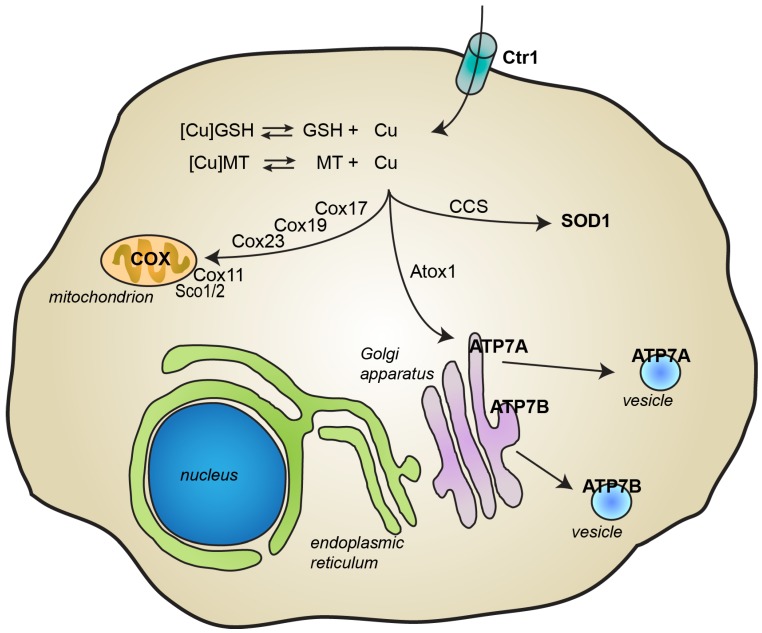
Cellular metabolism of copper. Copper import inside cells is mainly mediated by the copper transporter Ctr1. Inside cells, glutathione (GSH) and metallothioneins (MT) contribute to maintaining levels of free copper very low. Copper is transported to its final destination through the action of several specific chaperones. Copper transport protein Antioxidant-1 (Atox1) delivers copper to the P-type ATPases ATP7B and ATP7B, which are then responsible for the incorporation of copper into newly synthesized cuproproteins and for copper excretion through the plasma membrane. Copper chaperone for SOD1 (CCS) delivers copper to superoxide dismutase 1 (SOD1). At least 6 chaperones (Cox 11, Cox17, Cox19 and Cox23, and Sco1 and Sco2) deliver copper inside mitochondria into cytochrome c oxidase.
Figure 3
Figure 3
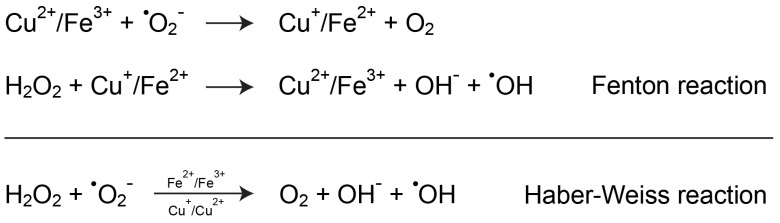
Copper-mediated increase of oxidative stress. Copper can participate in Fenton and Haber–Weiss reactions, which lead to the formation of the highly reactive hydroxyl radical intermediate, either directly or indirectly by interfering with iron homeostasis.
Figure 4
Figure 4
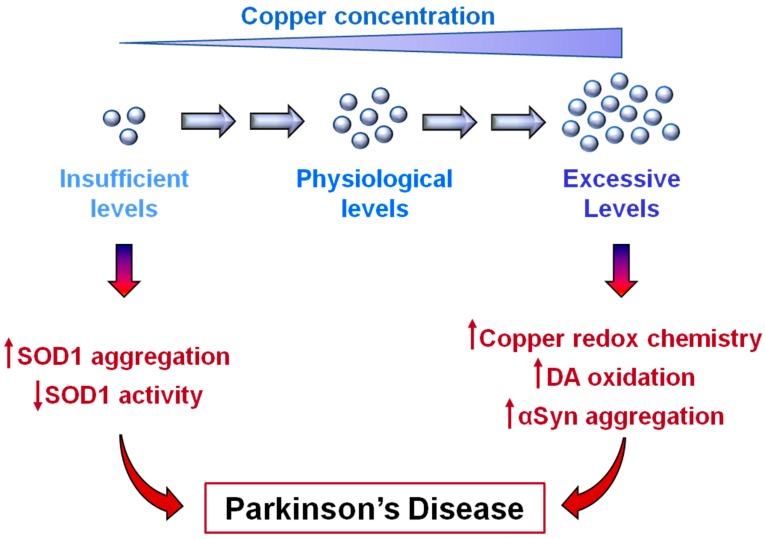
Copper dishomeostasis in Parkinson’s disease (PD). Copper deficiency, as well as excessive copper levels, can promote cellular events associated with PD. Low levels of copper are responsible for SOD1 aggregation while hindering SOD1 maturation. High levels of copper promote α-synuclein aggregation and increase oxidative conditions through Fenton and Haber–Weiss reactions and by favoring dopamine (DA) oxidation.

References

    1. Szerdahelyi P., Kasa P. Histochemical demonstration of copper in normal rat brain and spinal cord. Evidence of localization in glial cells. Histochemistry. 1986;85:341–347. doi: 10.1007/BF00493487. - DOI - PubMed
    1. Lewinska-Preis L., Jablonska M., Fabianska M.J., Kita A. Bioelements and mineral matter in human livers from the highly industrialized region of the upper silesia coal basin (poland) Env. Geochem. Health. 2011;33:595–611. doi: 10.1007/s10653-011-9373-7. - DOI - PubMed
    1. Bulcke F., Dringen R., Scheiber I.F. Neurotoxicity of copper. Adv. Neurobiol. 2017;18:313–343. - PubMed
    1. Navarro J.A., Schneuwly S. Copper and zinc homeostasis: Lessons from drosophila melanogaster. Front. Genet. 2017;8:223. doi: 10.3389/fgene.2017.00223. - DOI - PMC - PubMed
    1. Pohanka M. Copper and copper nanoparticles toxicity and their impact on basic functions in the body. Bratisl. Lek. Listy. 2019;120:397–409. doi: 10.4149/BLL_2019_065. - DOI - PubMed