


The Unfinished Agenda for Food Fortification in Low- and Middle-Income Countries: Quantifying Progress, Gaps and Potential Opportunities
- PMID: 32013129
- PMCID: PMC7071326
- DOI: 10.3390/nu12020354
The Unfinished Agenda for Food Fortification in Low- and Middle-Income Countries: Quantifying Progress, Gaps and Potential Opportunities
Abstract
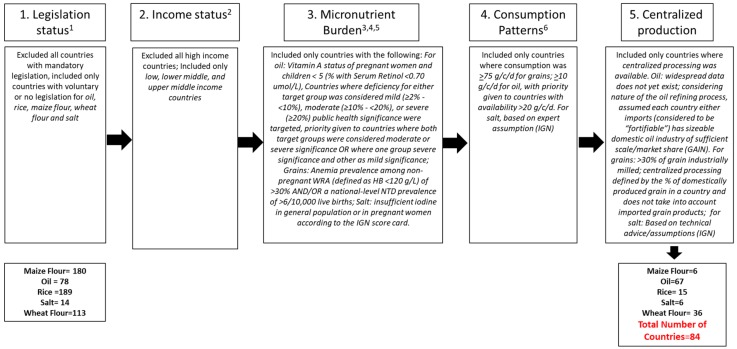
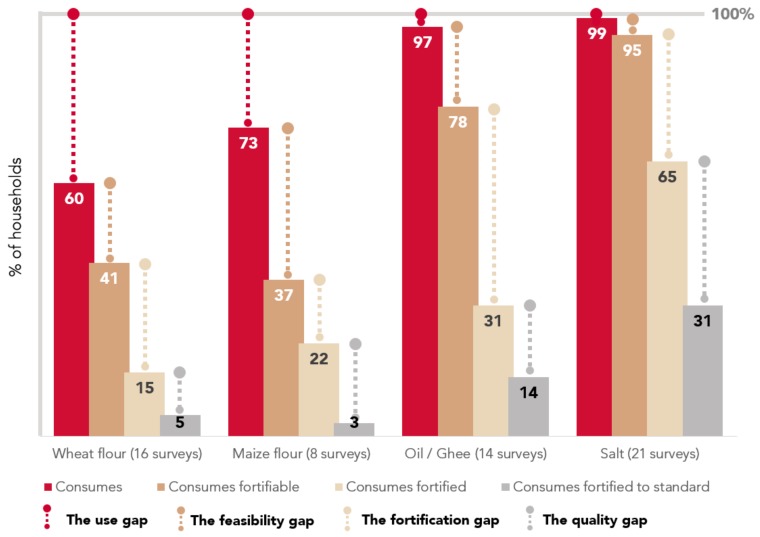
Large-scale food fortification (LSFF) is a cost-effective intervention that is widely implemented, but there is scope to further increase its potential. To identify gaps and opportunities, we first accessed the Global Fortification Data Exchange (GFDx) to identify countries that could benefit from new fortification programs. Second, we aggregated Fortification Assessment Coverage Toolkit (FACT) survey data from 16 countries to ascertain LSFF coverage and gaps therein. Third, we extended our narrative review to assess current innovations. We identified 84 countries as good candidates for new LSFF programs. FACT data revealed that the potential of oil/ghee and salt fortification is not being met due mainly to low coverage of adequately fortified foods (quality). Wheat, rice and maize flour fortification have similar quality issues combined with lower coverage of the fortifiable food at population-level (< 50%). A four-pronged strategy is needed to meet the unfinished agenda: first, establish new LSFF programs where warranted; second, systems innovations informed by implementation research to address coverage and quality gaps; third, advocacy to form new partnerships and resources, particularly with the private sector; and finally, exploration of new fortificants and vehicles (e.g. bouillon cubes; salt fortified with multiple nutrients) and other innovations that can address existing challenges.
Keywords: fortification; large- scale food fortification; low- and middle-income countries; micronutrient deficiency; micronutrients.
Conflict of interest statement
The authors declare no conflict of interest. All authors are employed by organizations which receive funding from several donors to support food fortification programs in many countries. Mawuli Sablah is a UNICEF staff member and the opinions and statements in this article are those of the author and may not reflect official UNICEF policies.
Figures
References
-
- Bhutta Z.A., Das J.K., Rizvi A., Gaffey M.F., Walker N., Horton S., Webb P., Lartey A., Black R.E., The Lancet Nutrition Interventions Review Group et al. Evidence-based interventions for improvement of maternal and child nutrition: What can be done and at what cost? Lancet. 2013;382:452–477. doi: 10.1016/S0140-6736(13)60996-4. - DOI - PubMed
Publication types
MeSH terms
Grants and funding
LinkOut - more resources
Full Text Sources
Miscellaneous
