


Trabecular Bone Deficit and Enhanced Anabolic Response to Re-Ambulation after Disuse in Perlecan-Deficient Skeleton
- PMID: 32013135
- PMCID: PMC7072656
- DOI: 10.3390/biom10020198
Trabecular Bone Deficit and Enhanced Anabolic Response to Re-Ambulation after Disuse in Perlecan-Deficient Skeleton
Abstract
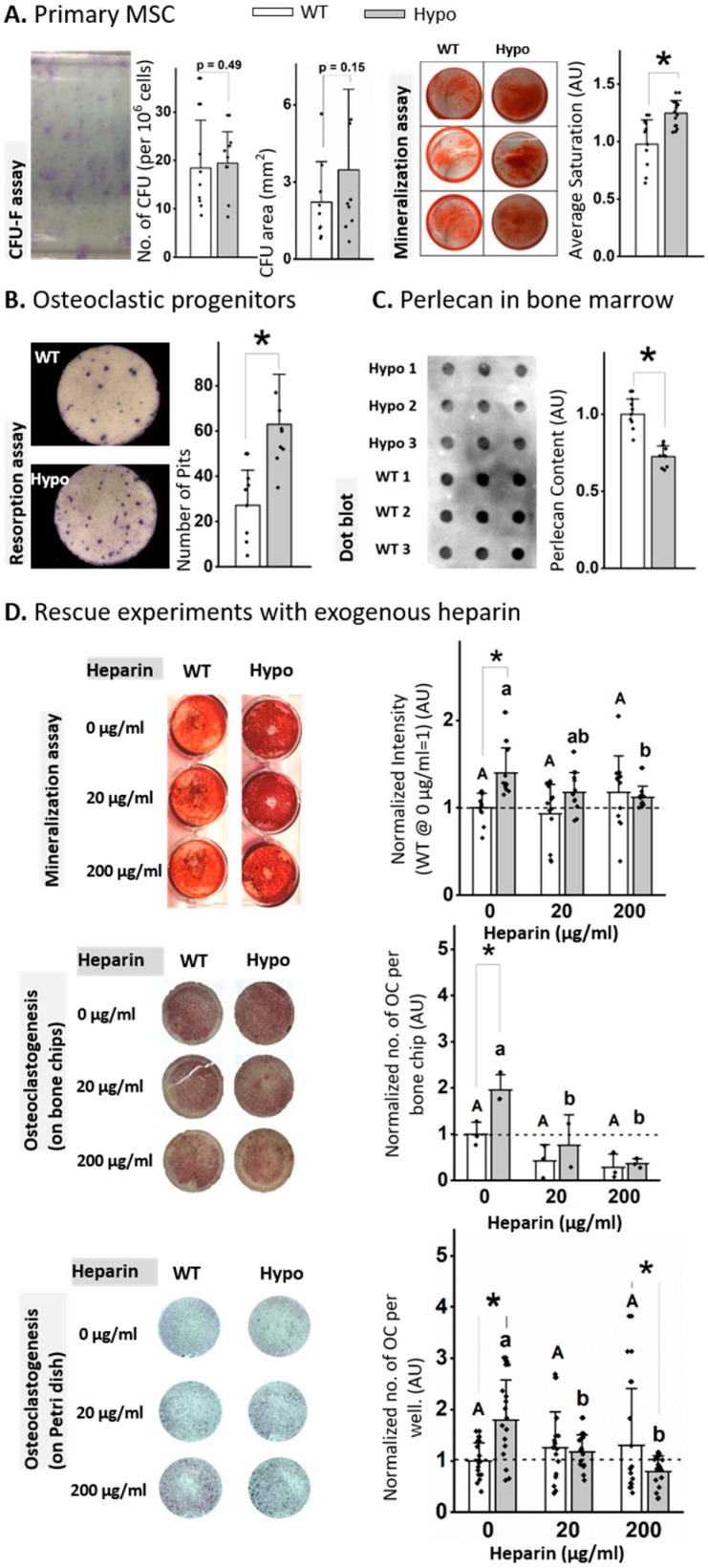
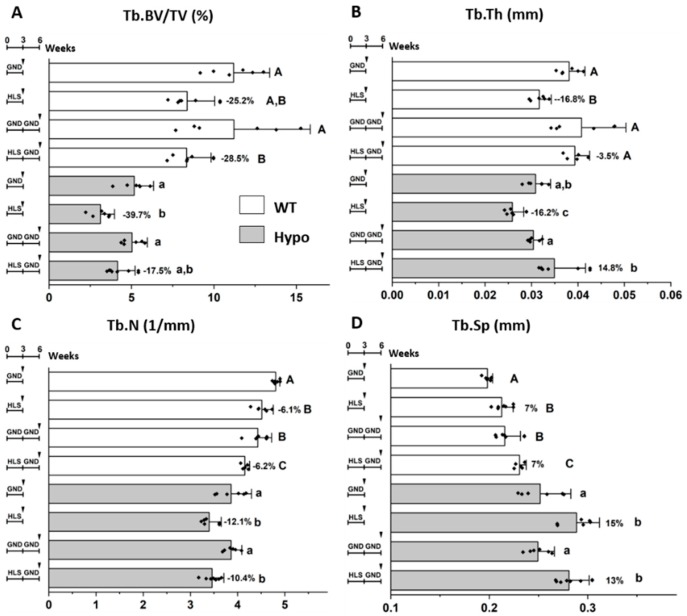
Perlecan/Hspg2, a large monomeric heparan sulfate proteoglycan, is found in the basement membrane and extracellular matrix, where it acts as a matrix scaffold, growth factor depot, and tissue barrier. Perlecan deficiency leads to skeletal dysplasia in Schwartz-Jampel Syndrome (SJS) and is a risk factor for osteoporosis. In the SJS-mimicking murine model (Hypo), inferior cortical bone quality and impaired mechanotransduction in osteocytes were reported. This study focused on trabecular bone, where perlecan deficiency was hypothesized to result in structural deficit and altered response to disuse and re-loading. We compared the Hypo versus WT trabecular bone in both axial and appendicular skeletons of 8-38-week-old male mice, and observed severe trabecular deficit in Hypo mice, approximately 50% reduction of Tb.BV/TV regardless of skeletal site and animal age. Defects in endochondral ossification (e.g., accelerated mineralization), increases in osteoclast activity, and altered differentiation of bone progenitor cells in marrow contributed to the Hypo phenotype. The Hypo trabecular bone deteriorated further under three-week hindlimb suspension as did the WT. Re-ambulation partially recovered the lost trabecular bone in Hypo, but not in WT mice. The novel finding that low-impact loading could counter detrimental disuse effects in the perlecan-deficient skeleton suggests a strategy to maintain skeletal health in SJS patients.
Keywords: Schwartz-Jampel syndrome; hindlimb suspension; micro-computed tomography; osteoclastogenesis; osteoporosis; perlecan; re-ambulation; trabecular bone.
Conflict of interest statement
The authors declare no conflict of interests.
Figures


References
-
- French M.M., Smith S.E., Akanbi K., Sanford T., Hecht J., Farach-Carson M.C., Carson D.D. Expression of the heparan sulfate proteoglycan, perlecan, during mouse embryogenesis and perlecan chondrogenic activity in vitro. J. Cell Biol. 1999;145:1103–1115. doi: 10.1083/jcb.145.5.1103. - DOI - PMC - PubMed
-
- Arikawa-Hirasawa E., Le A.H., Nishino I., Nonaka I., Ho N.C., Francomano C.A., Govindraj P., Hassell J.R., Devaney J.M., Spranger J., et al. Structural and functional mutations of the perlecan gene cause Schwartz-Jampel syndrome, with myotonic myopathy and chondrodysplasia. Am. J. Hum. Genet. 2002;70:1368–1375. doi: 10.1086/340390. - DOI - PMC - PubMed
-
- Valds-Flores M., Casas-Avila L., Ponce V. Topics in Osteoporosis. IntechOpen Limited; London, UK: 2013. Genetic Diseases Related with Osteoporosis; pp. 70–85. - DOI
-
- Lowe D.A., Lepori-Bui N., Fomin P.V., Sloofman L.G., Zhou X., Farach-Carson M.C., Wang L., Kirn-Safran C.B. Deficiency in perlecan/HSPG2 during bone development enhances osteogenesis and decreases quality of adult bone in mice. Calcif. Tissue Int. 2014;95:29–38. doi: 10.1007/s00223-014-9859-2. - DOI - PMC - PubMed
Publication types
MeSH terms
Substances
Grants and funding
LinkOut - more resources
Full Text Sources
Molecular Biology Databases
