


Emergency department and inpatient utilization among U.S. older adults with multiple chronic conditions: a post-reform update
- PMID: 32013969
- PMCID: PMC6998236
- DOI: 10.1186/s12913-020-4902-7
Emergency department and inpatient utilization among U.S. older adults with multiple chronic conditions: a post-reform update
Abstract
Background: The Affordable Care Act (ACA) was enacted to enhance access to care primarily among nonelderly and low-income populations; however, several provisions addressed key determinants of emergency department (ED) and inpatient visits among Medicare beneficiaries over age 65 years. We take stock of the overall changes in these visits among older Medicare beneficiaries, focusing on those with multiple chronic conditions (MCCs), and provide a nationally representative post-reform update.
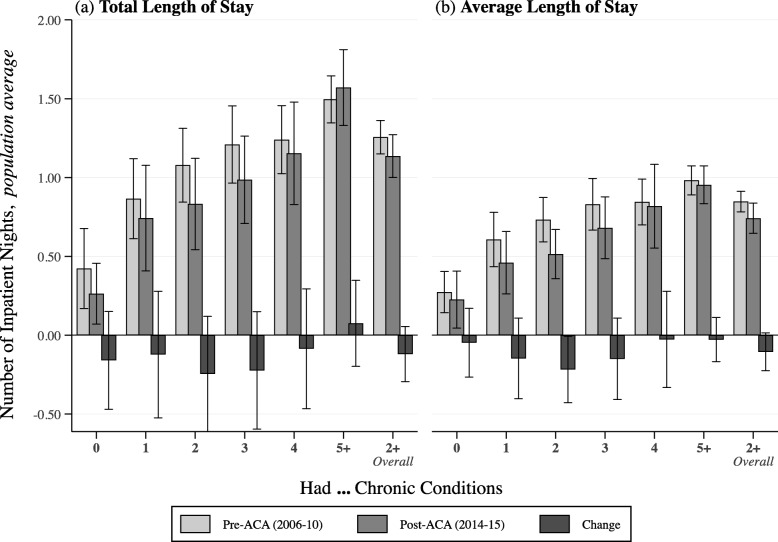
Methods: We analyzed a sample of 32,919 older adults (65+) on Medicare from the 2006-2015 Medical Expenditure Panel Survey (MEPS). Using a survey-weighted two-part model, we examined changes in ED visits, inpatient visits, and length of stay (LOS) by MCC status, before (2006-2010), during (2011-2013), and after the ACA (2014-2015).
Results: Prior to the ACA, 18.1% of Medicare older adults had ≥1 ED visit, whereas 17.1% had ≥1 inpatient visits, with an average of 5.1 nights/visit. Following ACA reforms, among those with 2+ chronic conditions, the rate of ever having an ED visit increased by 4.3 percentage points [95% confidence intervals [CI]: 2.5, 6.1, p < 0.01], whereas the rate of inpatient visits decreased by 1.4 percentage points [95%CI: - 2.9, 0.2, p < 0.1], after multivariable adjustment.
Conclusions: We found sizable increases in ED visits and nontrivial decreases in inpatient visits among older Medicare beneficiaries with MCCs, underscoring the continuing need for improving access to and quality of care among older adults with MCCs to decrease reliance on the ED and reduce preventable hospitalizations.
Keywords: Affordable care act; Emergency department (ED) visits; Inpatient visits; Length of stay (LOS); Medicare; Multiple chronic conditions; Older adults.
Conflict of interest statement
The authors declare that they have no competing interests.
Figures


References
-
- Boyd CM, Fortin M. Future of multimorbidity research: how should understanding of multimorbidity inform health system design? Public Health Rev. 2010;32(2):451. doi: 10.1007/BF03391611. - DOI
-
- Anderson GF. Chronic care: making the case for ongoing care. Princeton: Robert Wood Johnson Foundation; 2010.
-
- Buttorff C, Ruder T, Bauman M. RAND Corporation. 2017. Multiple chronic conditions in the United States.
MeSH terms
Grants and funding
LinkOut - more resources
Full Text Sources
Medical
