


The effect of cisatracurium infusion on the energy expenditure of critically ill patients: an observational cohort study
- PMID: 32014039
- PMCID: PMC6998072
- DOI: 10.1186/s13054-020-2744-7
The effect of cisatracurium infusion on the energy expenditure of critically ill patients: an observational cohort study
Abstract
Background: Both overfeeding and underfeeding of intensive care unit (ICU) patients are associated with worse outcomes. A reliable estimation of the energy expenditure (EE) of ICU patients may help to avoid these phenomena. Several factors that influence EE have been studied previously. However, the effect of neuromuscular blocking agents on EE, which conceptually would lower EE, has not been extensively investigated.
Methods: We studied a cohort of adult critically ill patients requiring invasive mechanical ventilation and treatment with continuous infusion of cisatracurium for at least 12 h. The study aimed to quantify the effect of cisatracurium infusion on EE (primary endpoint). EE was estimated based on ventilator-derived VCO2 (EE in kcal/day = VCO2 × 8.19). A subgroup analysis of septic and non-septic patients was performed. Furthermore, the effects of body temperature and sepsis on EE were evaluated. A secondary endpoint was hypercaloric feeding (> 110% of EE) after cisatracurium infusion.
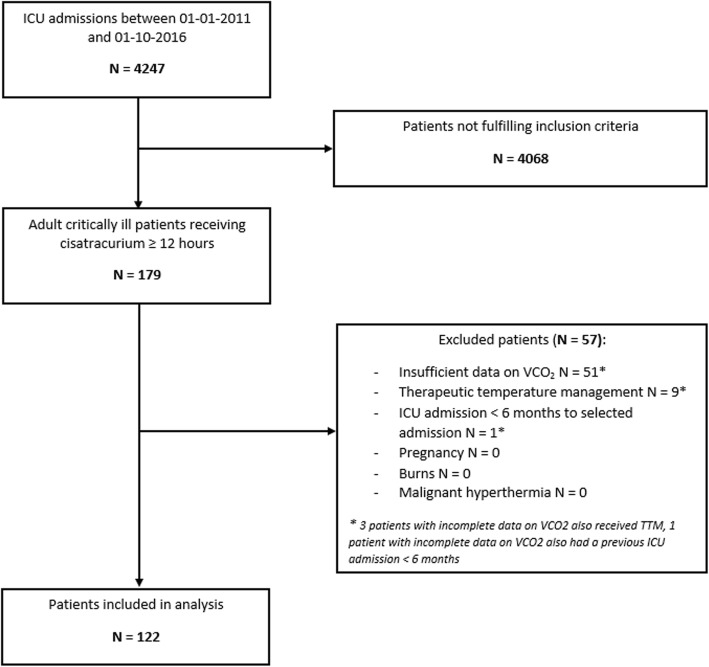
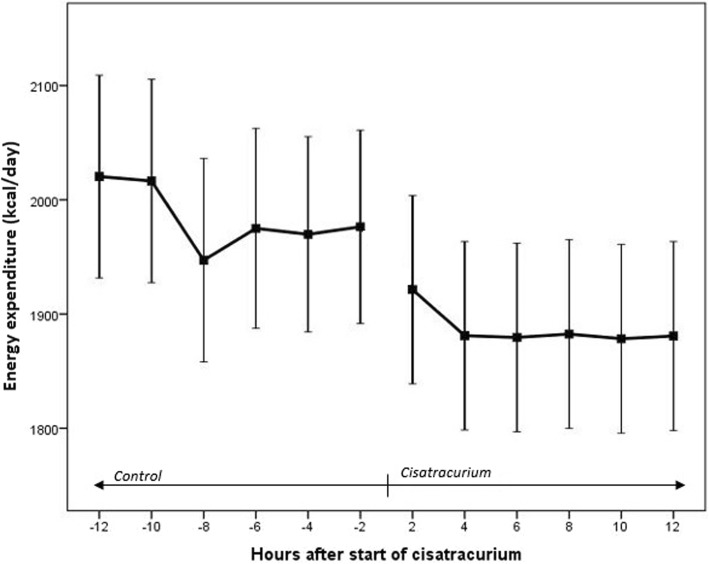
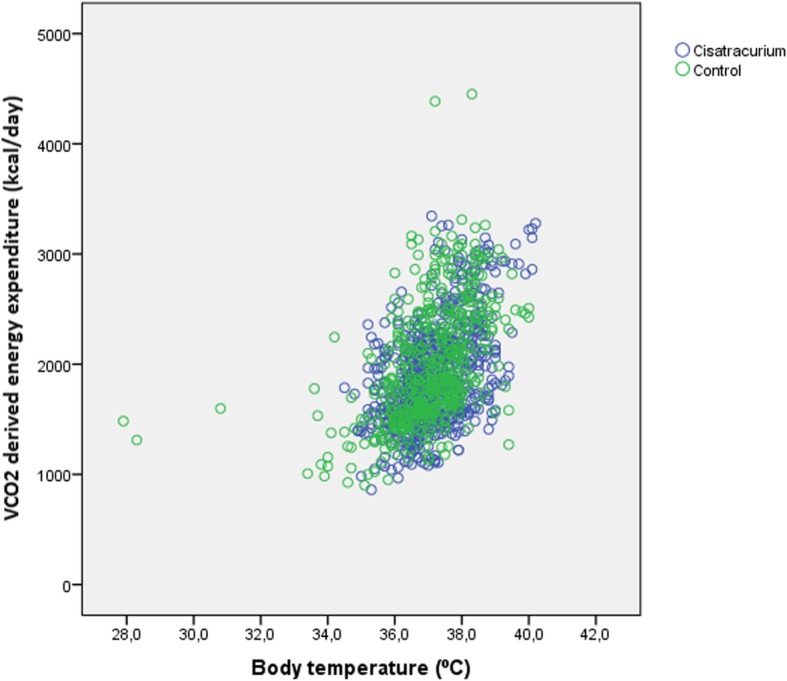
Results: In total, 122 patients were included. Mean EE before cisatracurium infusion was 1974 kcal/day and 1888 kcal/day after cisatracurium infusion. Multivariable analysis showed a significantly lower EE after cisatracurium infusion (MD - 132.0 kcal (95% CI - 212.0 to - 52.0; p = 0.001) in all patients. This difference was statistically significant in both sepsis and non-sepsis patients (p = 0.036 and p = 0.011). Non-sepsis patients had lower EE than sepsis patients (MD - 120.6 kcal; 95% CI - 200.5 to - 40.8, p = 0.003). Body temperature and EE were positively correlated (Spearman's rho = 0.486, p < 0.001). Hypercaloric feeding was observed in 7 patients.
Conclusions: Our data suggest that continuous infusion of cisatracurium in mechanically ventilated ICU patients is associated with a significant reduction in EE, although the magnitude of the effect is small. Sepsis and higher body temperature are associated with increased EE. Cisatracurium infusion is associated with overfeeding in only a minority of patients and therefore, in most patients, no reductions in caloric prescription are necessary.
Keywords: Energy expenditure; Neuromuscular blocking agent; Overfeeding.
Conflict of interest statement
Arthur van Zanten reported that he has received honoraria for advisory board meetings, lectures, and travel expenses from Abbott, Baxter, BBraun, Danone-Nutricia, Fresenius Kabi, Mermaid, Lyric, and Nestle -Novartis. Inclusion fees for patients in nutrition trials were paid to the local ICU research foundation. The remaining authors declare that they have no competing interests.
Figures
References
-
- De Waele E, Spapen H, Honoré P, Mattens S, Van Gorp V, Diltoer M, et al. Introducing a new generation indirect calorimeter for estimating energy requirements in adult intensive care unit patients: Feasibility, practical considerations, and comparison with a mathematical equation. J Crit Care. 2013;28:884.e1–884.e6. doi: 10.1016/j.jcrc.2013.02.011. - DOI - PubMed
-
- Mooij CM, Beurskens CJ, Juffermans NP. Energy expenditure in different patient populations on intensive care: one size does not fit all. Neth J Crit Care. 2013;17:3–7.
Publication types
MeSH terms
Substances
LinkOut - more resources
Full Text Sources
