. 2020 Jan 3:2020:8747023.
doi: 10.1155/2020/8747023. eCollection 2020.

20(S)-Protopanaxdiol Suppresses the Abnormal Granule-Monocyte Differentiation of Hematopoietic Stem Cells in 4T1 Breast Cancer-Bearing Mouse

Affiliations

20(S)-Protopanaxdiol Suppresses the Abnormal Granule-Monocyte Differentiation of Hematopoietic Stem Cells in 4T1 Breast Cancer-Bearing Mouse

Wen-Qin Guo et al. Evid Based Complement Alternat Med. .

Abstract

Panax notoginseng (PN) has been used as a qi- and blood-activating (Huoxue) drug for thousands of years in China. It has also been widely used as an anticancer drug at present. As a Huoxue drug, the effect of PN on hematopoietic differentiation in tumor-bearing body has been paid more and more attention. Our research found that panax notoginseng saponins (PNS), especially panaxadiol saponins (PDS) and its aglucon 20(S)-Protopanaxdiol (PPD), could improve the immunosuppressive state by regulating the abnormal hematopoietic differentiation in a tumor-bearing body by multiple ways. An interesting phenomenon is that PDS reduced the neutrophil-lymphocyte ratio (NLR) via its inhibition effect on the granule-monocyte differentiation of spleen cells, which is associated with a decrease in the secretion of tumor MPO, G-CSF, PU.1, and C/EBPα. Otherwise, PDS increased the proportion of both hematopoietic stem cells and erythroid progenitor cells in the bone marrow, but inhibited spleen erythroid differentiation via inhibiting secretion of tumor EPO, GATA-1, and GATA-2. This study suggests that PNS regulated the tumor-induced abnormal granule-monocyte differentiation of hematopoietic stem cells, affecting the distribution and function of haemocytes in tumor-bearing mice.


Conflict of interest statement

The authors declare no conflicts of interest.

Figures
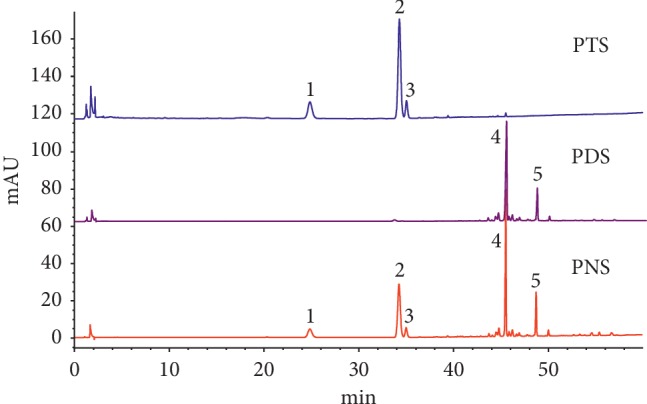
Figure 1
Figure 1
HPLC chromatograms of PTS and PDS isolated from Panax notoginseng saponins. Compound 1, notoginsenoside R1, 2–5, ginsenoside Rg1, Re, Rb1, and Rd, respectively.
Figure 2
Figure 2
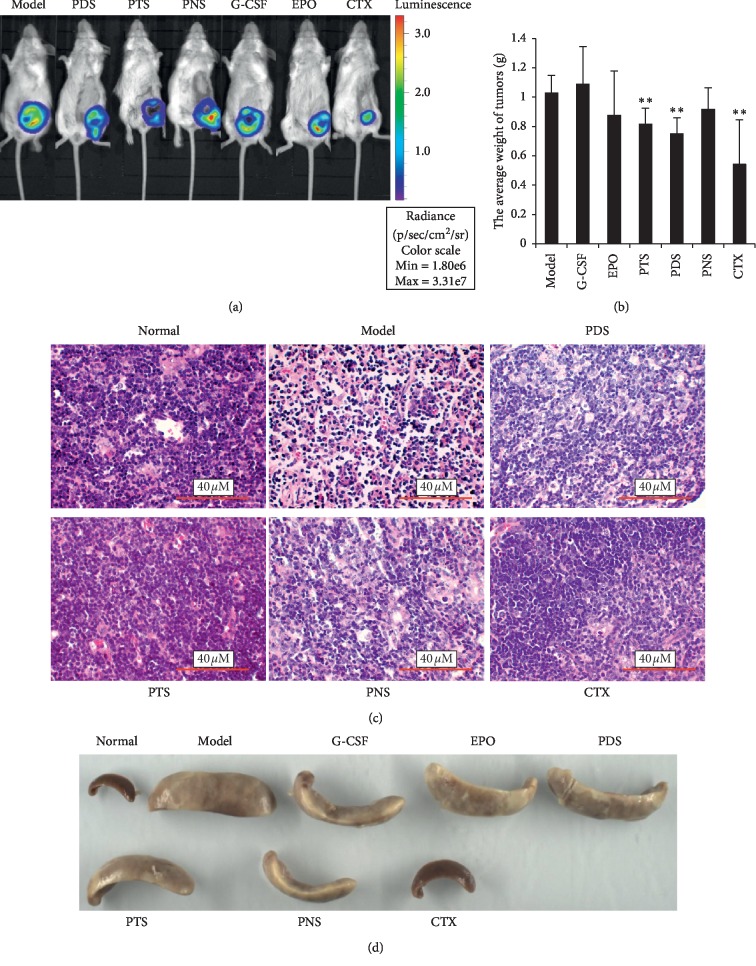
(a) Xenogen images of the representative mouse in the model group, PDS, PTS, and PNS group. (b) The average tumor weight of mice, ∗∗P < 0.01, in PDS, PTS, and PNS groups vs. the model group. (c) Hemotoxylin & Eosin staining of mice thymus tissue (×400 magnification). (d) The changes of spleen after PDS, PNS, and PDS administration.
Figure 3
Figure 3
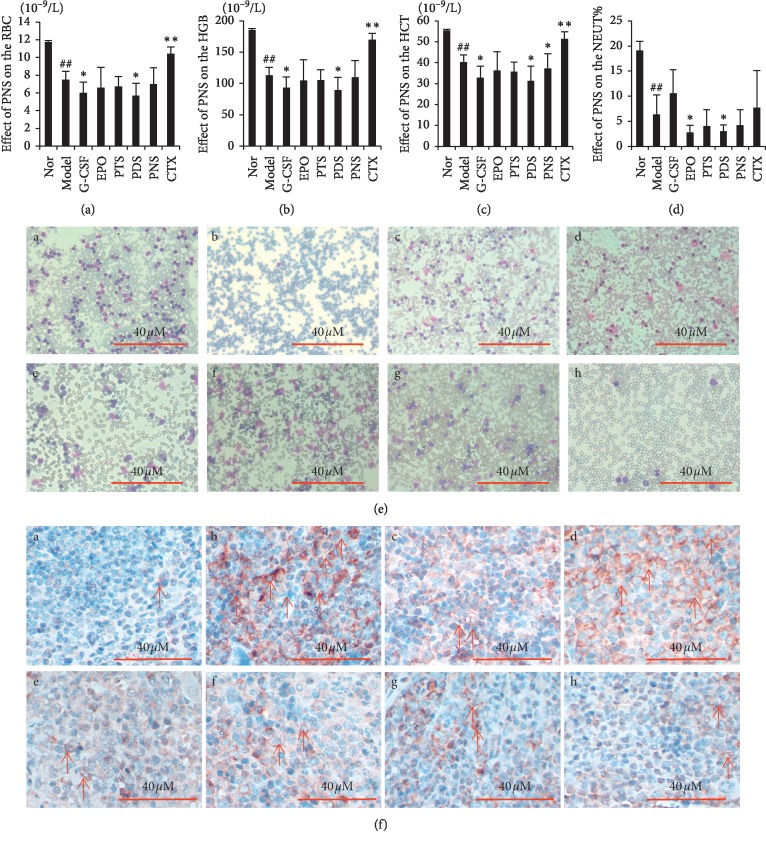
PDS, PTS, and PNS promote the hematopoietic capacity of the tumor-bearing mice. (a–d) The RBC, HGB, HCT, and NEUT% in mouse peripheral blood, P < 0.05,∗∗P < 0.01 vs. model group. ##P < 0.01, vs. normal group. (e) Morphological pictures of peripheral blood for different groups. (f) Immunohistochemical staining of mice spleen tissues. MPO expression in mice spleens (×400 magnification). a: normal group; b: model group; c: EPO group; d: G-CSF group; e: PDS group; f: PTS group; g: PNS group; and h: CTX group.
Figure 4
Figure 4
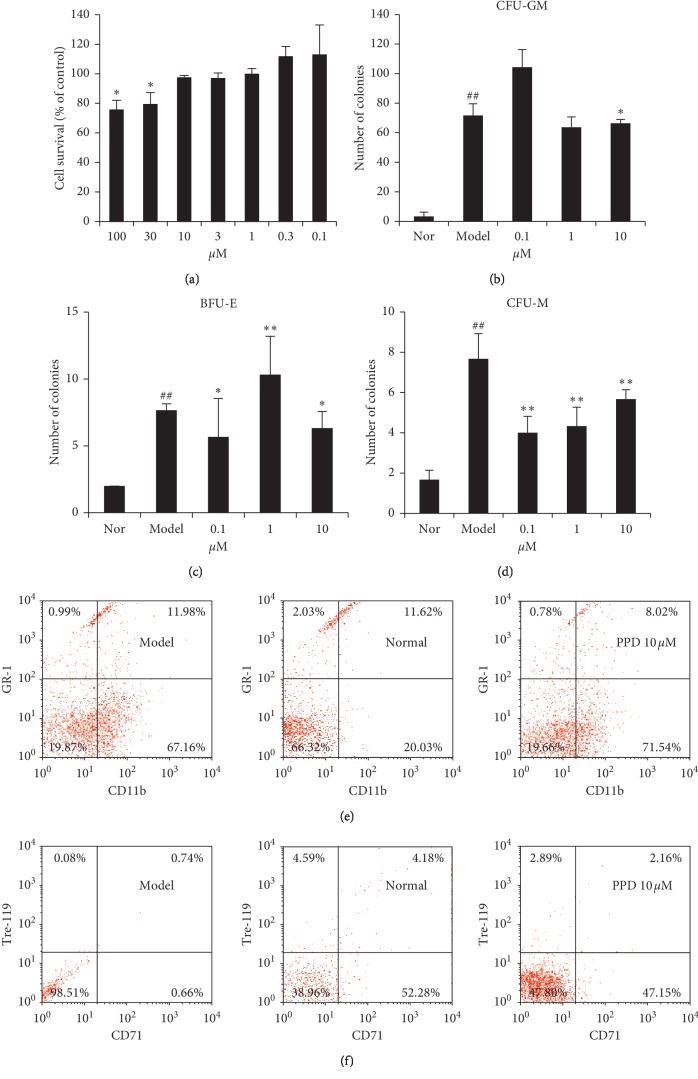
(a) The cytotoxicity effect of PPD in mouse splenocytes.P < 0.05, vs. normal group. (b–d) The effect of PPD on the colon formation of BFU-E, CFU-M, and CFU-GM, P < 0.05, ∗∗P < 0.01, vs. model group. ##P < 0.01, vs. normal group. (e-f) The proportion of monocyte (CD11b+/Gr-1), granulocyte (CD11b+/Gr-1+), and erythroid progenitor cells (CD71+/Ter119+) in mouse splenocytes.
Figure 5
Figure 5
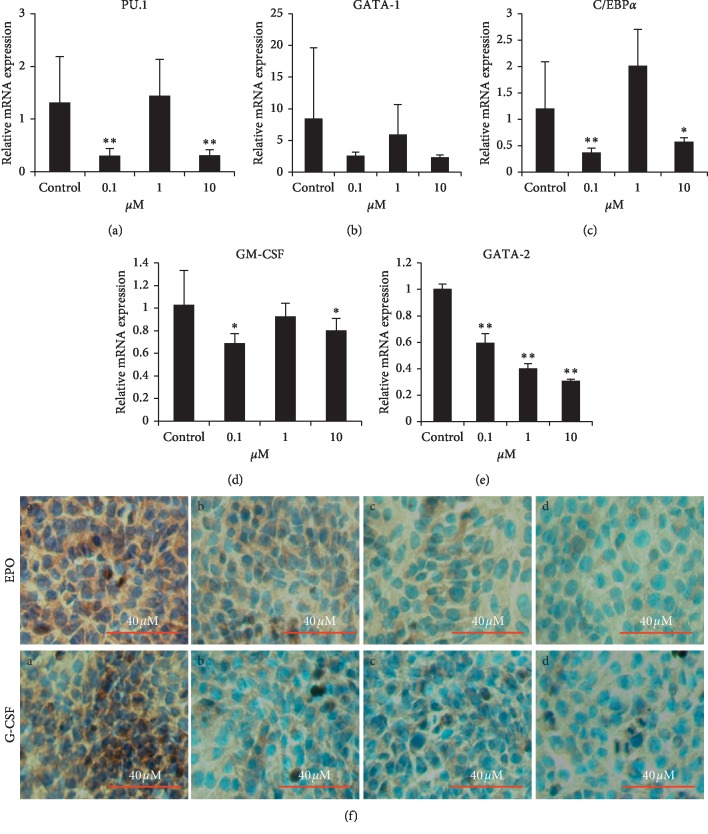
(a–e) The relative expression of C/EBPα, GATA-1, GM-CSF, GATA-1, and PU.1. Data are from three independent experiments. Values are shown as means ± SD (n = 3). P < 0.05, ∗∗P < 0.01 vs. control. (f) EPO and G-CSF expression in 4T1 cells. PPD reduced expression of G-CSF and EPO in 4T1 (×400 magnification). a: control; b: PPD 0.1 μM; c: PPD 10 μM; d: PPD 100 μM.

References

    1. Yang C.-Y., Wang J., Zhao Y., et al. Anti-diabetic effects of Panax notoginseng saponins and its major anti-hyperglycemic components. Journal of Ethnopharmacology. 2010;130(2):231–236. doi: 10.1016/j.jep.2010.04.039. - DOI - PubMed
    1. Duan L., Xiong X., Hu J., et al. Panax notoginseng saponins for treating coronary artery disease: a functional and mechanistic overview. Frontiers in Pharmacology. 2017;8:p. 702. doi: 10.3389/fphar.2017.00702. - DOI - PMC - PubMed
    1. Fan J.-S., Liu D.-N., Huang G., et al. Panax notoginseng saponins attenuate atherosclerosis via reciprocal regulation of lipid metabolism and inflammation by inducing liver X receptor alpha expression. Journal of Ethnopharmacology. 2012;142(3):732–738. doi: 10.1016/j.jep.2012.05.053. - DOI - PubMed
    1. Han S.-Y., Li H.-X., Ma X., et al. Evaluation of the anti-myocardial ischemia effect of individual and combined extracts of Panax notoginseng and Carthamus tinctorius in rats. Journal of Ethnopharmacology. 2013;145(3):722–727. doi: 10.1016/j.jep.2012.11.036. - DOI - PubMed
    1. Luo H., Vong C.-T., Chen H.-B., et al. Naturally occurring anti-cancer compounds: shining from Chinese herbal medicine. Chinese Medicine. 2019;14:p. 48. doi: 10.1186/s13020-019-0270-9. - DOI - PMC - PubMed