Editorial
doi: 10.21037/atm.2019.12.106.
Use of high flow nasal cannula for preoxygenation and apneic oxygenation during intubation
Affiliations
- PMID: 32016098
- PMCID: PMC6976447
- DOI: 10.21037/atm.2019.12.106
Item in Clipboard
Editorial
Use of high flow nasal cannula for preoxygenation and apneic oxygenation during intubation
Ann Transl Med.
2019 Dec.
No abstract available
Conflict of interest statement
Conflicts of Interest: JD Ricard declares travel and accommodation expenses covered by Fisher & Paykel to attend scientific meetings. J Messika declares travel and accommodation expenses covered by Fisher & Paykel and CSL Behring to attend scientific meetings. The other authors have no conflicts of interest to declare.
Figures
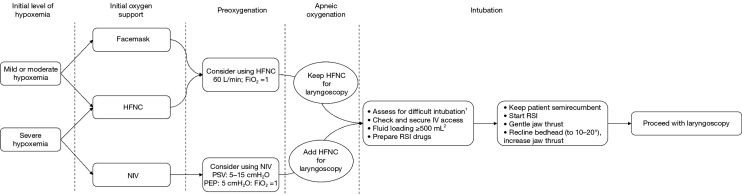
Algorithm of intubation in ICU. The choice of the preoxygenation method is based on the device the patient is supported with at the time of intubation decision. 1, using the MACOCHA scale; 2, except in case of left heart failure or cardiogenic pulmonary. NIV, noninvasive ventilation; HFNC, high-flow nasal cannula oxygen support; RSI, rapid sequence induction.
Comment on
-
Nasal high-flow preoxygenation for endotracheal intubation in the critically ill patient: a randomized clinical trial.Intensive Care Med. 2019 Apr;45(4):447-458. doi: 10.1007/s00134-019-05529-w. Epub 2019 Jan 21. Intensive Care Med. 2019. PMID: 30666367 Clinical Trial.
References
-
- Ricard JD. Hazards of intubation in the ICU: role of nasal high flow oxygen therapy for preoxygenation and apneic oxygenation to prevent desaturation. Minerva Anestesiol 2016;82:1098-106. - PubMed
-
- Ni Y-N, Luo J, Yu H, et al. Can High-flow Nasal Cannula Reduce the Rate of Endotracheal Intubation in Adult Patients With Acute Respiratory Failure Compared With Conventional Oxygen Therapy and Noninvasive Positive Pressure Ventilation?: A Systematic Review and Meta-analysis. Chest 2017;151:764-75. - PubMed
Publication types
LinkOut - more resources
Full Text Sources