


Causes and predictors of early mortality in patients treated with left ventricular assist device implantation in the European Registry of Mechanical Circulatory Support (EUROMACS)
- PMID: 32016536
- PMCID: PMC7334284
- DOI: 10.1007/s00134-020-05939-1
Causes and predictors of early mortality in patients treated with left ventricular assist device implantation in the European Registry of Mechanical Circulatory Support (EUROMACS)
Abstract
Purpose: The aim of the study was to analyze early mortality after continuous-flow left ventricular assist device (LVAD) implantation which remains high.
Methods: We analyzed consecutive (n = 2689) patients from the European Registry for Patients with Mechanical Circulatory Support (EUROMACS) undergoing continuous-flow LVAD implantation. The primary outcome was early (< 90 days) mortality. Secondary outcomes were differential causes of early post-operative death following LVAD implantation.
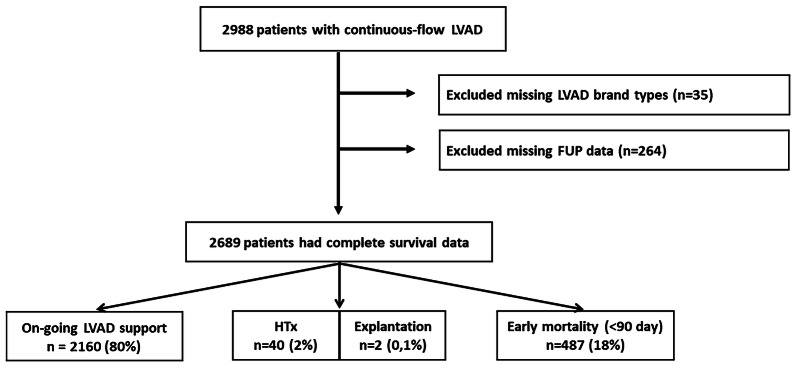
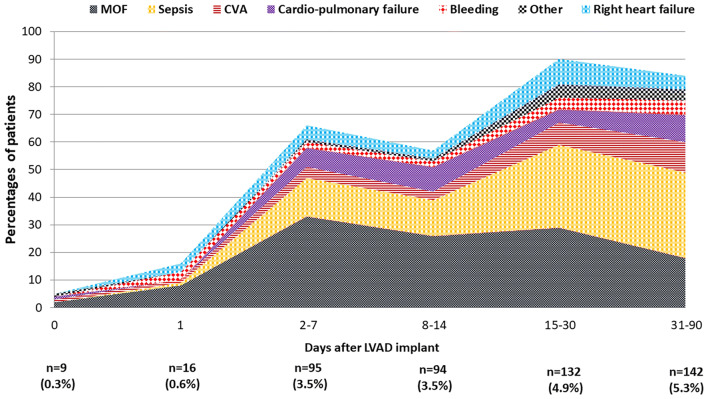
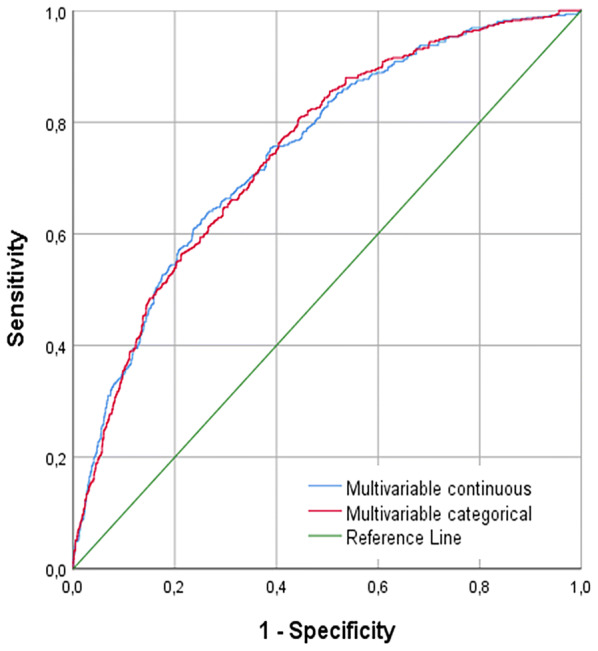
Results: Univariable and multivariable analysis as well as regression analysis were used to examine determinants and differential causes of early (< 90 days) mortality after LVAD implantation. During the first 90 days, 2160 (80%) patients were alive with ongoing LVAD support, 40(2%) patients underwent heart transplantation, and 487(18%) deceased. The main causes of early death were MOF (36%), sepsis (28%), cardiopulmonary failure (CPF; 10%), CVA (9%), and right-sided heart failure (RHF, 8%). Furthermore, MOF and sepsis are 70% of causes of death in the first week. Independent clinical predictors of early death were age, female sex, INTERMACS profile 1 to 3, and ECMO. Laboratory predictors included elevated serum creatinine, total bilirubin, lactate, and low hemoglobin. Furthermore, hemodynamic predictors included elevated RA-to-PCWP ratio, pulmonary vascular resistance, and low systemic vascular resistance. Longer total implantation time was also independent predictor of early mortality. A simple model of 12 variables predicts early mortality following LVAD implantation with a good discriminative power with area under the curve of 0.75.
Conclusions: In the EUROMACS registry, approximately one out of five patients die within 90 days after LVAD implantation. Early mortality is primarily dominated by multiorgan failure followed by sepsis. A simple model identifies important parameters which are associated with early mortality following LVAD implantation.
Keywords: Causes; Intensive care; Left ventricular assist device; Mortality; Predictors.
Conflict of interest statement
The authors declare that they have no conflicts of interest.
Figures
References
-
- Starling RC, Estep JD, Horstmanshof DA, Milano CA, Stehlik J, Shah KB, Bruckner BA, Lee S, Long JW, Selzman CH, et al. Risk assessment and comparative effectiveness of left ventricular assist device and medical management in ambulatory heart failure patients: the roadmap study 2-year results. JACC Heart Fail. 2017;5(7):518–527. - PubMed
-
- Kirklin JK, Naftel DC, Pagani FD, Kormos RL, Stevenson LW, Blume ED, Miller MA, Baldwin JT, Young JB. Sixth INTERMACS annual report: a 10,000-patient database. J Heart Lung Transplant. 2014;33(6):555–564. - PubMed
-
- Slaughter MS, Rogers JG, Milano CA, Russell SD, Conte JV, Feldman D, Sun B, Tatooles AJ, Delgado RM, 3rd, Long JW, et al. Advanced heart failure treated with continuous-flow left ventricular assist device. N Engl J Med. 2009;361(23):2241–2251. - PubMed
-
- Mehra MR, Naka Y, Uriel N, Goldstein DJ, Cleveland JC, Jr, Colombo PC, Walsh MN, Milano CA, Patel CB, Jorde UP, et al. A fully magnetically levitated circulatory pump for advanced heart failure. N Engl J Med. 2017;376(5):440–450. - PubMed
-
- Dang NC, Topkara VK, Mercando M, Kay J, Kruger KH, Aboodi MS, Oz MC, Naka Y. Right heart failure after left ventricular assist device implantation in patients with chronic congestive heart failure. J Heart Lung Transplant. 2006;25(1):1–6. - PubMed
MeSH terms
LinkOut - more resources
Full Text Sources
Medical
