


Impact of sleep deprivation and high-fat feeding on insulin sensitivity and beta cell function in dogs
- PMID: 32016566
- PMCID: PMC7304935
- DOI: 10.1007/s00125-019-05084-5
Impact of sleep deprivation and high-fat feeding on insulin sensitivity and beta cell function in dogs
Abstract
Aims/hypothesis: Insufficient sleep is increasingly recognised as a major risk factor for the development of obesity and diabetes, and short-term sleep loss in clinical studies leads to a reduction in insulin sensitivity. Sleep loss-induced metabolic impairments are clinically relevant, since reductions in insulin sensitivity after sleep loss are comparable to insulin sensitivity differences between healthy individuals and those with impaired glucose tolerance. However, the relative effects of sleep loss vs high-fat feeding in the same individual have not been assessed. In addition, to our knowledge no diurnal (active during the daytime) non-human mammalian model of sleep loss-induced metabolic impairment exists, which limits our ability to study links between sleep and metabolism.
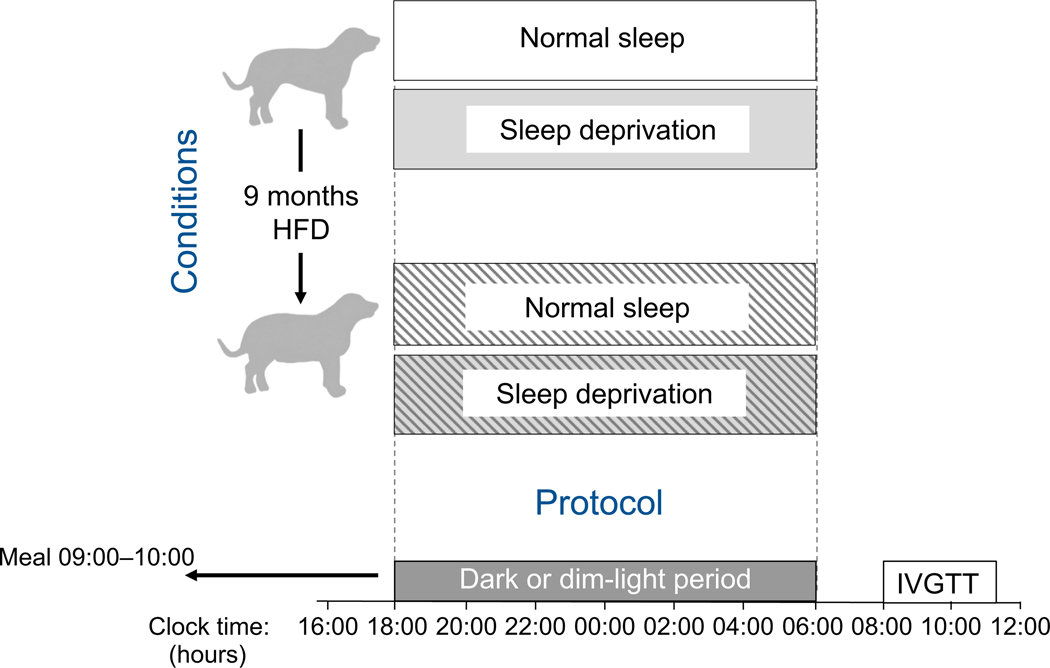
Methods: This study examined the effects of one night of total sleep deprivation on insulin sensitivity and beta cell function, as assessed by an IVGTT, before and after 9 months of high-fat feeding in a canine model.
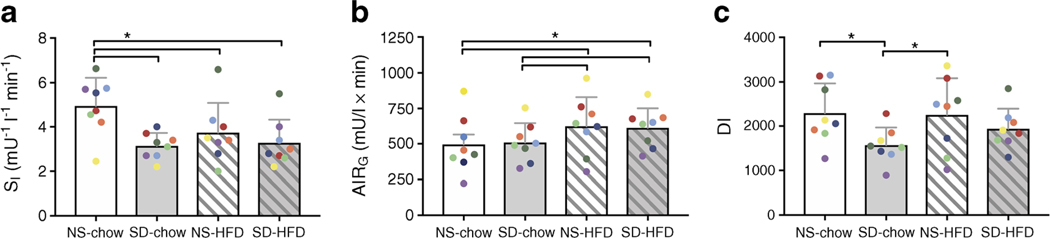
Results: One night of total sleep deprivation in lean dogs impaired insulin sensitivity to a similar degree as a chronic high-fat diet (HFD)(normal sleep: 4.95 ± 0.45 mU-1 l-1 min-1; sleep deprivation: 3.14 ± 0.21 mU-1 l-1 min-1; HFD: 3.74 ± 0.48 mU-1 l-1 min-1; mean ± SEM). Hyperinsulinaemic compensation was induced by the chronic HFD, suggesting adequate beta cell response to high-fat feeding. In contrast, there was no beta cell compensation after one night of sleep deprivation, suggesting that there was metabolic dysregulation with acute sleep loss that, if sustained during chronic sleep loss, could contribute to the risk of type 2 diabetes. After chronic high-fat feeding, acute total sleep deprivation did not cause further impairments in insulin sensitivity (sleep deprivation + chronic HFD: 3.28 mU-1 l-1 min-1).
Conclusions/interpretation: Our findings provide further evidence that sleep is important for metabolic health and establish a diurnal animal model of metabolic disruption during insufficient sleep.
Keywords: Canine; Diabetes; Diet; Dog; Fat; Glucose; Insulin; Obesity; Sleep.
Figures
References
Publication types
MeSH terms
Substances
Grants and funding
LinkOut - more resources
Full Text Sources
Research Materials
Miscellaneous
