


The Effect of the APOE ε2ε4 Genotype on the Development of Alzheimer's Disease (AD) and Mild Cognitive Impairment (MCI) in Non-Latino Whites
- PMID: 32017008
- PMCID: PMC7482099
- DOI: 10.1111/jgs.16337
The Effect of the APOE ε2ε4 Genotype on the Development of Alzheimer's Disease (AD) and Mild Cognitive Impairment (MCI) in Non-Latino Whites
Abstract
Objectives: To examine the associations of APOE ε2ε4 with the development of Alzheimer's disease (AD) and mild cognitive impairment (MCI) in non-Latino whites.
Design: Prospective longitudinal cohort study.
Setting: Uniform Data Set from the National Alzheimer's Coordinating Center (NACC) between 2005 and August 2018 (data freeze in September 2018).
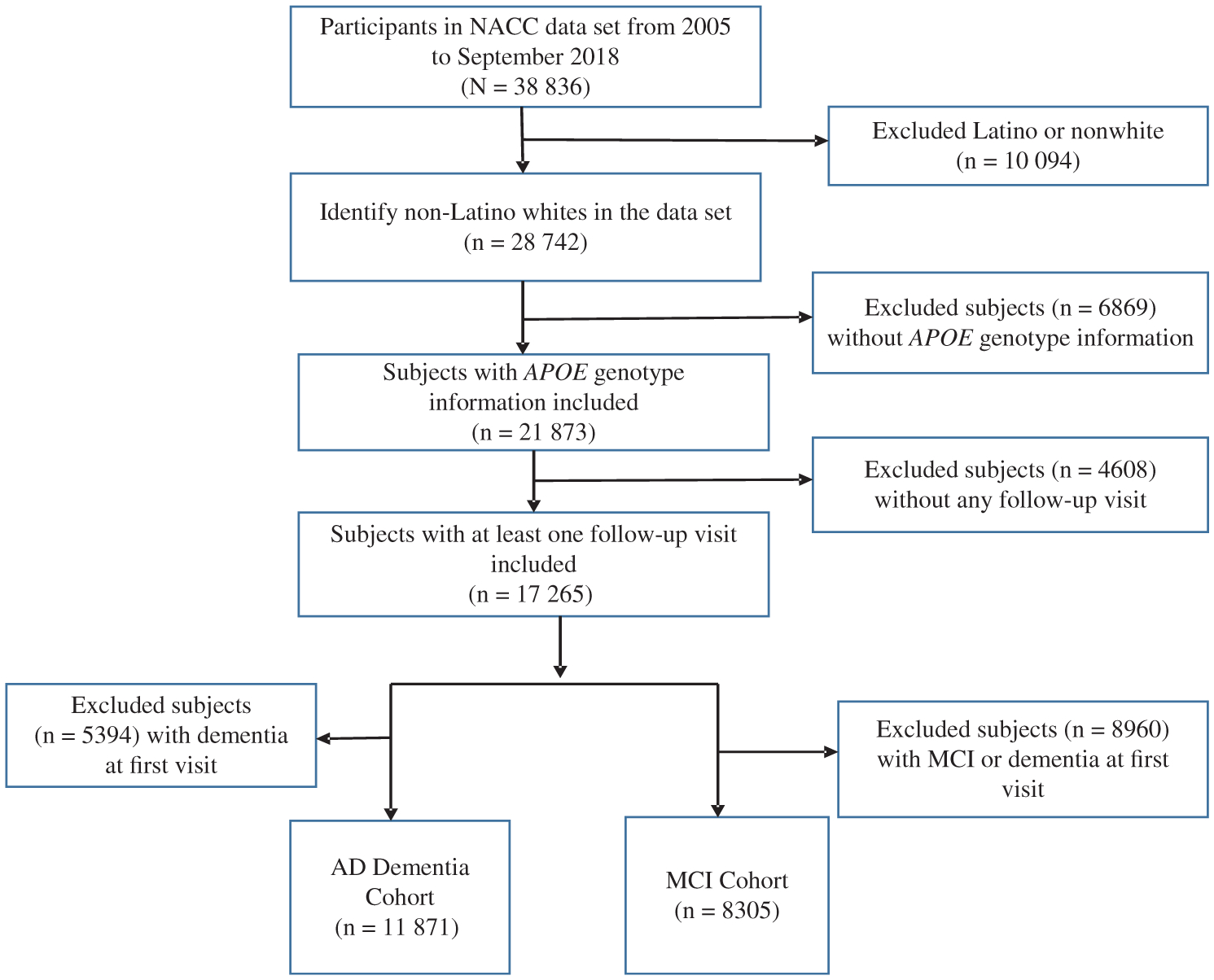
Participants: Participants who were non-Latino white, had an APOE genotype available, first visit with dementia free for AD cohort and both dementia and MCI free for MCI cohort, and had a minimum of one follow-up visit (n = 11 871 for AD cohort, and n = 8305 for MCI cohort).
Measurements: The incidences of AD and MCI were determined based on consensus meetings at each Alzheimer's disease center. We used NACC-derived variables to define individuals experiencing incidents of AD and MCI at the initial visit as well as the follow-up visits.
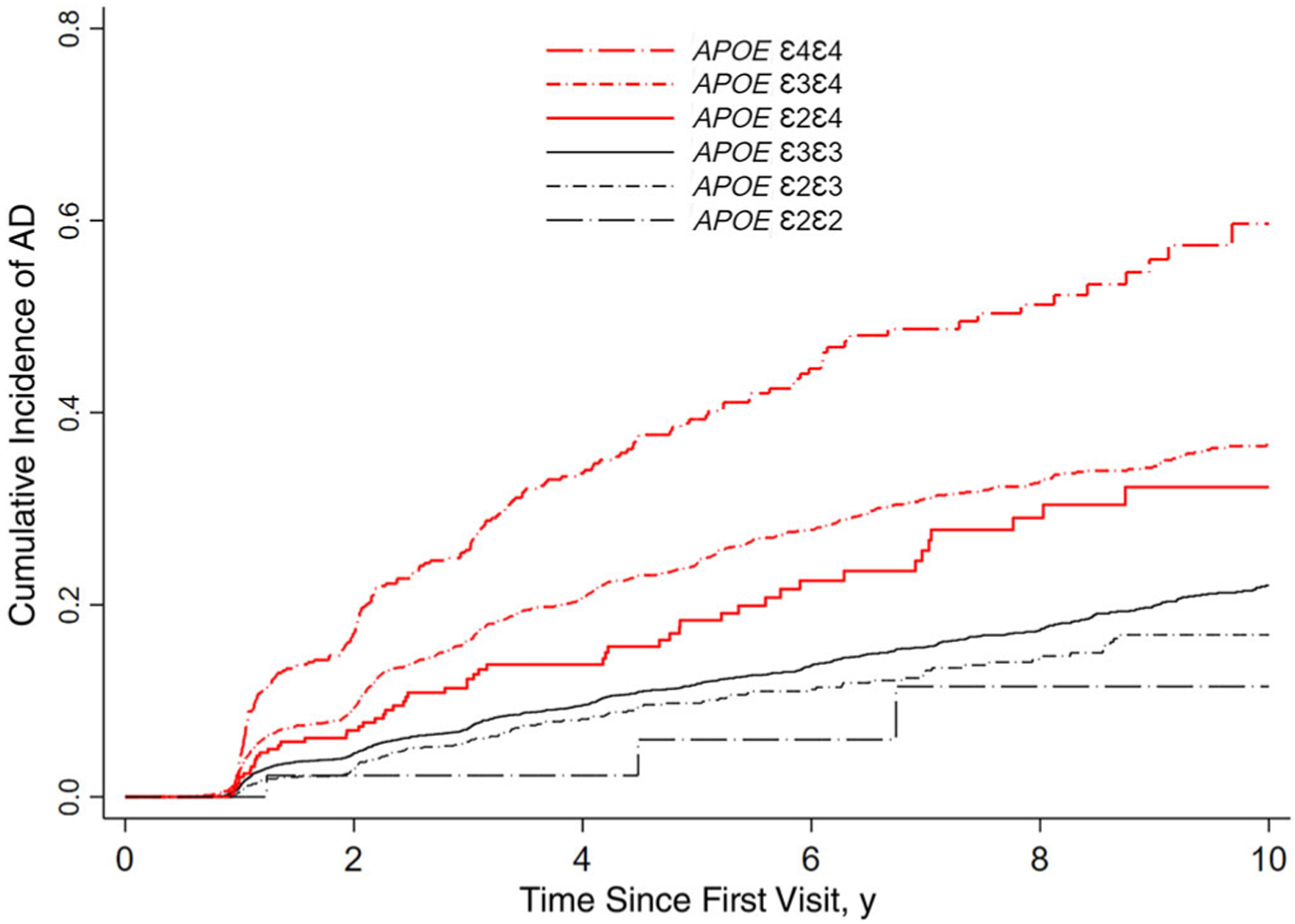
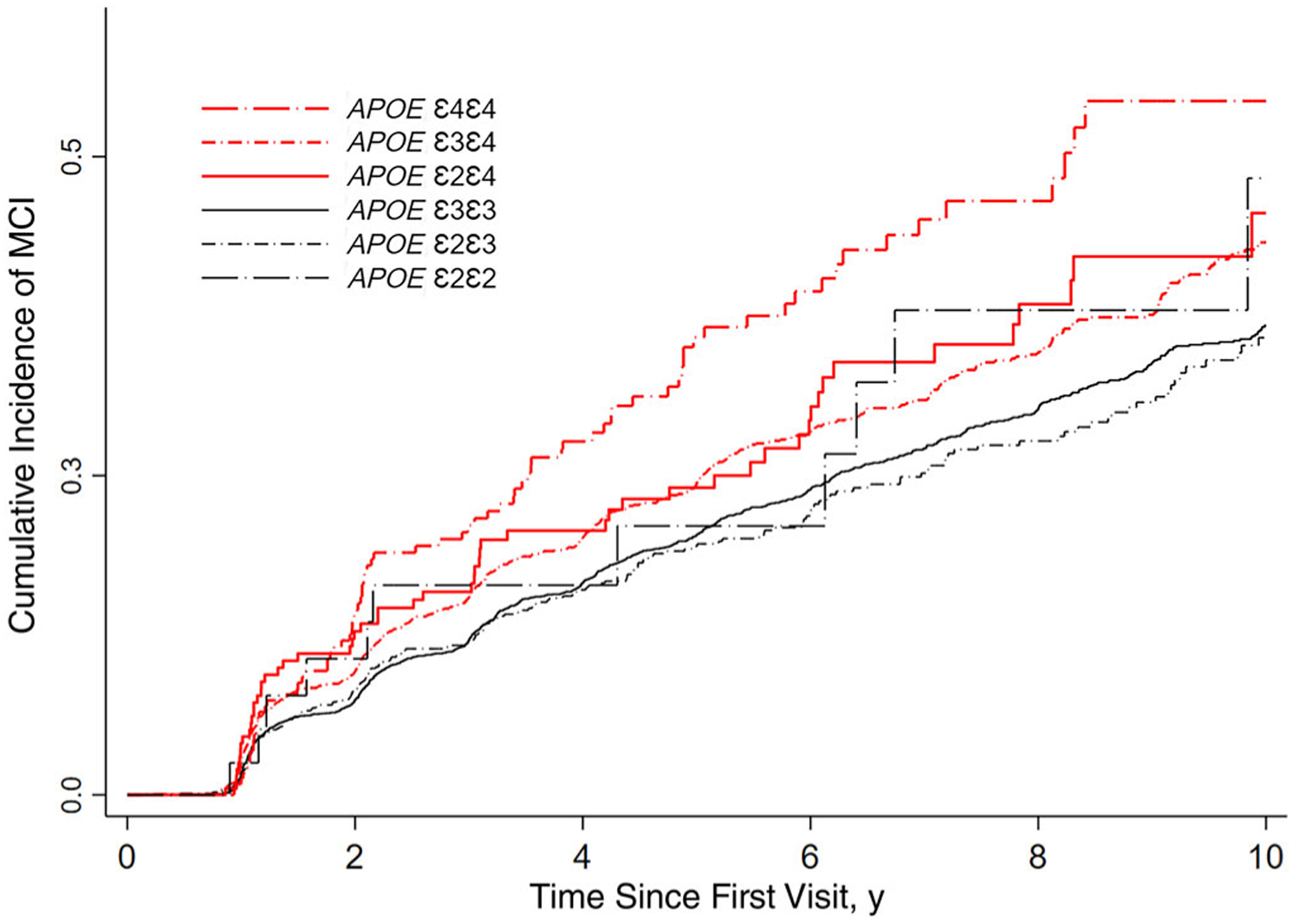
Results: Among participants in the AD cohort (N = 11 871), ε2ε4 accounted for 2.5%, ε2ε2 accounted for 0.4%, ε2ε3 accounted for 11.0%, ε4ε4 accounted for 4.4%, ε3ε4 accounted for 27.3%, and ε3ε3 accounted for 54.4%. Over an average of 4.6 years follow-up, 1857 (15.6%) developed AD dementia, with the range from 6.0% to 35.2% across the six groups. Compared to ε3ε3 carriers, ε2ε4 carriers exhibited an increased risk of incident AD (18.4% vs 11.7%; adjusted hazard ratio [aHR] = 1.74; 95% confidence interval [CI] = 1.32-2.30; P < .0001). Among participants in the MCI cohort (N = 8305), the average follow-up was 4.7 years, and 1912 (23.0%) developed MCI, with the range from 20.4% to 33.9% across the six groups. Compared to ε3ε3 carriers, ε2ε4 carriers exhibited an increased risk of incident MCI (27.5% vs 21.5%; aHR = 1.52; 95% CI = 1.15-1.99; P = .003).
Conclusions: The APOE ε2ε4 genotype is associated with the increased risk of AD and MCI in non-Latino whites. J Am Geriatr Soc 68:1044-1049, 2020.
Keywords: APOE ε2ε4 genotype; Alzheimerʼs disease; mild cognitive impairment.
© 2020 The American Geriatrics Society.
Conflict of interest statement
Figures
References
-
- Saunders AM, Strittmatter WJ, Schmechel D, et al. Association of apolipoprotein E allele epsilon 4 with late-onset familial and sporadic Alzheimerʼs disease. Neurology. 1993;43(8):1467–1472. - PubMed
-
- Strittmatter WJ, Roses AD, Apolipoprotein E. Alzheimerʼs disease. Annu Rev Neurosci. 1996;19:53–77. - PubMed
-
- Seshadri S, Drachman DA, Lippa CF. Apolipoprotein E epsilon 4 allele and the lifetime risk of Alzheimerʼs disease: what physicians know, and what they should know. Arch Neurol. 1995;52(11):1074–1079. - PubMed
Publication types
MeSH terms
Substances
Grants and funding
- and P50 AG047270/AG/NIA NIH HHS/United States
- P50 AG005142/AG/NIA NIH HHS/United States
- P30 AG010133/AG/NIA NIH HHS/United States
- P30 AG008017/AG/NIA NIH HHS/United States
- P30 AG010161/AG/NIA NIH HHS/United States
- P50 AG025688/AG/NIA NIH HHS/United States
- P30 AG062422-01/AG/NIA NIH HHS/United States
- P50 AG005133/AG/NIA NIH HHS/United States
- P50 AG005138/AG/NIA NIH HHS/United States
- P30 AG062428-01/AG/NIA NIH HHS/United States
- P50 AG047366/AG/NIA NIH HHS/United States
- P30 AG019610/AG/NIA NIH HHS/United States
- P30 AG028383/AG/NIA NIH HHS/United States
- P30 AG062421-01/AG/NIA NIH HHS/United States
- P30 AG013854/AG/NIA NIH HHS/United States
- P30 AG053760/AG/NIA NIH HHS/United States
- P30 AG066444/AG/NIA NIH HHS/United States
- P30 AG062428/AG/NIA NIH HHS/United States
- P30 AG010124/AG/NIA NIH HHS/United States
- P50 AG023501/AG/NIA NIH HHS/United States
- P50 AG005146/AG/NIA NIH HHS/United States
- U24 AG072122/AG/NIA NIH HHS/United States
- P30 AG062421/AG/NIA NIH HHS/United States
- P30 AG035982/AG/NIA NIH HHS/United States
- P50 AG008702/AG/NIA NIH HHS/United States
- U01 AG016976/AG/NIA NIH HHS/United States
- P30 AG062715-01/AG/NIA NIH HHS/United States
- P30 AG008051/AG/NIA NIH HHS/United States
- P50 AG005681/AG/NIA NIH HHS/United States
- P30 AG013846/AG/NIA NIH HHS/United States
- P50 AG047270/AG/NIA NIH HHS/United States
- P30 AG062429/AG/NIA NIH HHS/United States
- P50 AG005136/AG/NIA NIH HHS/United States
- P30 AG049638/AG/NIA NIH HHS/United States
- P30 AG012300/AG/NIA NIH HHS/United States
- P30 AG062422/AG/NIA NIH HHS/United States
- P50 AG016573/AG/NIA NIH HHS/United States
- P50 AG047266/AG/NIA NIH HHS/United States
- P30 AG062429-01/AG/NIA NIH HHS/United States
- P30 AG062715/AG/NIA NIH HHS/United States
- P30 AG066468/AG/NIA NIH HHS/United States
- P30 AG010129/AG/NIA NIH HHS/United States
LinkOut - more resources
Full Text Sources
Medical
Miscellaneous
