


Frequent emergency department use by older adults with ambulatory care sensitive conditions: A population-based cohort study
- PMID: 32017348
- PMCID: PMC7187263
- DOI: 10.1111/ggi.13875
Frequent emergency department use by older adults with ambulatory care sensitive conditions: A population-based cohort study
Abstract
Aim: To identify factors associated with frequent emergency department (ED) use among older adults with ambulatory care sensitive conditions.
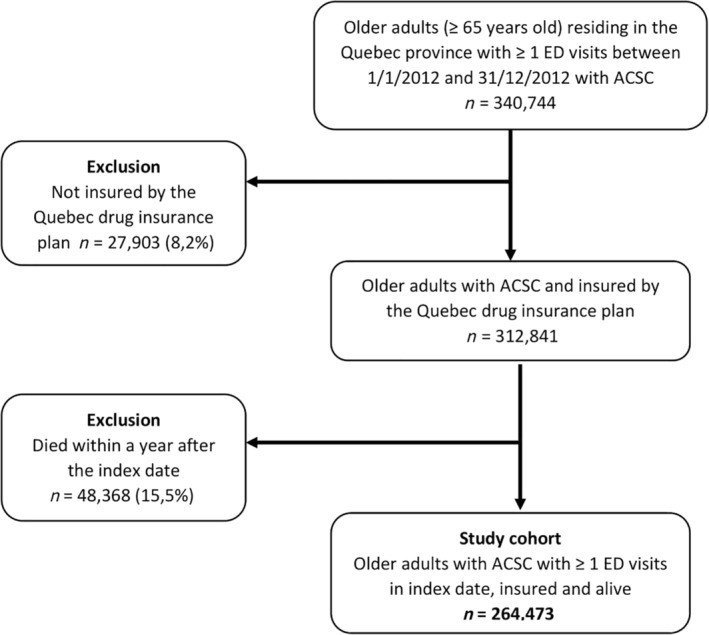
Methods: This was a retrospective cohort study using databases from the Régie de l'assurance maladie du Québec. We included community-dwelling individuals aged ≥65 years in the Province of Quebec (Canada), who consulted in ED at least once between 2012 and 2013 (index period), and were diagnosed with at least one ambulatory care sensitive condition in the 2 years preceding and including the index date (n = 264 473). We used a multivariate logistic regression model to evaluate the association between independent variables and being a frequent geriatric ED user, defined as four or more visits during the year after the index date.
Results: Out of the total study population, 17 332 (6.6%) individuals were considered frequent ED users in the year after the index date, accounting for 38% of ED uses for this period. The main variables associated with frequent geriatric ED use were older age, presence of chronic obstructive pulmonary disorder or diabetes, higher comorbidity index, common mental health disorders, polypharmacy, higher number of past ED and specialist visits, rural residence, and higher material and social deprivation. Dementia was inversely associated with frequent ED use.
Conclusions: Frequent geriatric ED users constitute a complex population whose characteristics need to be managed thoroughly in order to enhance the quality and efficiency of their care. Further studies should address their description in administrative databases so as to combine self-perceived and professionally evaluated variables. Geriatr Gerontol Int 2020; 20: 317-323.
Keywords: administrative database; aged; ambulatory care sensitive conditions; emergency; frequent use.
© 2020 The Authors. Geriatrics & Gerontology International published by John Wiley & Sons Australia, Ltd on behalf of Japan Geriatrics Society.
Figures
References
-
- Carpenter CR, Shelton E, Fowler S et al Risk factors and screening instruments to predict adverse outcomes for undifferentiated older emergency department patients: a systematic review and meta‐analysis. Acad Emerg Med 2015; 22: 1–21. - PubMed
-
- Chukmaitov AS, Tang A, Carretta HJ, Menachemi N, Brooks RG. Characteristics of all, occasional, and frequent emergency department visits due to ambulatory care – sensitive conditions in Florida. J Ambul Care Manage 2012; 35: 149–158. - PubMed
MeSH terms
Grants and funding
LinkOut - more resources
Full Text Sources
Medical
Miscellaneous
