Review
. 2020 Jan 30;12(2):320.
doi: 10.3390/cancers12020320.

The Non-Coding RNA Landscape of Plasma Cell Dyscrasias

Affiliations
Review

The Non-Coding RNA Landscape of Plasma Cell Dyscrasias

Eugenio Morelli et al. Cancers (Basel). .

Abstract

Despite substantial advancements have been done in the understanding of the pathogenesis of plasma cell (PC) disorders, these malignancies remain hard-to-treat. The discovery and subsequent characterization of non-coding transcripts, which include several members with diverse length and mode of action, has unraveled novel mechanisms of gene expression regulation often malfunctioning in cancer. Increasing evidence indicates that such non-coding molecules also feature in the pathobiology of PC dyscrasias, where they are endowed with strong therapeutic and/or prognostic potential. In this review, we aim to summarize the most relevant findings on the biological and clinical features of the non-coding RNA landscape of malignant PCs, with major focus on multiple myeloma. The most relevant classes of non-coding RNAs will be examined, along with the mechanisms accounting for their dysregulation and the recent strategies used for their targeting in PC dyscrasias. It is hoped these insights may lead to clinical applications of non-coding RNA molecules as biomarkers or therapeutic targets/agents in the near future.

Keywords: lncRNA; miRNA; multiple myeloma; non-coding RNA; plasma cell dyscrasia.


Conflict of interest statement

The authors declare no conflict of interest. The funders had no role in the design of the study; in the collection, analyses or interpretation of data; in the writing of the manuscript, or in the decision to publish the results.

Figures
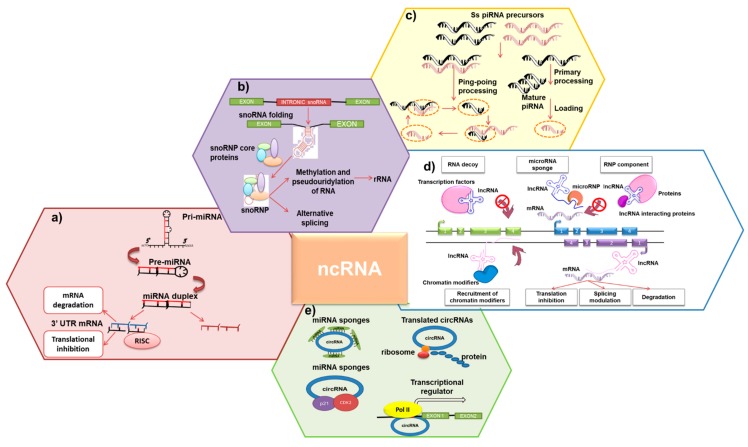
Figure 1
Figure 1
Molecular features and mechanism of action of the different ncRNA classes. (a) After being transcribed in the nucleus from a primary-miRNA (pri-miRNA), precursor miRNAs (pre-miRNAs) are exported by exportin 5 in the cytoplasm and processed by Dicer, which generates mature miRNAs, then loaded into the RNA-induced silencing complex (RISC). miRNAs function through degradation of protein-coding transcripts or translational repression. (b) Mature snoRNAs generated by splicing, debranching and trimming are either exported from the nucleus, where they regulate ribosomal RNA (rRNA) processing, or remain in the nucleus, where they can regulate alternative splicing. (c) piRNAs are expressed as single stranded RNAs (ss piRNAs) or produced through a secondary amplification loop. The PIWI ribonucleoprotein (piRNP) complex functions in transposon repression through target degradation and epigenetic silencing. (d) LncRNAs can modify gene expression by multiple mechanisms: they can act as decoy of transcription factors, sponge for miRNAs, regulators of splicing, recruiters of chromatin modifier complexes or modulate mRNA stability. (e) circRNAs can bind miRNAs acting as a sponge to regulate downstream transcription, or can enhance the expression of host genes by improving the activity of Pol II in the nucleus. Part of the circRNA can also encode peptides or proteins.
Figure 2
Figure 2
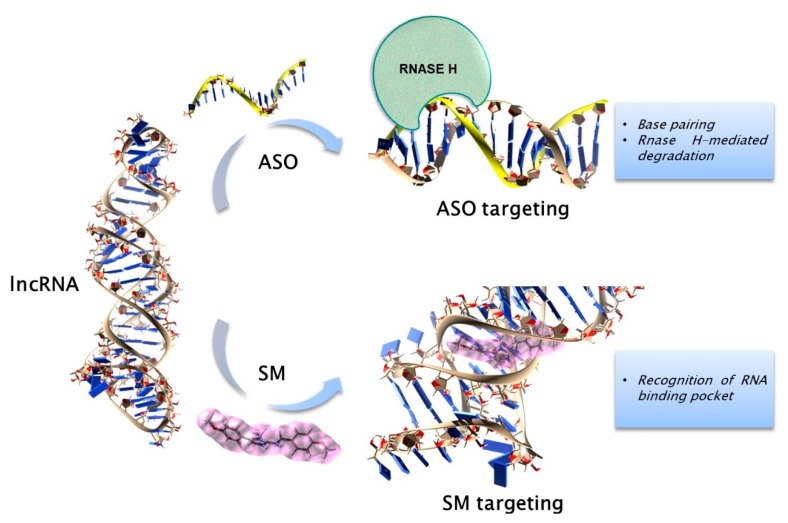
Strategies for lncRNA targeting. The picture reports, as a representative model, the triple helix region of the lncRNA MALAT1, which can be targeted or by LNA gapmeR ASO, that binds the lncRNA by perfect complementarity and triggers the RNAse H-mediated degradation (upper part), or by an SM designed to specifically recognize an RNA binding pocket (bottom part).

References

    1. Beason T.S., Chang S.H., Sanfilippo K.M., Luo S., Colditz G.A., Vij R., Tomasson M.H., Dipersio J.F., Stockerl-Goldstein K., Ganti A., et al. Influence of body mass index on survival in veterans with multiple myeloma. Oncologist. 2013;18:1074–1079. doi: 10.1634/theoncologist.2013-0015. - DOI - PMC - PubMed

    1. Morris E.V., Edwards C.M. Adipokines, adiposity, and bone marrow adipocytes: Dangerous accomplices in multiple myeloma. J. Cell Physiol. 2018;233:9159–9166. doi: 10.1002/jcp.26884. - DOI - PubMed
    1. Kyle R.A., Larson D.R., Therneau T.M., Dispenzieri A., Kumar S., Cerhan J.R., Rajkumar S.V. Long-Term Follow-up of Monoclonal Gammopathy of Undetermined Significance. N Engl. J. Med. 2018;378:241–249. doi: 10.1056/NEJMoa1709974. - DOI - PMC - PubMed
    1. Multiple myeloma: 2018 update on diagnosis, risk-stratification, and management. Am. J. Hematol. 2018;93:981–1114. doi: 10.1002/ajh.25117. - DOI - PMC - PubMed
    1. Wadhera R.K., Rajkumar S.V. Prevalence of monoclonal gammopathy of undetermined significance: A systematic review. Mayo Clin. Proc. 2010;85:933–942. doi: 10.4065/mcp.2010.0337. - DOI - PMC - PubMed