


Not in My Backyard: Public Perceptions of Wildlife and 'Pest Control' in and around UK Homes, and Local Authority 'Pest Control'
- PMID: 32019151
- PMCID: PMC7071040
- DOI: 10.3390/ani10020222
Not in My Backyard: Public Perceptions of Wildlife and 'Pest Control' in and around UK Homes, and Local Authority 'Pest Control'
Erratum in
-
Erratum: Baker, S.E.; Maw, S.A.; Johnson P.J.; Macdonald, D.W. Not in My Backyard: Public Perceptions of Wildlife and 'Pest Control' in and around UK Homes, and Local Authority 'Pest Control'.Animals (Basel). 2020 Apr 8;10(4):644. doi: 10.3390/ani10040644. Animals (Basel). 2020. PMID: 32276481 Free PMC article.
Abstract
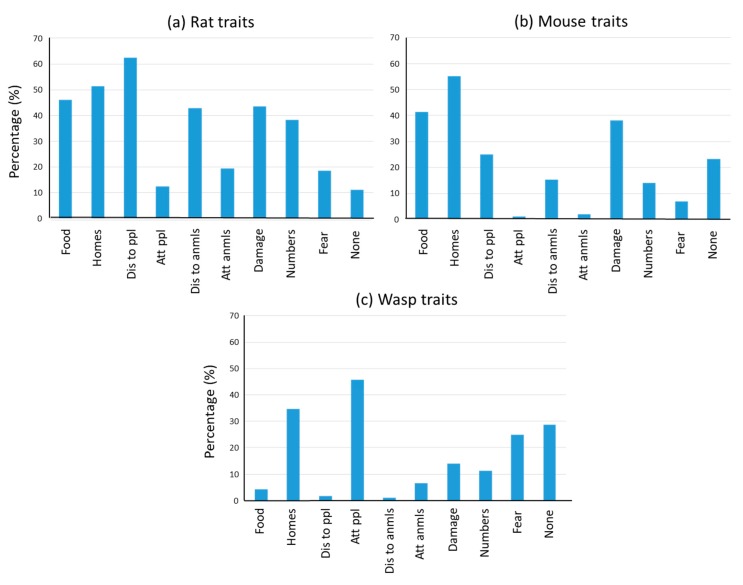
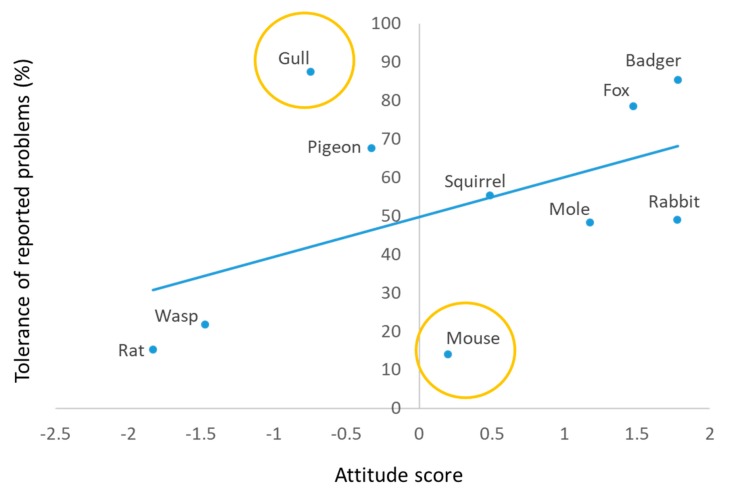
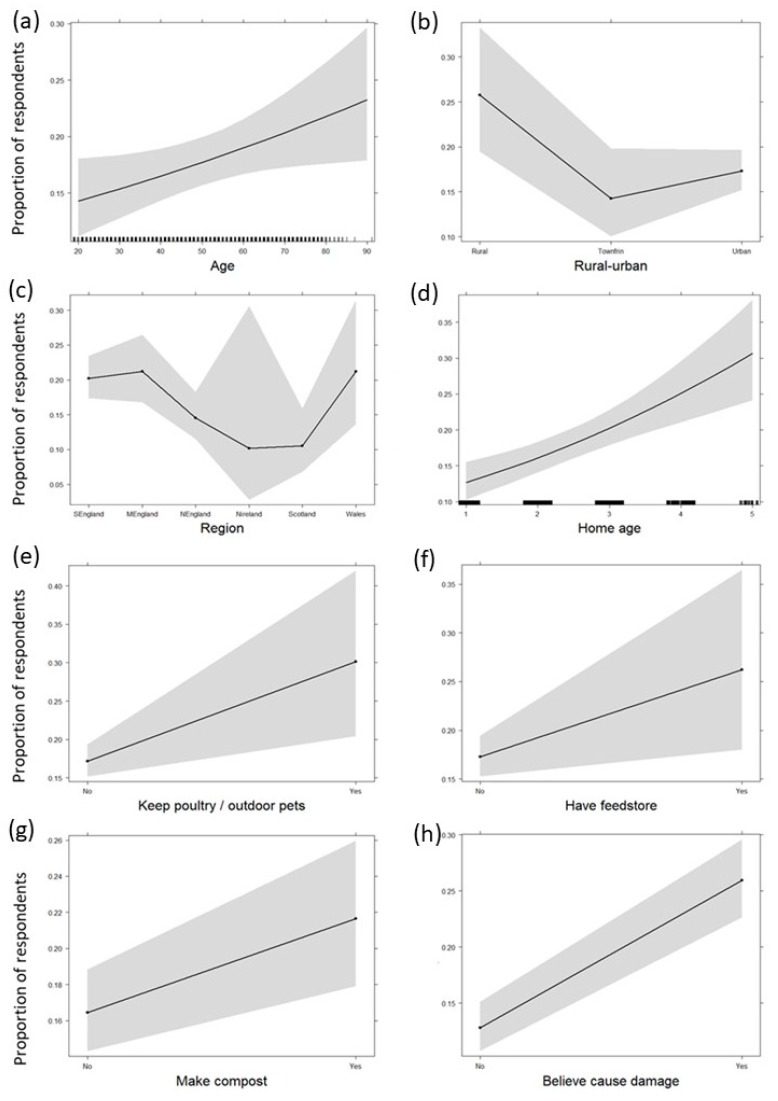
Human-wildlife conflict occurs globally. Attempts to control 'pest' wildlife involve killing and harming the welfare of animals on a vast scale. We examined public perceptions of 10 wildlife species/groups and wildlife management, in and around UK homes, and public authority 'pest control' provision, in an effort to identify ethical, welfare-friendly ways to reduce conflict. Most people reported never having problems with each of the 10 species, and reported problems for some species were largely tolerated. Wasps, mice, and rats were the most frequently problematic species, the least tolerated, and those for which local authorities most often offered pest control services. Do-It-Yourself pest control was preferred over professional control, except for with wasps. People wanted control to be quick, lasting, and safe for people and non-target animals. Where people accepted lethal control, they were nevertheless concerned for animal welfare. Drivers of pest status were complex, while drivers of demand for control were fewer and species-specific. Local authority pest control provision increased over the four years studied, but only half of councils offered advice on preventing/deterring wildlife; this advice was patchy and variable in quality. Greater focus is required on preventing/deterring rather than controlling wildlife problems. Councils should provide standardised, comprehensive advice on prevention/deterrence and prevention/deterrence services.
Keywords: attitudes; mouse; pest; pest control; rat; tolerance; vermin; wasp; wildlife; wildlife management.
Conflict of interest statement
The authors declare no conflict of interest. SB received funding from Humane Society International UK and the Elinor Patterson-Baker Trust, and SM worked as a consultant for Humane Society International UK during this research. The funders had no other role in the design of the study; in the collection, analyses, or interpretation of data; in the writing of the manuscript, or in the decision to publish the results.
Figures







References
-
- Sillero-Zubiri C., Sukumar R., Treves A. Living with wildlife: The roots of conflict and the solutions. In: Macdonald D.W., Service K., editors. Key Topics in Conservation Biology. Blackwell Scientific; Oxford, UK: 2007. pp. 253–270.
-
- Inskip C., Zimmermann A. Review of human-felid conflict: A review of patterns and priorities worldwide. Oryx. 2009;43:18–34. doi: 10.1017/S003060530899030X. - DOI
-
- Mayberry A.L., Hovorka A.J., Evans K.E. Well-Being Impacts of Human-Elephant Conflict in Khumaga, Botswana: Exploring Visible and Hidden Dimensions. Conserv. Soc. 2017;15:280–291. doi: 10.4103/cs.cs_16_132. - DOI
-
- Langton S.D., Cowan D.P., Meyer A.N. The occurrence of commensal rodents in dwellings as revealed by the 1996 English House Condition Survey. J. Appl. Ecol. 2001;38:699–709. doi: 10.1046/j.1365-2664.2001.00631.x. - DOI
Grants and funding
LinkOut - more resources
Full Text Sources
