


Plasma Ceramides and Sphingomyelins in Relation to Atrial Fibrillation Risk: The Cardiovascular Health Study
- PMID: 32019406
- PMCID: PMC7070192
- DOI: 10.1161/JAHA.119.012853
Plasma Ceramides and Sphingomyelins in Relation to Atrial Fibrillation Risk: The Cardiovascular Health Study
Abstract
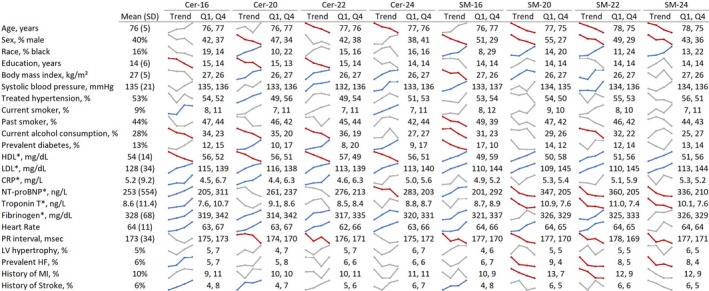
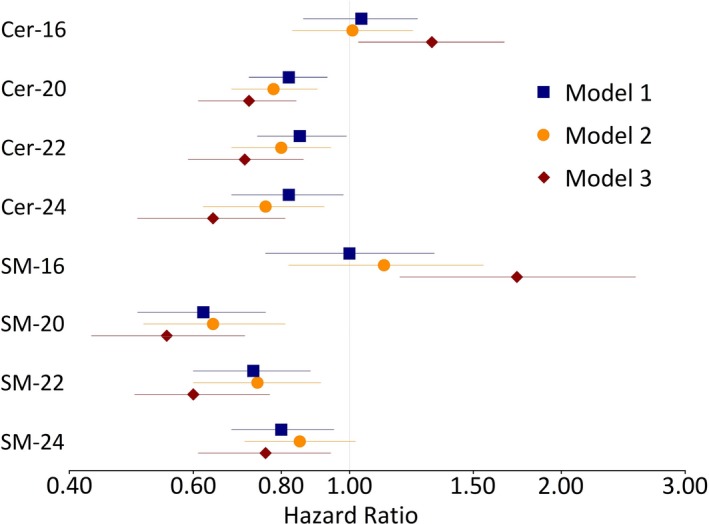
Background Ceramides exhibit multiple biological activities that may influence the pathophysiological characteristics of atrial fibrillation (AF). Whether the length of the saturated fatty acid carried by the ceramide or their sphingomyelin precursors are associated with AF risk is not known. Methods and Results Among 4206 CHS (Cardiovascular Health Study) participants (mean age, 76 years; 40% men) who were free of prevalent AF at baseline, we identified 1198 incident AF cases over a median 8.7 years of follow-up. We examined 8 sphingolipid species: ceramide and sphingomyelin species with palmitic acid and species with very-long-chain saturated fatty acids: arachidic; behenic; and lignoceric. In adjusted Cox regression analyses, ceramides and sphingomyelins with very-long-chain saturated fatty acids were associated with reduced AF risk (ie, per 2-fold higher ceramide with behenic acid hazard ratio, 0.71; 95% CI, 0.59-0.86; sphingomyelin with behenic acid hazard ratio, 0.60; 95% CI, 0.46-0.77). In contrast, ceramides and sphingomyelins with palmitic acid were associated with increased AF risk (ceramide with palmitic acid hazard ratio, 1.31; 95% CI, 1.03-1.66; sphingomyelin with palmitic acid hazard ratio, 1.73; 95% CI, 1.18-2.55). Associations were attenuated with adjustment for NT-proBNP (N-terminal pro-B-type natriuretic peptide), but did not differ significantly by age, sex, race, body mass index, or history of coronary heart disease. Conclusions Our findings suggest that several ceramide and sphingomyelin species are associated with incident AF, and that these associations differ on the basis of the fatty acid. Ceramides and sphingomyelins with palmitic acid were associated with increased AF risk, whereas ceramides and sphingomyelins with very-long-chain saturated fatty acids were associated with reduced AF risk.
Keywords: atrial fibrillation; biomarker; epidemiology; lipid metabolites; lipids.
Figures
References
-
- Miyasaka Y, Barnes ME, Gersh BJ, Cha SS, Bailey KR, Abhayaratna WP, Seward JB, Tsang TS. Secular trends in incidence of atrial fibrillation in Olmsted County, Minnesota, 1980 to 2000, and implications on the projections for future prevalence. Circulation. 2006;114:119–125. - PubMed
-
- Benjamin EJ, Blaha MJ, Chiuve SE, Cushman M, Das SR, Deo R, de Ferranti SD, Floyd J, Fornage M, Gillespie C, Isasi CR, Jimenez MC, Jordan LC, Judd SE, Lackland D, Lichtman JH, Lisabeth L, Liu S, Longenecker CT, Mackey RH, Matsushita K, Mozaffarian D, Mussolino ME, Nasir K, Neumar RW, Palaniappan L, Pandey DK, Thiagarajan RR, Reeves MJ, Ritchey M, Rodriguez CJ, Roth GA, Rosamond WD, Sasson C, Towfighi A, Tsao CW, Turner MB, Virani SS, Voeks JH, Willey JZ, Wilkins JT, Wu JH, Alger HM, Wong SS, Muntner P; American Heart Association Statistics Committee and Stroke Statistics Subcommittee . Heart disease and stroke statistics‐2017 update: a report from the American Heart Association. Circulation. 2017;135:e146–e603. - PMC - PubMed
-
- Gulbins E, Li PL. Physiological and pathophysiological aspects of ceramide. Am J Physiol Regul Integr Comp Physiol. 2006;290:R11–R26. - PubMed
-
- Nattel S. Molecular and cellular mechanisms of atrial fibrosis in atrial fibrillation. JACC Clin Electrophysiol. 2017;3:425–435. - PubMed
-
- Burstein B, Nattel S. Atrial fibrosis: mechanisms and clinical relevance in atrial fibrillation. J Am Coll Cardiol. 2008;51:802–809. - PubMed
Publication types
MeSH terms
Substances
Grants and funding
- N01HC85080/HL/NHLBI NIH HHS/United States
- R01 AG023629/AG/NIA NIH HHS/United States
- HHSN268201200036C/HL/NHLBI NIH HHS/United States
- U01 HL130114/HL/NHLBI NIH HHS/United States
- N01HC85082/HL/NHLBI NIH HHS/United States
- N01HC55222/HL/NHLBI NIH HHS/United States
- N01HC85086/HL/NHLBI NIH HHS/United States
- P30 DK035816/DK/NIDDK NIH HHS/United States
- HHSN268200800007C/HL/NHLBI NIH HHS/United States
- N01HC85081/HL/NHLBI NIH HHS/United States
- R01 HL128575/HL/NHLBI NIH HHS/United States
- HHSN268201800001C/HL/NHLBI NIH HHS/United States
- U01 HL080295/HL/NHLBI NIH HHS/United States
- N01HC85079/HL/NHLBI NIH HHS/United States
- N01HC85083/HL/NHLBI NIH HHS/United States
LinkOut - more resources
Full Text Sources
Medical
Research Materials
