. 2020 Feb 4;19(1):23.
doi: 10.1186/s12943-019-1129-5.

circRIP2 accelerates bladder cancer progression via miR-1305/Tgf-β2/smad3 pathway

Affiliations

circRIP2 accelerates bladder cancer progression via miR-1305/Tgf-β2/smad3 pathway

Yinjie Su et al. Mol Cancer. .

Erratum in

Abstract

Background: Increasing evidences indicate that circular RNAs exert critical function in regulating bladder cancer progression. However, the expressive patterns and roles of circular RNAs in bladder cancer remain less investigated.

Methods: circRIP2 was identified and evaluated by RNA-sequencing and qPCR; in vitro effects of circRIP2 were determined by CCK8, clone forming, wound healing and trans-well assays; while mice subcutaneous tumor model was designed for in vivo analysis. Western blot, RNA pulldown assay, miRNA capture and dual luciferase assessment were applied for mechanistic studies.

Results: circRIP2 was identified as a conserved and dramatically repressed circular RNA in bladder cancer. Patients that displayed higher circRIP2 expression negatively associate with the grade, stage, metastasis as well as outcome of bladder cancer. In vitro and in vivo studies suggest that circRIP2 enables to promote bladder cancer progression via inducing EMT. Regarding the mechanism, we performed RNA-sequencing analysis, RNA pulldown with biotin-labeled circRIP2-specific probe, dual luciferase reporter assay. It was found that circRIP2 enables to sponge miR-1305 to elevate Tgf-β2 in bladder cancer, and inducing EMT via Tgf-β2/smad3 pathway. Blocking Tgf-β2 in bladder cancer deprives circRIP2 induced cancer progression and EMT.

Conclusions: Taken together, our study provides the first evidence that circRIP2 expresses differentially in bladder cancer and negatively along with the cancer progression; effective circRIP2 activity accelerates bladder cancer progression via inducing EMT by activating miR-1305/Tgf-β2/smad3 pathway. The research implies that circRIP2 might be a potential biomarker and therapeutic target for bladder cancer patients.

Keywords: Bladder cancer; EMT; Tgf-β2; circRIP2; miR-1305.


Conflict of interest statement

The authors declare that they have no competing interest.

Figures
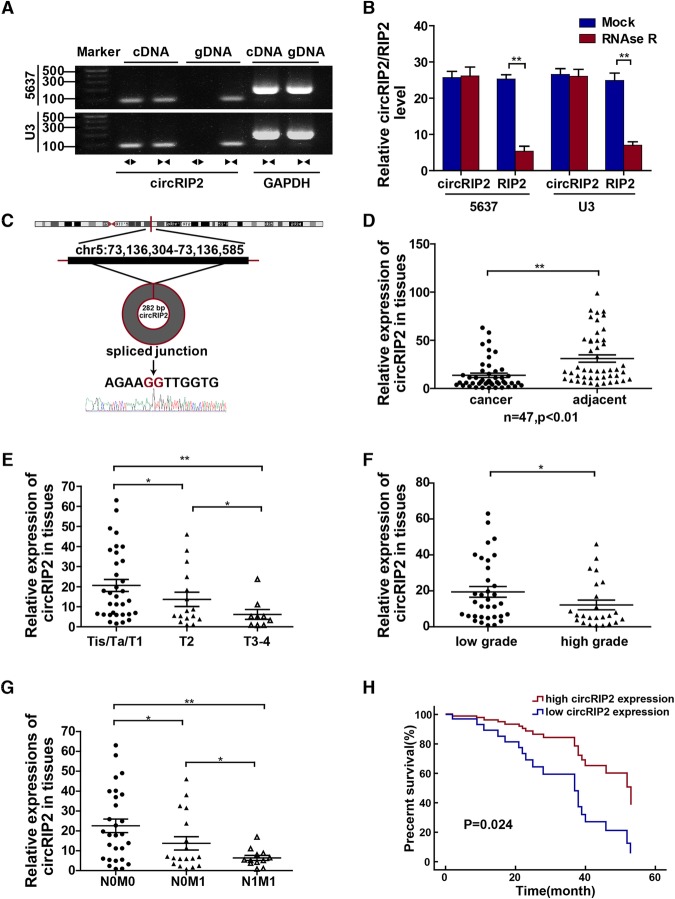
Fig. 1
Fig. 1
Higher circRIP2 level in bladder cancer associates with better outcome. Divergent (circRIP2, ◀▶) and convergent (RIP2, ▶◀) primers were designed; a To detect circRIP2 is circular RNA, agarose gel electrophoresis showed that circRIP2 was amplified by divergent primer in cDNA but not in gDNA. GAPDH was taken as negative control; b RNAse R treatment assay was performed, and only circRIP2 showed strong exonuclease resistance but not the RIP2; c sanger sequence of circRIP2; d qPCR was used to evaluate the expression of circRIP2 in 45 paired bladder cancer tissues; e circRIP2 level among 58 bladder cancer tissues was analyzed by T stages; f circRIP2 level among 58 bladder cancer tissues was analyzed by tumor grade; g circRIP2 level among 58 bladder cancer tissues was analyzed by metastasis; h circRIP2 level among 43 patients in following was analyzed for overall survival.
Fig. 2
Fig. 2
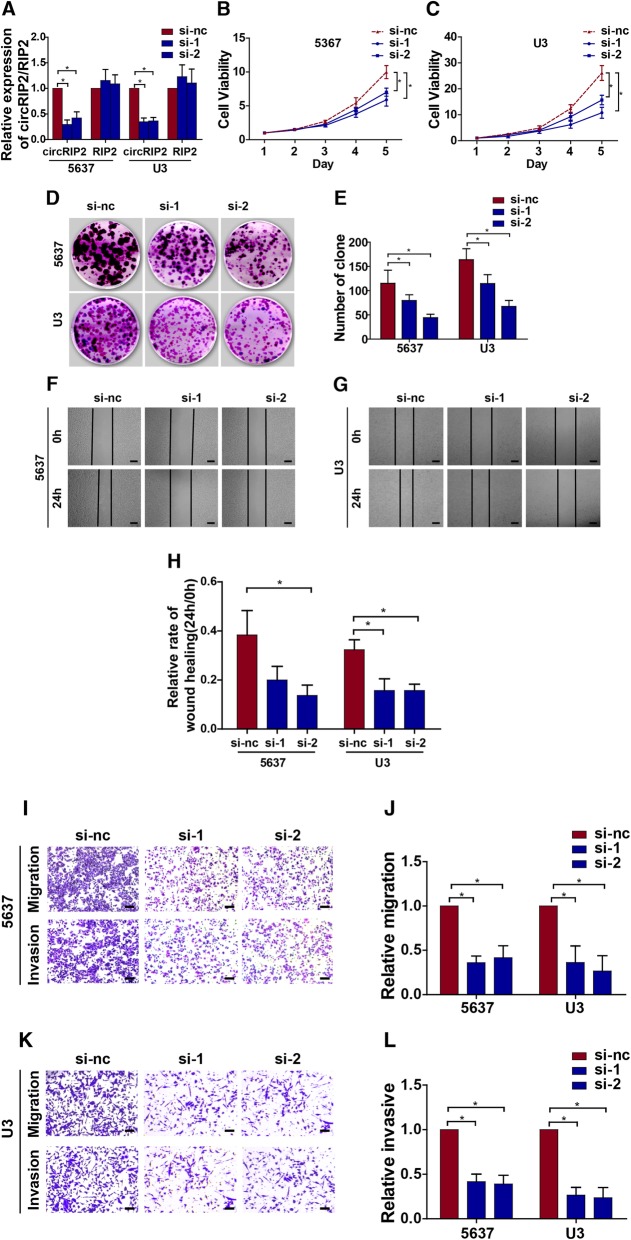
Silencing circRIP2 suppresses bladder cancer progression. circRIP2 silencing was performed by siRNAs interfering. a Level of circRIP2 in 5637 and U3 cells after siRNAs silencing were detected by qPCR. nc was taken as normal control; b, c CCK8 assay was performed to detect cell viability of bladder cancer cells; d, e. Cell potential to replicate and self-renew was reflected by clone formation; f, g, h Wound healing assay showed cell potential of migration; scale bar: 100 μm; i, j, k, l. Trans-well for migration and matrigel invasion assay showed cell potential of migration and invasion; scale bar: 25 μm.
Fig. 3
Fig. 3
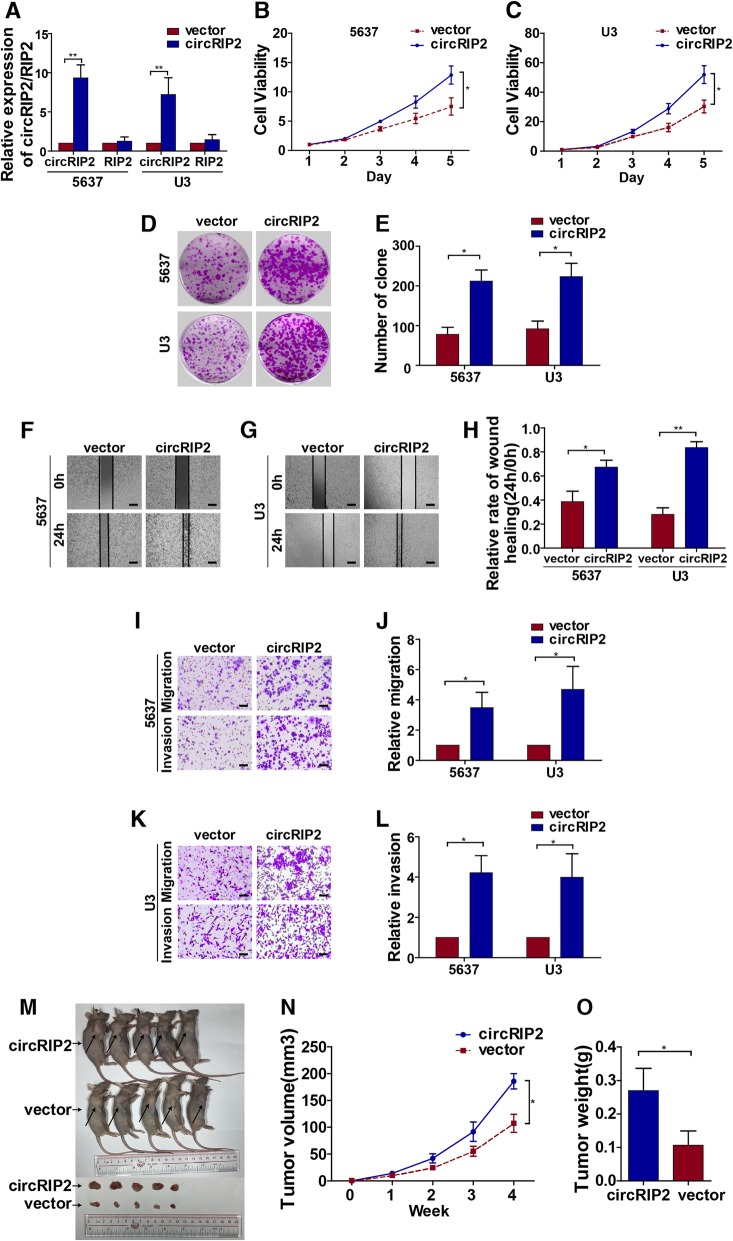
Over-expressing circRIP2 promotes bladder cancer progression. Bladder cancer cells that stably over-expressed circRIP2 was constructed. a Level of circRIP2 in 5637 and U3 cells after circRIP2 overexpression were detected by qPCR. Vector was taken as normal control; b, c. CCK8 assay was performed to detect cell viability of bladder cancer cells; d, e. Cell potential to replicate and self-renew were reflected by clone formation assay; f, g, h. Rate of wound healing assay showed cell potential of migration; scale bar: 100 μm; i, j, k, l Trans-well migration and matrigel invasion assay showed cell potential of migration and invasion; scale bar: 25 μm; m, n, o Over-expressed circRIP2 bladder cancer cells were injected subcutaneously to detect in vivo effect of circRIP2. n = 5 mice for each group.
Fig. 4
Fig. 4
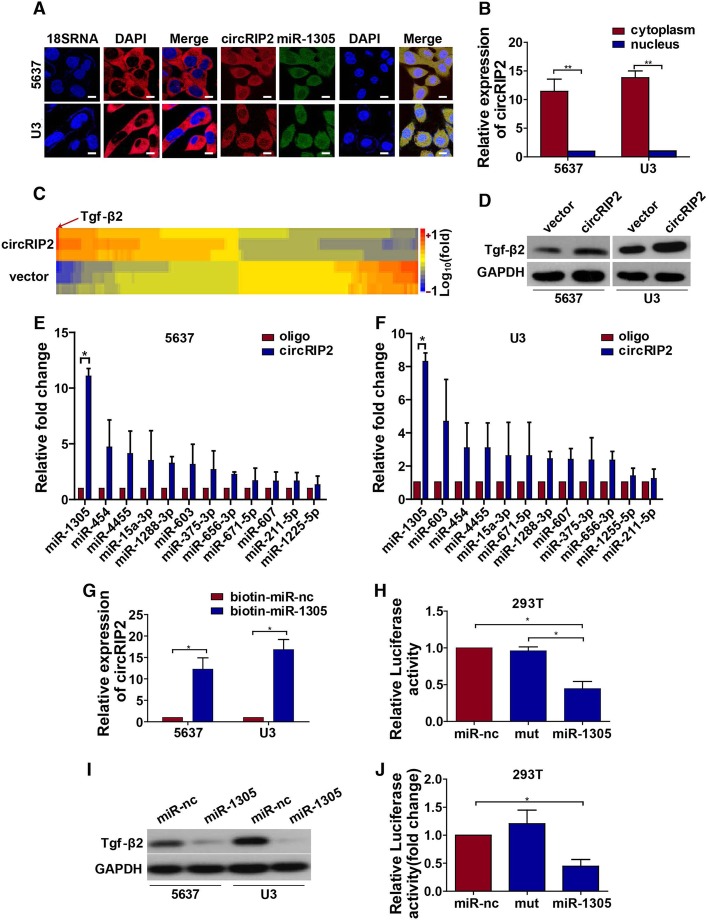
circRIP2 sponges miR-1305 to elevate Tgf-β2 in bladder cancer cell. a, b FISH and nuclear-plasma extraction assay were performed to detect the location of circRIP2. Cytoplasm located 18SRNA was taken as positive control, scale bar: 2.5 μm; c. Heat map and RNA-sequencing analyze mRNAs expression that were differently expressed between circRIP2 over-expressed and vector in U3 bladder cancer cells; Each group contains 3 samples; Each column corresponds to the expression profile of a sample, and each row represents a mRNA (log fold change (FC) ≥1.5 and P < 0.05); d. Western blot re-verified the up-regulation of Tgf-β2 caused by circRIP2 over-expression; e, f. RNA pull-down assay was used to evaluate miRNAs that could bind with circRIP2 in 2 bladder cancer cells, 5637 and U3; g. Pull-down assay for biotin labeled miRNA was used to evaluate binding properties between miR-1305 and circRIP2 in 2 bladder cancer cells, 5637 and U3; h. Dual luciferase reporter assay was used to prove the binding properties between circRIP2 and miR-1305; i. Western blot showed a significant interfering effect on Tgf-β2 expression by miR-1305; j. Dual luciferase reporter assay showed the binding property between miR-1305 and Tgf-β2;
Fig. 5
Fig. 5
miR-1305 rescues the tumor progressive role of circRIP2. To prove tumor suppressive role of circRIP2 could be rescued by miR-1305. miR-1305 and miR-nc were introduced together into circRIP2 over-expressed and control cells. a, b. qPCR was taken to evaluate circRIP2, RIP2, miR-1305 expression; c, d. CCK8 assay was performed to detect cell viability of bladder cancer cells; e, f. Cell potential to replicate and self-renew was reflected by clone formation; g, h. Rate of wound healing assay showed cell potential of migration; scale bar: 100 μm. i, j, k, l, m. Trans-well migration and matrigel invasion assay showed cell potential of migration and invasion of bladder cancer cells; scale bar: 25 μm.
Fig. 6
Fig. 6
circRIP2 contributes to EMT via Tgf-β2/smad3 pathway. a. Cell morphology of bladder cancer cells in vector and circRIP2 overexpressed cells was observed under light microscope (400×); b, c. Western blot showed expression of different epithelial and mesenchymal markers.

References

    1. Health Commission of PRC National. Chinese guidelines for diagnosis and treatment of urothelial carcinoma of bladder 2018 (English Version) Chinese Journal of Cancer Research. 2019;31(1):49–66. doi: 10.21147/j.issn.1000-9604.2019.01.03. - DOI - PMC - PubMed
    1. Dreicer R. Chemotherapy for advanced urothelial cancer: end of the beginning? Lancet Oncol. 2017;18(5):567–569. doi: 10.1016/S1470-2045(17)30241-3. - DOI - PubMed
    1. Robertson A. Gordon, Kim Jaegil, Al-Ahmadie Hikmat, Bellmunt Joaquim, Guo Guangwu, Cherniack Andrew D., Hinoue Toshinori, Laird Peter W., Hoadley Katherine A., Akbani Rehan, Castro Mauro A.A., Gibb Ewan A., Kanchi Rupa S., Gordenin Dmitry A., Shukla Sachet A., Sanchez-Vega Francisco, Hansel Donna E., Czerniak Bogdan A., Reuter Victor E., Su Xiaoping, de Sa Carvalho Benilton, Chagas Vinicius S., Mungall Karen L., Sadeghi Sara, Pedamallu Chandra Sekhar, Lu Yiling, Klimczak Leszek J., Zhang Jiexin, Choo Caleb, Ojesina Akinyemi I., Bullman Susan, Leraas Kristen M., Lichtenberg Tara M., Wu Catherine J., Schultz Nicholaus, Getz Gad, Meyerson Matthew, Mills Gordon B., McConkey David J., Weinstein John N., Kwiatkowski David J., Lerner Seth P. Comprehensive Molecular Characterization of Muscle-Invasive Bladder Cancer. Cell. 2018;174(4):1033. doi: 10.1016/j.cell.2018.07.036. - DOI - PMC - PubMed
    1. Su Y, Zhong G, Jiang N, Huang M, Lin T. Circular RNA, a novel marker for cancer determination (review) Int J Mol Med. 2018;42:1786–1798. - PubMed
    1. Su M, Xiao Y, Ma J, Tang Y, Tian B, Zhang Y, et al. Circular RNAs in Cancer: emerging functions in hallmarks, stemness, resistance and roles as potential biomarkers. Mol Cancer. 2019;18:90. doi: 10.1186/s12943-019-1002-6. - DOI - PMC - PubMed

Publication types

MeSH terms