Association between financial links to indoor tanning industry and conclusions of published studies on indoor tanning: systematic review
- PMID: 32019742
- PMCID: PMC7190068
- DOI: 10.1136/bmj.m7
Association between financial links to indoor tanning industry and conclusions of published studies on indoor tanning: systematic review
Abstract
Objective: To assess whether an association exists between financial links to the indoor tanning industry and conclusions of indoor tanning literature.
Design: Systematic review.
Data sources: PubMed, Embase, and Web of Science, up to 15 February 2019.
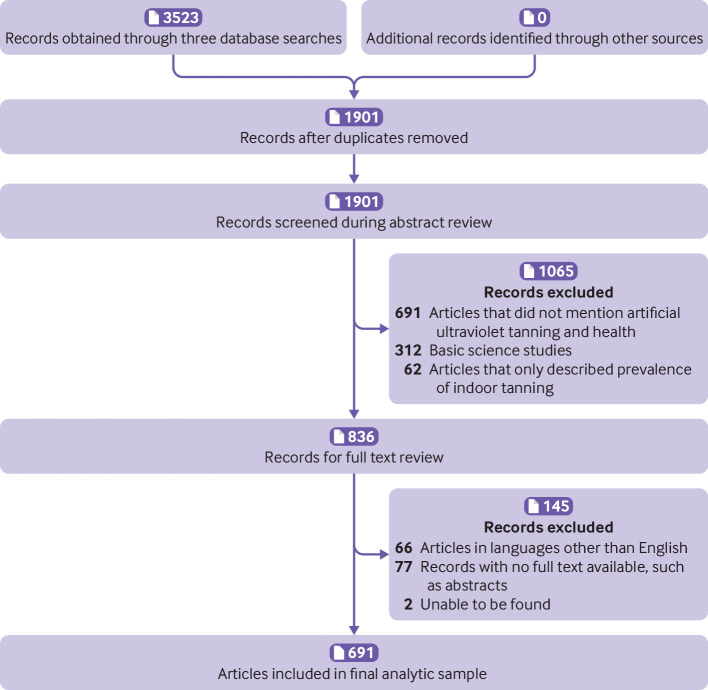
Study selection criteria: Articles discussing indoor tanning and health were eligible for inclusion, with no article type restrictions (original research, systematic reviews, review articles, case reports, editorials, commentaries, and letters were all eligible). Basic science studies, articles describing only indoor tanning prevalence, non-English articles, and articles without full text available were excluded.
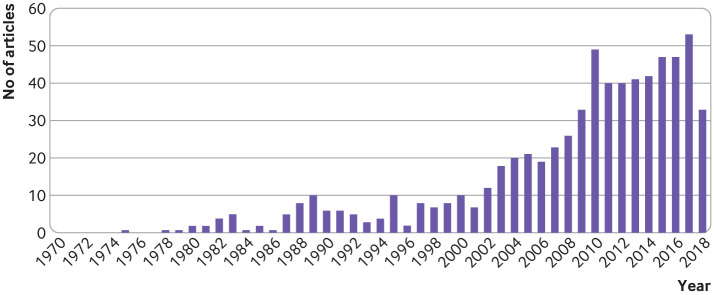
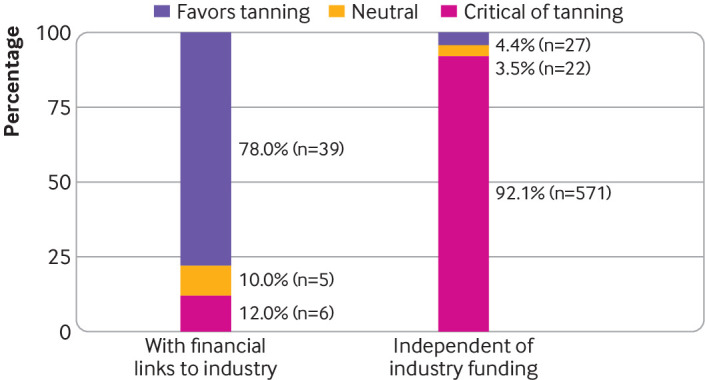
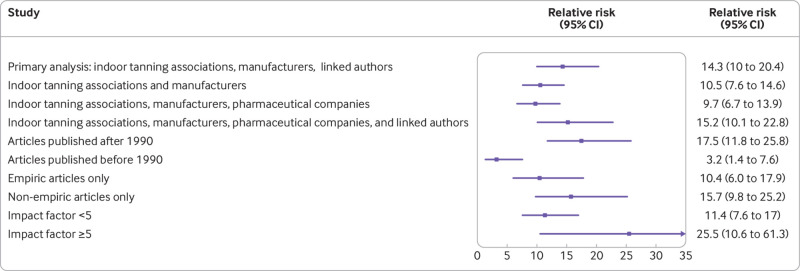
Results: 691 articles were included in analysis, including empiric articles (eg, original articles or systematic reviews) (357/691; 51.7%) and non-empiric articles letters (eg, commentaries, letters, or editorials) (334/691; 48.3%). Overall, 7.2% (50/691) of articles had financial links to the indoor tanning industry; 10.7% (74/691) articles favored indoor tanning, 3.9% (27/691) were neutral, and 85.4% (590/691) were critical of indoor tanning. Among the articles without industry funding, 4.4% (27/620) favored indoor tanning, 3.5% (22/620) were neutral, and 92.1% (571/620) were critical of indoor tanning. Among the articles with financial links to the indoor tanning industry, 78% (39/50) favored indoor tanning, 10% (5/50) were neutral, and 12% (6/50) were critical of indoor tanning. Support from the indoor tanning industry was significantly associated with favoring indoor tanning (risk ratio 14.3, 95% confidence interval 10.0 to 20.4).
Conclusions: Although most articles in the indoor tanning literature are independent of industry funding, articles with financial links to the indoor tanning industry are more likely to favor indoor tanning. Public health practitioners and researchers need to be aware of and account for industry funding when interpreting the evidence related to indoor tanning.
Systematic review registration: PROSPERO CRD42019123617.
Published by the BMJ Publishing Group Limited. For permission to use (where not already granted under a licence) please go to http://group.bmj.com/group/rights-licensing/permissions.
Conflict of interest statement
Competing interests: All authors have completed the ICMJE uniform disclosure form at www.icmje.org/coi_disclosure.pdf and declare: no support from any organization for the submitted work; no financial relationships with any organizations that might have an interest in the submitted work in the previous three years; no other relationships or activities that could appear to have influenced the submitted work.
Figures
Comment in
-
Industry influence in indoor tanning research.BMJ. 2020 Feb 4;368:m345. doi: 10.1136/bmj.m345. BMJ. 2020. PMID: 32019763 No abstract available.
References
Publication types
MeSH terms
Grants and funding
LinkOut - more resources
Full Text Sources
Medical