. 2020 Feb 4;11(1):699.
doi: 10.1038/s41467-020-14369-y.

The megabiota are disproportionately important for biosphere functioning

Affiliations

The megabiota are disproportionately important for biosphere functioning

Brian J Enquist et al. Nat Commun. .

Abstract

A prominent signal of the Anthropocene is the extinction and population reduction of the megabiota-the largest animals and plants on the planet. However, we lack a predictive framework for the sensitivity of megabiota during times of rapid global change and how they impact the functioning of ecosystems and the biosphere. Here, we extend metabolic scaling theory and use global simulation models to demonstrate that (i) megabiota are more prone to extinction due to human land use, hunting, and climate change; (ii) loss of megabiota has a negative impact on ecosystem metabolism and functioning; and (iii) their reduction has and will continue to significantly decrease biosphere functioning. Global simulations show that continued loss of large animals alone could lead to a 44%, 18% and 92% reduction in terrestrial heterotrophic biomass, metabolism, and fertility respectively. Our findings suggest that policies that emphasize the promotion of large trees and animals will have disproportionate impact on biodiversity, ecosystem processes, and climate mitigation.


Conflict of interest statement

The authors declare no competing interests.

Figures
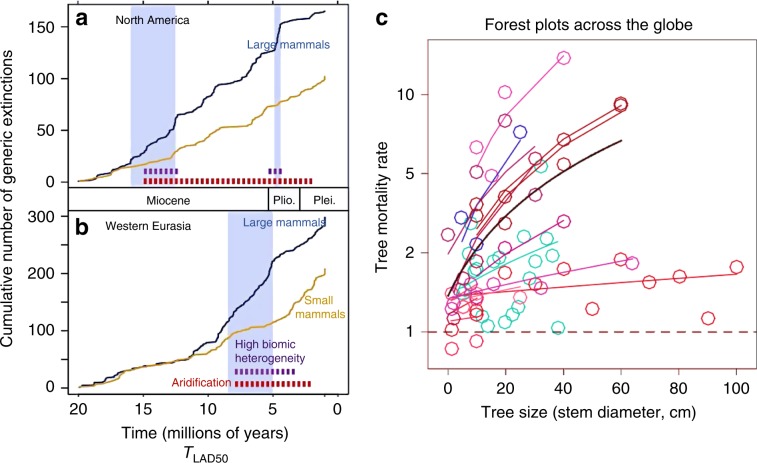
Fig. 1
Fig. 1. Larger body sized animals and plants are more susceptible to mortality and extinction in times of increased climatic stress.
The cumulative number of mammalian genus-level extinctions for large and small body size mammals plotted against the sampling-adjusted last appearance dates (TLAD50). For animals, both North American (a) and western Eurasian (b) large (blue) and small (orange) mammals are shown. In both continents, phases of increasing drought (aridification; red broken bars) and fragmentation and heterogeneity of biomes is associated with elevated extinctions of larger mammals relative to those of smaller mammals (shaded areas). Graph modified from Tomiya. For trees (c), larger trees exhibit greater increases in mortality rate relative to non-drought conditions. The different symbols and lines represent a unique drought instance within a given forest study (graph modified from Bennett et al.). The dashed line is the expectation when tree mortality in non-drought conditions are similar to tree mortality in drought conditions.
Fig. 2
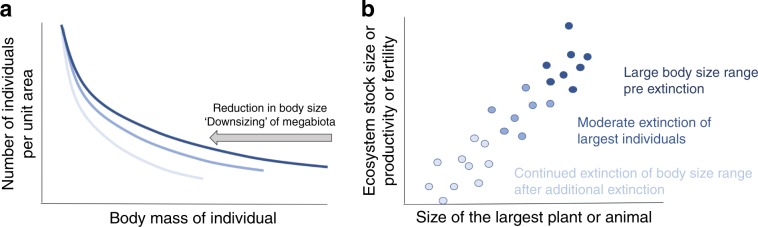
Fig. 2. Conceptual diagram for how the downsizing of the biosphere (the sequential loss of the megabiota) influences the total amount of ecosystem stock (biomass, carbon, nutrients), productivity, or fertility.
In (a), for assemblages of either plants or animals,  there is an inverse relationship between size and abundance. But, as larger organisms are disproportionately more prone to population reduction and extinction than smaller organisms, this leads to a reduction in the number of larger body sized individuals and a reduction in their numbers. As a result, past extinction and continued hunting, fishing, land and water use pressures in addition to climate change, are compressing body size distributions across most of the worldʼs ecosystems. In (b) metabolic scaling theory and empirical data show that communities and ecosystems with larger body sized plants and animals flux more energy and resources. As a result, continued reductions in body size in (a) will lead to a continued reduction in ecosystem stocks and flux of energy and nutrients.
Fig. 3
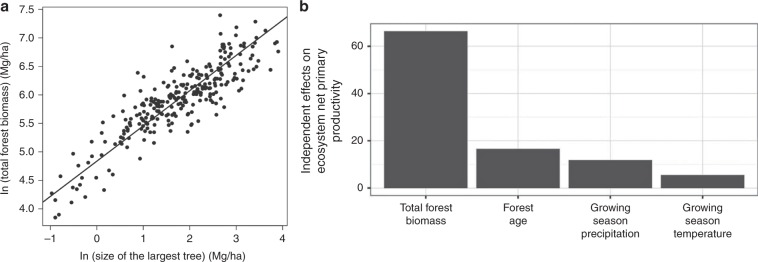
Fig. 3. Forests with larger trees disproportionately store more biomass (carbon) and are more productive.
In (a) the total above ground forest biomass is best predicted by the size of the largest tree. Analysis of biomass calculated from n = 267 independent forest plots distributed across the Americas from 40.7° S to 54.6° N latitude. The best single predictor of variation in forest biomass is the size of the largest tree in that forest. The fitted slope of the relationship (the scaling exponent) is 0.62, which is indistinguishable from the predicted scaling function from metabolic scaling theory where the total biomass should scale as maximum tree size to the 5/8 or 0.625 power. Data from ref. . In (b) global analyses of the relative importance of several drivers of variation in forest ecosystem net primary productivity (data from ref. ). The most important driver of variation in terrestrial net primary productivity is the total forest biomass. Variation in forest biomass has a larger effect than precipitation, temperature, and forest age. As the best predictor of total forest biomass is the size of the largest individual (a) these results indicate that forests with large megaflora are more productive. Vegetation with megaflora collectively dominate the biomass and carbon stored in vegetation and the productivity of land vegetation.
Fig. 4
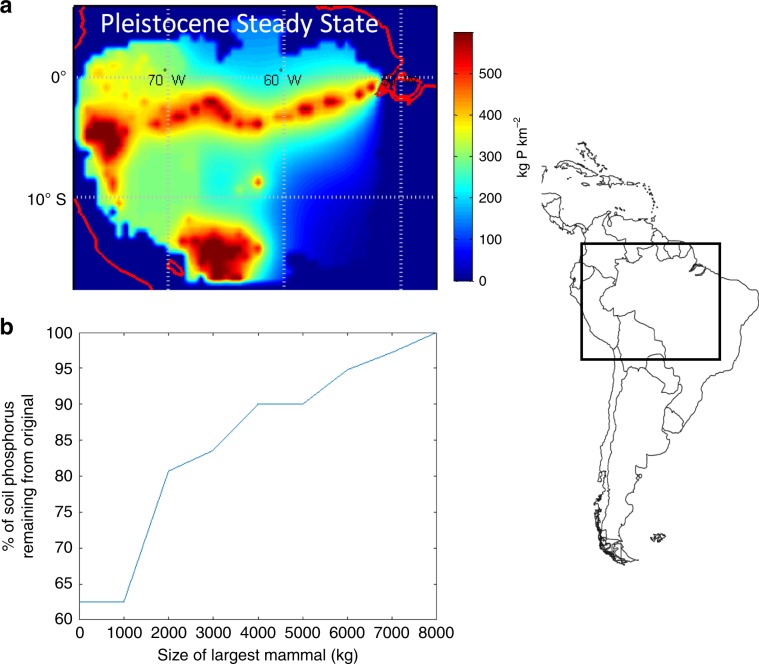
Fig. 4. A decrease in the mean size of South American fauna is predicted to decrease soil fertility (phosphorus) throughout the Amazon basin.
Predictions for how the steady state fertility of the Amazon basin (soil phosphorus concentrations) has changed in response to the megafaunal extinctions. This simulation is characterized by lateral diffusivity of nutrients, Φ, by mammals away from the Amazon river floodplain source. The diffusivity of nutrients through the Amazon via ingestion, transport, and eventual defecation yields a Φ value of 4.4 km2 yr−1 (based on Doughty et al.). a Simulated steady state soil P concentrations across the Amazon Basin with the now extinct megafauna; b With the extinction of large mammals and a continued forecasted reduction in mammal body size, the percentage of original steady state P concentrations in the Amazon Basin will decrease. Here, under a series of size thresholds for the extinct megafauna, we expect a 20–40% reduction in soil steady state P concentrations. For instance, a 5000 kg size threshold removes all animals above 5000 kg and continental P concentrations are reduced by ~10%. A size threshold of 0 has all extant South American mammals. Amazonian map from MATLAB worldmap from the Global Optimization Toolbox, The MathWorks, Inc. www.mathworks.com.
Fig. 5
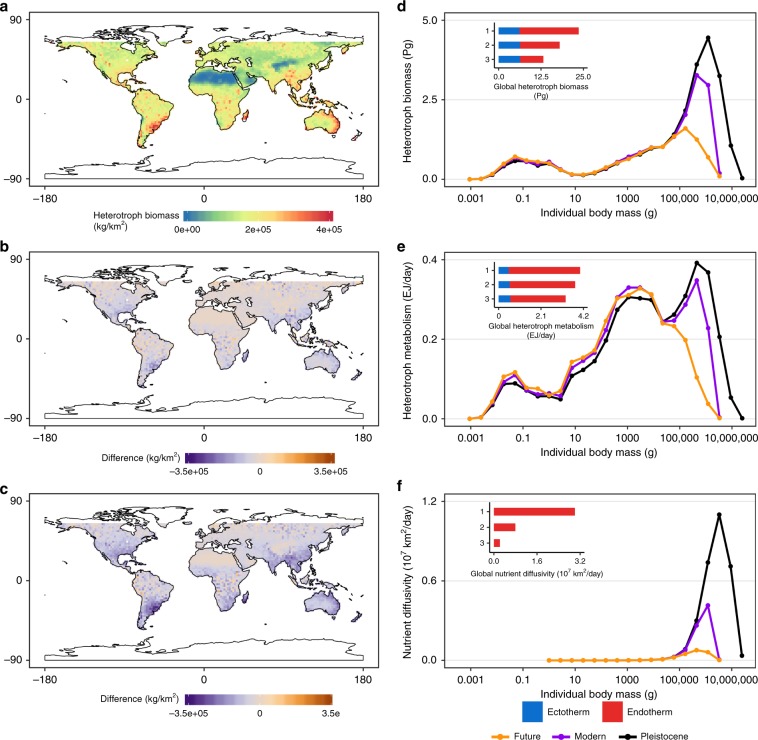
Fig. 5. The continued global downsizing of large animals results in reductions in terrestrial biosphere biomass, metabolism, and fertility.
The annual mean heterotrophic community biomass from three ensemble experiments using the General Ecosystem Model (GEM) mapped spatially showing a the Pleistocene world, b the difference between the Pleistocene world and Modern world and c Future world. The implications of this downsizing for the functioning of the biosphere are measured using the annual mean of the GEM experiments for the three ecosystem-level measures; d heterotrophic biomass, e heterotrophic metabolism and f nutrient diffusivity summarized into 25 mass bins. The inset graphs display the global total for each metric and are numbered (1) Pleistocene, (2) Modern and (3) Future world respectively. Global map from the 110 m land polygon shapefile from Natural Earth Data (https://www.naturalearthdata.com/downloads/110m-physical-vectors/).

References

    1. Ducarme F, Luque GM, Courchamp F. What are ‘charismatic species’ for conservation biologists? Biosci. Master Rev. 2013;1:1–8.
    1. Lindenmayer DB, Laurance WF, Franklin JF. Global decline in large old trees. Science. 2012;338:1305–1306. doi: 10.1126/science.1231070. - DOI - PubMed
    1. Sergio F, et al. Top predators as conservation tools: ecological rationale, assumptions, and efficacy. Annu. Rev. Ecol., Evolution, Syst. 2008;39:1–19. doi: 10.1146/annurev.ecolsys.39.110707.173545. - DOI
    1. Simberloff D. Flagships, umbrellas, and keystones: Is single-species management passe in the landscape era? in. Biol. Conserv. 1998;83:247–257. doi: 10.1016/S0006-3207(97)00081-5. - DOI
    1. Williams M, et al. The anthropocene biosphere. Anthropocene Rev. 2015;2:196–219. doi: 10.1177/2053019615591020. - DOI

Publication types