Review
. 2020 Aug;42(4):397-412.
doi: 10.1007/s00281-019-00772-1. Epub 2020 Feb 4.

Multiomic immune clockworks of pregnancy

Affiliations
Review

Multiomic immune clockworks of pregnancy

Laura S Peterson et al. Semin Immunopathol. 2020 Aug.

Abstract

Preterm birth is the leading cause of mortality in children under the age of five worldwide. Despite major efforts, we still lack the ability to accurately predict and effectively prevent preterm birth. While multiple factors contribute to preterm labor, dysregulations of immunological adaptations required for the maintenance of a healthy pregnancy is at its pathophysiological core. Consequently, a precise understanding of these chronologically paced immune adaptations and of the biological pacemakers that synchronize the pregnancy "immune clock" is a critical first step towards identifying deviations that are hallmarks of peterm birth. Here, we will review key elements of the fetal, placental, and maternal pacemakers that program the immune clock of pregnancy. We will then emphasize multiomic studies that enable a more integrated view of pregnancy-related immune adaptations. Such multiomic assessments can strengthen the biological plausibility of immunological findings and increase the power of biological signatures predictive of preterm birth.

Keywords: Cytomics; Immunology; Mass cytometry; Metabolomics; Microbiome; Pregnancy; Prematurity; Preterm birth; Proteomics; Transcriptomics; multiomics; parturition.


Conflict of interest statement

D.A.R holds stock in Seres Therapeutics and Evelo Bioscences and stock options in ArcBio, Karius, NanoBio, ProdermIQ, and Second Genome. M.P.S is a cofounder and on the Scientific Advisory board of the following: Personalis, Qbio, SensOmics, January, Mirvie, and Filtricine. M.P.S is on the scientific advisory board of the following: Genapsys and Jupiter. Authors M.N.M and S.R.Q are inventors on a patent on cfRNA associated with article by Ngo et al. cited in this text (10.1126/science.aar3819). S.Q. is founder, shareholder and board member of Mirvie.

Figures

Fig. 1
Fig. 1
Need for longitudinal, multiomic profiling studies to understand immunological adaptations in healthy and pathologic pregnancies. An integrated examination of the factors that influence the timing of immune adaptations during pregnancy will be key to allowing determination of normal immunological variations in healthy pregnancies (lefthand, blue) and identification of deviations predictive of pathological pregnancy outcomes (righthand, orange)
Fig. 2
Fig. 2
Contribution of the embryo, fetus, and trophoblasts to the programming of immune adaptations during pregnancy. a The blastocyst implants into the endometrium where it induces decidualization and begins interacting with local immune cells, such as DCs and NKs. b Trophoblasts invade the decidua and secrete cytokines, chemokines (chemokine (C-X-C motif), ligands (CXCL), and matrix metalloproteinases (MMPs) that recruit maternal immune cells and allow for remodeling of decidua/uterus. Specialized HLA molecules on trophoblasts inhibit CD8+ T cell and NK cell cytotoxicity. A tolerogenic milieu is fostered with Th2-polarized cells, immature dendritic cells, and Treg cells. c The fetus and placenta modulate the peripheral immune system to enhance fetal tolerance. Fetal microchimerism, cell-free fetal (cff)DNA, and placental extracellular vesicles enter maternal circulation and either promote systemic tolerance (exosomes) via mechanisms such as induction of fetal-specific regulatory T cells (Treg) or contribute to pathologic inflammation in diseases of pregnancy (microparticles). d Signals of fetal maturity, such as surfactant protein A production by fetal lungs and stretch of the amniotic membranes, trigger inflammation, leading to the common pathway of parturition
Fig. 3
Fig. 3
Contribution of maternal decidua to the programming of immune adaptations during pregnancy. a Decidual stromal cells condition the local immune environment by secreting chemokines and cytokines that recruit and activate specialized maternal immune cells (Tregs, Th2 cells, NK cells, restricted subsets of T cells) and chemoattract invading trophoblasts. Several studies support that this decidual chemokine/cytokine profile is under gestational-age-dependent control and that disruption of the normal profile affects pregnancy outcomes and the timing of parturition [115, 139, 192, 200]. b The decidua prompts inflammatory changes that contribute to the onset of labor by expressing chemokines and cytokines that contribute to inflammatory cell infiltration, prompting myometrial contractions via production of prostaglandins and inflammatory cytokines (particularly, IL-1β and TNFα) and promoting cervical ripening and rupture of chorioamniotic membranes via release of MMPs [45, 57, 62, 118, 120, 142, 151, 183, 189]
Fig. 4
Fig. 4
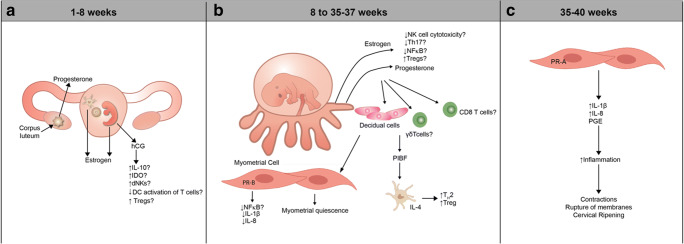
Endocrine regulation of immune adaptations during pregnancy. a In the first 8 weeks of human pregnancy, progesterone is produced predominantly by the corpus luteum; hCG is produced by the early embryo; and the placenta is the major source of estrogen (as it is for the duration of pregnancy) [125]. Early in pregnancy, hCG may interact with the immune system to promote vascular remodeling via dNK cells and to promote an immature DC phenotype that encourages Th2 and Treg differentiation. b Nuclear progesterone receptors (PR-B or PR-A) are found in decidual cells, myometrial cells, and a subset of immune cells (e.g., CD4 and CD8 T cells) [12, 28, 69, 83, 128, 172, 177]. Progesterone binding to PR-B induces transcription of PIBF. In humans and mice, progesterone (either directly or via PIBF) contributes to the arrest of dDC maturation in vitro, which fosters a Th2 environment and encourages differentiation and expansion of Tregs [22, 95, 131, 165, 181]. In vitro studies in humans have suggested that progesterone decreases NK cell cytotoxicity and renders NK cells more susceptible to apoptosis [12, 44, 171, 173]. Estrogen may impair NK cell cytotoxicity, discourage Th17 differentiation, encourage peripheral Treg differentiation, and inhibit NF-kB-mediated transcription [, , , , –131, 134, 176, 186]. c At parturition, progesterone’s effects on human myometrial cells shifts from anti-inflammatory/pro-quiescent to pro-inflammatory/pro-contractile. PR-B inhibits the pro-inflammatory transcription factor NF-κB in human myometrial cells, thereby decreasing production of pro-inflammatory cytokines such as IL-1β and IL-8, which are implicated on the onset of labor. Immediately preceding labor, decreased myometrial expression of PR-B and increased expression of PR-A are associated with production of IL-1β and IL-8 by myometrial cells [177]. This change in nuclear progesterone receptor profile may represent a functional progesterone withdrawal in humans. IDO, indoleamine 2,3-dioxygenase
Fig. 5
Fig. 5
Summary of the immunological timeline during pregnancy and putative immune pacemakers

References

    1. Aggelakopoulou M, Kourepini E, Paschalidis N, Simoes DCM, Kalavrizioti D, Dimisianos N, Papathanasopoulos P, Mouzaki A, Panoutsakopoulou V. ERβ-dependent direct suppression of human and murine Th17 cells and treatment of established central nervous system autoimmunity by a neurosteroid. J Immunol. 2016;197(7):2598–2609. - PubMed
    1. Aghaeepour N, Ganio EA, Mcilwain D, Tsai AS, Tingle M et al (2017) An immune clock of human pregnancy. Sci Immunol 2(15) - PMC - PubMed
    1. Aghaeepour N, Lehallier B, Baca Q, Ganio EA, Wong RJ, et al. A proteomic clock of human pregnancy. Am J Obstet Gynecol. 2018;218(3):347.e1–347.e14. - PubMed
    1. Ali ES, Mangold C, Peiris AN. Estriol: emerging clinical benefits. Menopause. 2017;24(9):1081–1085. - PubMed
    1. AlSaif S, Mumtaz S, Wray S. A short review of adipokines, smooth muscle and uterine contractility. Life Sci. 2015;125:2–8. - PubMed

Publication types

LinkOut - more resources