. 2020 Jan 23;20(1):20.
doi: 10.1186/s12906-019-2738-7.

Neuroprotective effects of Danshensu on rotenone-induced Parkinson's disease models in vitro and in vivo

Affiliations

Neuroprotective effects of Danshensu on rotenone-induced Parkinson's disease models in vitro and in vivo

Tian Wang et al. BMC Complement Med Ther. .

Abstract

Background: Danshensu is an active constituent in the extracts of Danshen which is a traditional Chinese medical herb. Rotenone inhibits complex I of the mitochondrial electron transport chain in dopaminergic neurons leading to glutathione (GSH) level reduction and oxidative stress. The aim of this study is to investigate neuroprotective effects of Danshensu on rotenone-induced Parkinson's disease (PD) in vitro and in vivo.

Methods: In vitro, SH-SY5Y human neuroblastoma cell line was pretreated with Danshensu and challenged with rotenone. Then the reactive oxygen species (ROS) production was assayed. In vivo, male C57BL/6 mice were intragastrically administered with Danshensu (15, 30, or 60 mg/kg), followed by oral administration with rotenone at a dose of 30 mg/kg. Pole and rotarod tests were carried out at 28 d to observe the effects of Danshensu on PD.

Results: Danshensu repressed ROS generation and therefore attenuated the rotenone-induced injury in SH-SY5Y cells. Danshensu improved motor dysfunction induced by rotenone, accompanied with reducing MDA content and increasing GSH level in striatum. Danshensu increased the number of TH positive neurons, the expression of TH and the dopamine contents. The expressions of p-PI3K, p-AKT, Nrf2, hemeoxygenase (HO-1), glutathione cysteine ligase regulatory subunit (GCLC), glutathione cysteine ligase modulatory subunit (GCLM) were significantly increased and the expression of Keap1 was decreased in Danshensu groups.

Conclusions: The neuroprotective effects of Danshensu on rotenone-induced PD are attributed to the anti-oxidative properties by activating PI3K/AKT/Nrf2 pathway and increasing Nrf2-induced expression of HO-1, GCLC, and GCLM, at least in part.

Keywords: Danshensu; Glutathione; Parkinson’s disease; Rotenone.


Conflict of interest statement

The authors declare that they have no competing interests.

Figures
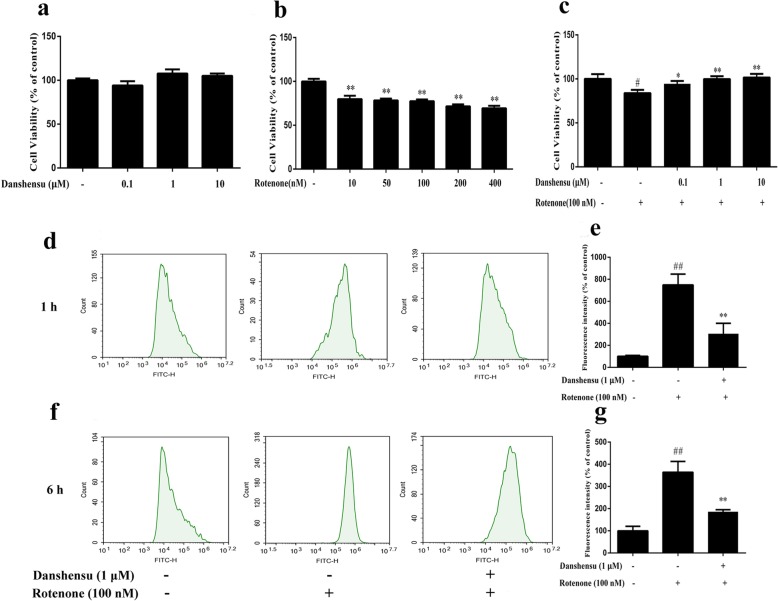
Fig. 1
Fig. 1
Danshensu attenuated the cytotoxicity and ROS generation induced by rotenone in SH-SY5Y cells. Data were expressed as the Mean ± SEM of three experiments. Statistical analyses were performed using One-way ANOVA followed by Tukey’s post hoc test. #P < 0.05, ##P < 0.01 compared with the control group; *P < 0.05, **P < 0.01 compared with the rotenone group. a Effect of Danshensu on cell viability. b Effect of rotenone on cell viability. c Effect of Danshensu on rotenone-induced cytotoxicity. d Representative photographs of rotenone-induced ROS generation after treatment with rotenone for 1 h. e Bar graph of quantitative analysis of rotenone-induced ROS generation after treatment with rotenone for 1 h. f Representative photographs of rotenone-induced ROS generation after treatment with rotenone for 6 h. g Bar graph of quantitative analysis of rotenone-induced ROS generation after treatment with rotenone for 6 h
Fig. 2
Fig. 2
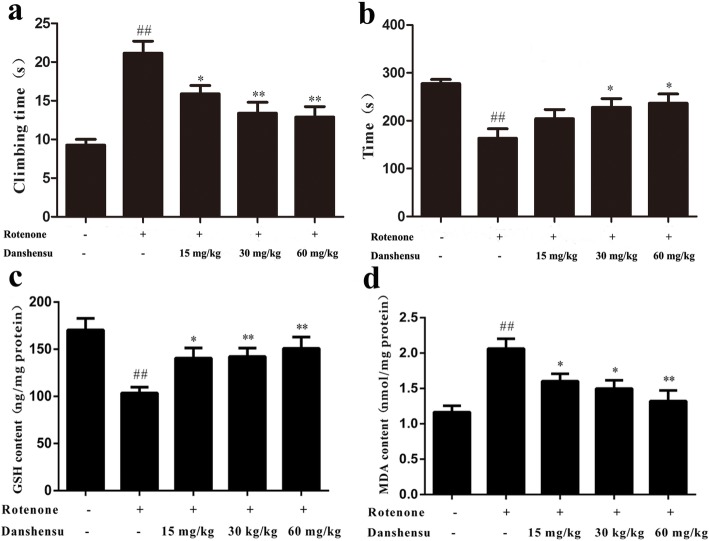
Effect of Danshensu on motor dysfunction, levels of GSH and MDA in the rotenone-induced PD mice. a Pole test, b Rotarod test, c GSH, d MDA. The data were expressed as the Mean ± SEM. Statistical analyses were performed using One-way ANOVA followed by Tukey’s post hoc test. #P < 0.05, ##P < 0.01 compared with the control group; *P < 0.05, **P < 0.01 compared with the rotenone group
Fig. 3
Fig. 3
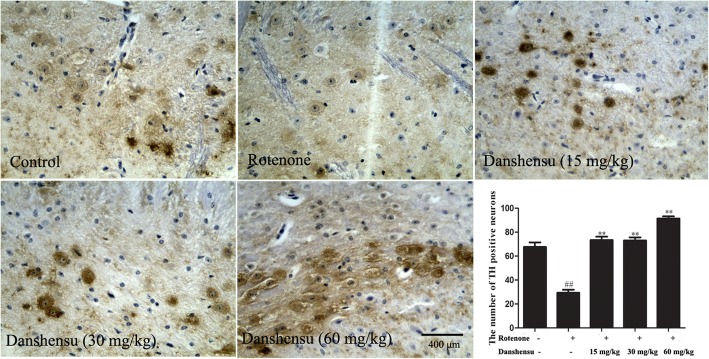
Effect of Danshensu on the number of TH positive neurons in rotenone-induced PD mice. Bar = 400 μm. ##P < 0.01 compared with the control group; **P < 0.01 compared with the rotenone group
Fig. 4
Fig. 4
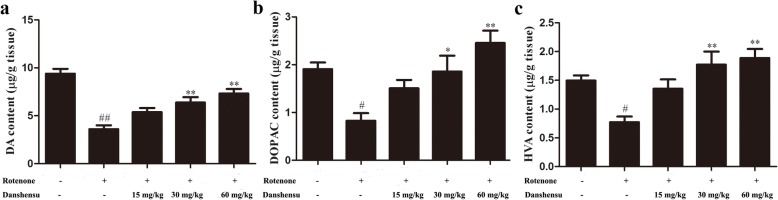
Effect of Danshensu on levels of dopamine (DA) (a), DOPAC (b) and HVA (c) in rotenone-induced PD mice. The data were expressed as the Mean ± SEM. Statistical analyses were performed using One-way ANOVA followed by Tukey’s post hoc test. #P < 0.05, ##P < 0.01 compared with the control group; *P < 0.05, **P < 0.01 compared with the rotenone group
Fig. 5
Fig. 5
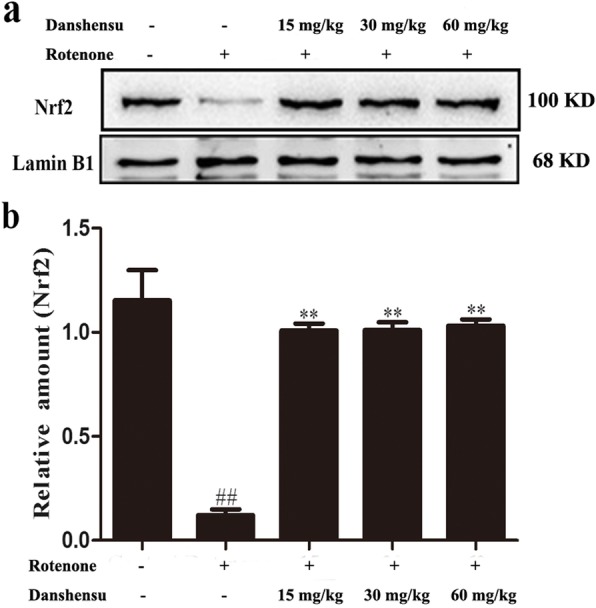
Effect of Danshensu on the expressions of nuclear translocation of Nrf2 in rotenone-induced PD mice. a showed representative photographs of Nrf2 in western blot measurement. b indicated bar graphs of Nrf2 expression in western blot measurement. The data were expressed as the Mean ± SEM. Statistical analyses were performed using One-way ANOVA followed by Tukey’s post hoc test. ##P < 0.01 compared with the control group; **P < 0.01 compared with the rotenone group
Fig. 6
Fig. 6
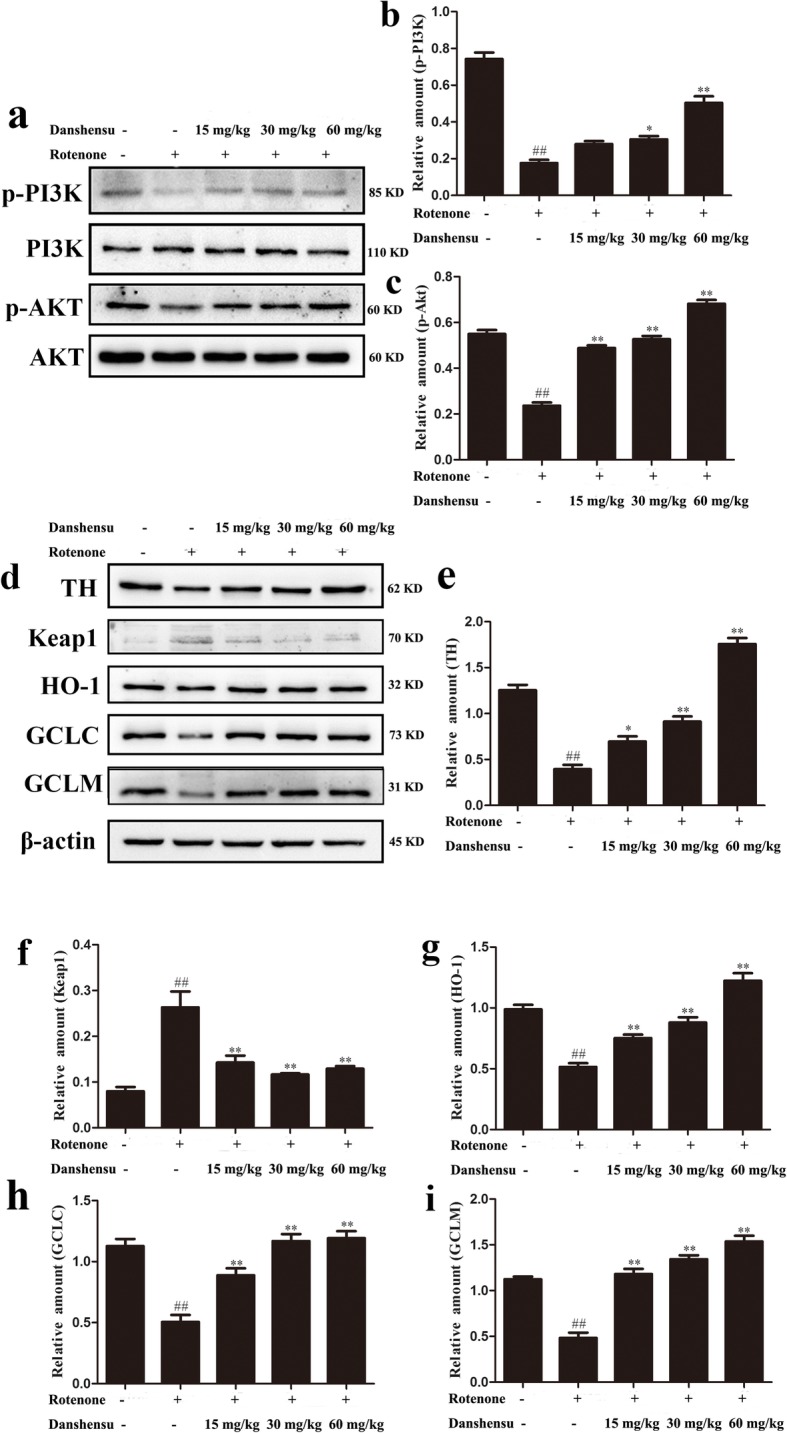
Effect of Danshensu on the expressions of nuclear translocation of Nrf2 in rotenone-induced PD mice. a showed representative photographs of Nrf2 in western blot measurement. b indicated bar graphs of Nrf2 expression in western blot measurement. The data were expressed as the Mean ± SEM. Statistical analyses were performed using One-way ANOVA followed by Tukey’s post hoc test. ##P < 0.01 compared with the control group; *P < 0.05, **P < 0.01 compared with the rotenone group. a Representative photographs of p-PI3K, PI3K, p-AKT, AKT in Western blot. b Bar graph of quantitative analysis of the expression of p-PI3K. c Bar graph of quantitative analysis of the expression of p-AKT. d Representative photographs of TH, Keap1, HO-1, GCLC, GCLM in Western blot. e Bar graph of quantitative analysis of the expression of TH. f Bar graph of quantitative analysis of the expression of Keap1. g Bar graph of quantitative analysis of the expression of HO-1. h Bar graph of quantitative analysis of the expression of GCLC. i Bar graph of quantitative analysis of the expression of GCLM

References

    1. Erro R, Stamelou M. The motor syndrome of Parkinson's disease. Int Rev Neurobiol. 2017;132:25–32. doi: 10.1016/bs.irn.2017.01.004. - DOI - PubMed
    1. Chang A, Fox SH. Psychosis in Parkinson's disease: epidemiology, pathophysiology, and management. Drugs. 2016;76(11):1093–1118. doi: 10.1007/s40265-016-0600-5. - DOI - PubMed
    1. Cacabelos Ramón. Parkinson’s Disease: From Pathogenesis to Pharmacogenomics. International Journal of Molecular Sciences. 2017;18(3):551. doi: 10.3390/ijms18030551. - DOI - PMC - PubMed
    1. Tseng WT, Hsu YW, Pan TM. Dimerumic acid and Deferricoprogen activate Ak mouse strain Thymoma/Heme Oxygenase-1 pathways and prevent apoptotic cell death in 6-Hydroxydopamine-induced SH-SY5Y cells. J Agric Food Chem. 2016;64(30):5995–6002. doi: 10.1021/acs.jafc.6b01551. - DOI - PubMed
    1. Jiang T, Sun Q, Chen S. Oxidative stress: a major pathogenesis and potential therapeutic target of antioxidative agents in Parkinson's disease and Alzheimer's disease. Prog Neurobiol. 2016;147:1–19. doi: 10.1016/j.pneurobio.2016.07.005. - DOI - PubMed