


Healthy Eating, Physical Activity, and Sleep Hygiene (HEPAS) as the Winning Triad for Sustaining Physical and Mental Health in Patients at Risk for or with Neuropsychiatric Disorders: Considerations for Clinical Practice
- PMID: 32021199
- PMCID: PMC6955623
- DOI: 10.2147/NDT.S229206
Healthy Eating, Physical Activity, and Sleep Hygiene (HEPAS) as the Winning Triad for Sustaining Physical and Mental Health in Patients at Risk for or with Neuropsychiatric Disorders: Considerations for Clinical Practice
Abstract
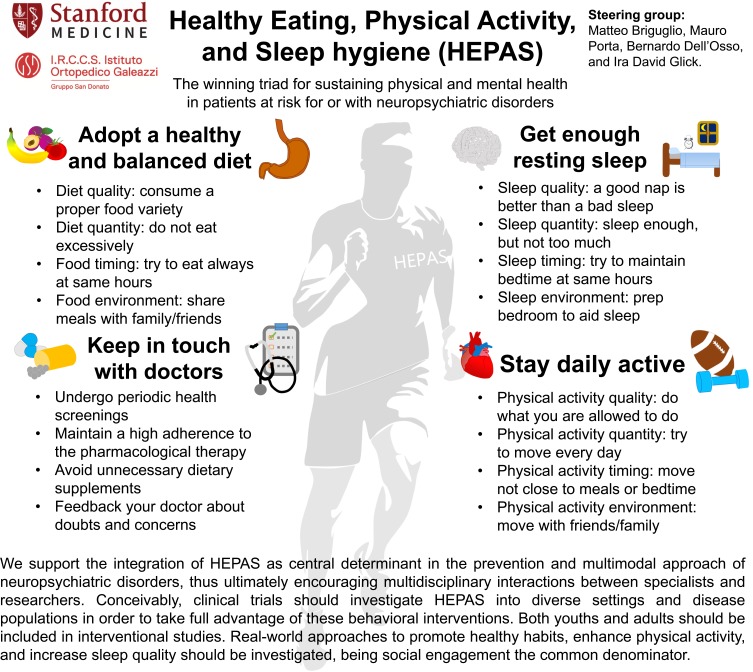
Neuropsychiatric disorders stem from gene-environment interaction and their development can be, at least in some cases, prevented by the adoption of healthy and protective lifestyles. Once full blown, neuropsychiatric disorders are prevalent conditions that patients live with a great burden of disability. Indeed, the determinants that increase the affliction of neuropsychiatric disorders are various, with unhealthy lifestyles providing a significant contribution in the interplay between genetic, epigenetic, and environmental factors that ultimately represent the pathophysiological basis of these impairing conditions. On one hand, the adoption of Healthy Eating education, Physical Activity programs, and Sleep hygiene promotion (HEPAS) has the potential to become one of the most suitable interventions to reduce the risk to develop neuropsychiatric disorders, while, on the other hand, its integration with pharmacological and psychological therapies seems to be essential in the overall management of neuropsychiatric disorders in order to reduce the disability and improve the quality of life of affected patients. We present an overview of the current evidence in relation to HEPAS components in the prevention and management of neuropsychiatric disorders and provide suggestions for clinical practice.
Keywords: diet; motor activity; neuropsychiatry; quality of health care; sleep.
© 2020 Briguglio et al.
Conflict of interest statement
Professor Ira Glick reports research support from Alkermes, speaker's bureau from Sunovion, consultant from Neurocrine, equity fromJohnson & Johnson, outside the submitted work.This study was part of the Italian project “Ricerca Corrente del Ministero Della Salute”. The authors report no other conflicts of interest in this work.
Figures
References
-
- Disease GBD, Injury I, Prevalence C. Global, regional, and national incidence, prevalence, and years lived with disability for 354 diseases and injuries for 195 countries and territories, 1990–2017: a systematic analysis for the global burden of disease study 2017. Lancet. 2018;392(10159):1789–1858. - PMC - PubMed
-
- Dell’Osso B, Marazziti D, Albert U, et al. Parsing the phenotype of obsessive-compulsive tic disorder (OCTD): a multidisciplinary consensus. Int J Psychiatry Clin Pract. 2017;21:1–4. - PubMed
