


Bladder cancer trends and mortality in the brazilian public health system
- PMID: 32022511
- PMCID: PMC7025845
- DOI: 10.1590/S1677-5538.IBJU.2019.0198
Bladder cancer trends and mortality in the brazilian public health system
Abstract
Introduction: Considering the lack of data on BC trends in Brazilian population, mainly as a result of the difficulty on gathering data, the present manuscript provides an overview of bladder cancer incidence, hospitalization, mortality patterns and trends using the Brazilian Data Center for The Public Health System (DATASUS).
Materials and methods: All hospital admissions associated with BC diagnosis (ICD-10 C67) between 2008 and 2017 were analyzed. Distributions according to year, gender, age group, ethnicity, death, length of hospital stay, and costs were evaluated. Demographic data was obtained from the last Brazilian national census.
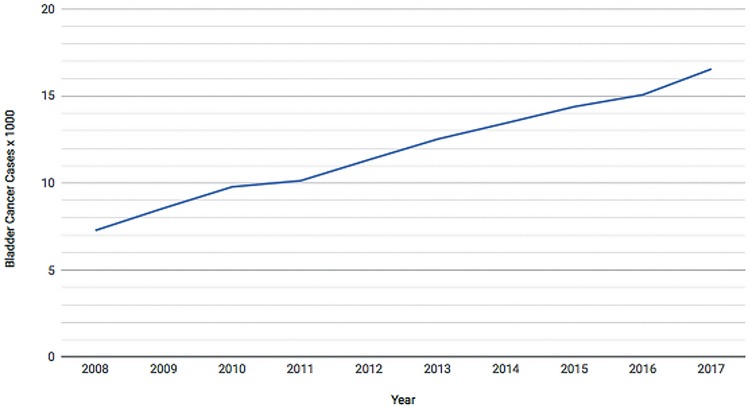
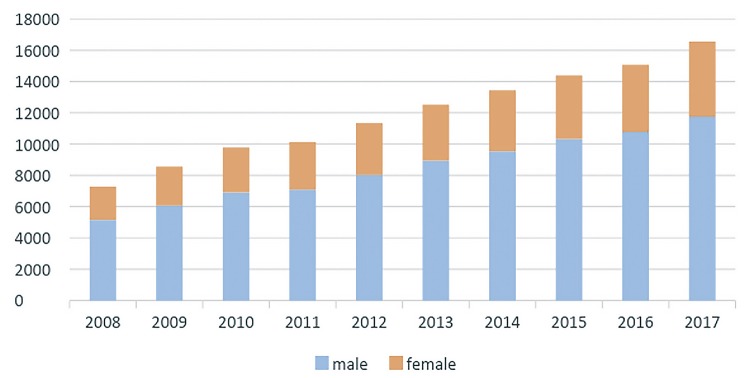
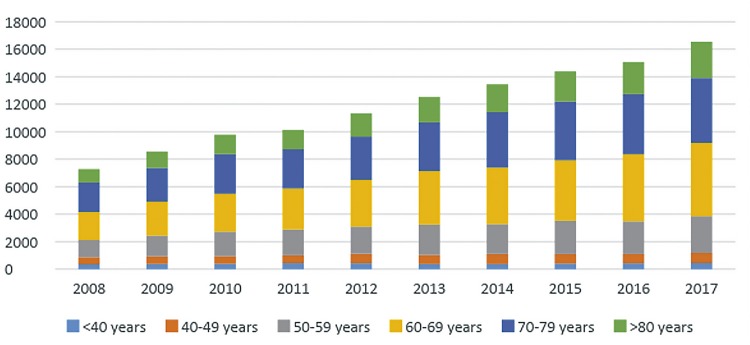
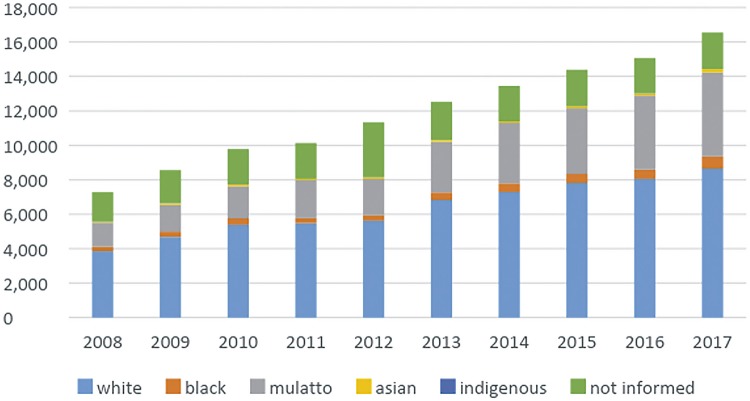
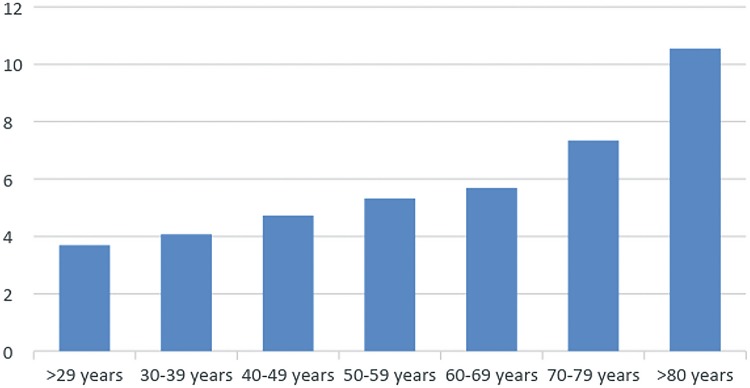
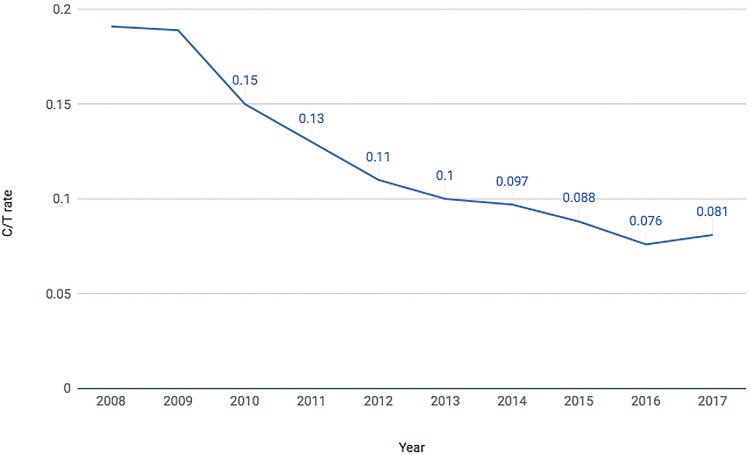
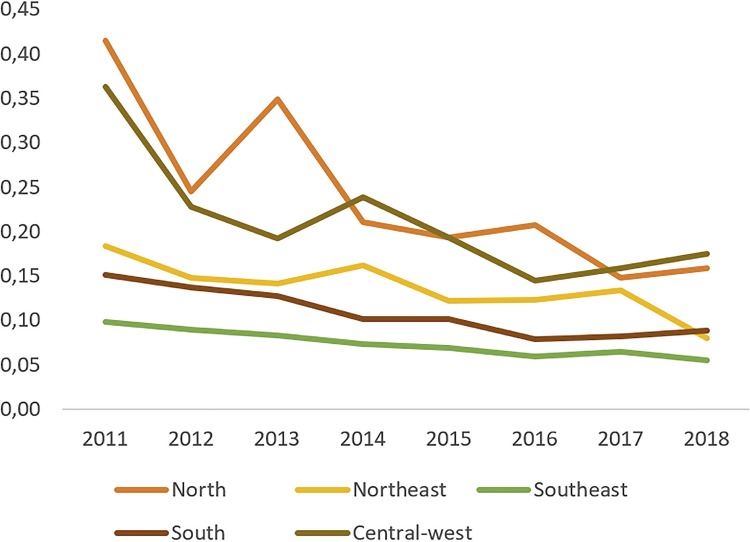
Results: From 2008 to 2017 there were 119,058 public hospital admissions related to BC. Patients were mostly white males aged 60 to 79 years-old. Mortality rates for patients who have undergone surgery was 6.75% on average, being 7.38% for women and 6.49% for men. Mortality rates were higher when open surgeries were performed compared to endoscopic procedures (4.98% vs 1.18%). Considering only endoscopic procedures, mortality rates were three times higher after urgent surgeries compared to elective ones (2.6% vs 0.6%). Over the years the cystectomy/transurethral bladder resection (C/T) ratio significantly decreased in all Brazilian Regions. In 2008, the C/T ratio was 0.19, while in 2017 it reduced to 0.08.
Conclusions: Despite BC relatively low incidence, it still represents a significant social economic burden in Brazil, as it presents with recurrent episodes that might require multiple hospitalizations and surgical treatment. The set of data collected might suggest that population access to health care has improved between 2008-2017.
Keywords: Mortality; Public Health; Urinary Bladder Neoplasms.
Copyright® by the International Brazilian Journal of Urology.
Conflict of interest statement
None declared.
Figures
References
-
- 1. Cancer Facts & Figures 2018, American Cancer of Society 2018. Avalable at. <https://www.cancer.org/research/cancer-facts-statistics/all-cancer-facts.... Access on January 2019.
- Cancer Facts & Figures American Cancer of Society 2018. 2018. [Access on January 2019]. https://www.cancer.org/research/cancer-facts-statistics/all-cancer-facts....
-
- 2. SEER Cancer Stat Facts: Bladder Cancer. National Cancer Institute. Avalable at.<https://seer.cancer.gov/statfacts/html/urinb.html>
- SEER Cancer Stat Facts: Bladder Cancer National Cancer Institute. https://seer.cancer.gov/statfacts/html/urinb.html.
-
- 3. Bray F, Ferlay J, Soerjomataram I, Siegel RL, Torre LA, Jemal A. Global cancer statistics 2018: GLOBOCAN estimates of incidence and mortality worldwide for 36 cancers in 185 countries. CA Cancer J Clin. 2018;68:394-424. - PubMed
- Bray F, Ferlay J, Soerjomataram I, Siegel RL, Torre LA, Jemal A. Global cancer statistics 2018: GLOBOCAN estimates of incidence and mortality worldwide for 36 cancers in 185 countries. CA Cancer J Clin. 2018;68:394–424. - PubMed
-
- 4. MINISTÉRIO DA SAÚDE- MS. Instituto Nacional de Câncer, Brasil, 2018. Estimativa da Incidência e Mortalidade por Câncer no Brasil - 2018. Avalable at. <http://www1.inca.gov.br/estimativa/2018/casos-taxas-brasil.asp>. Access on March 16, 2019.
- MINISTÉRIO DA SAÚDE- MS Instituto Nacional de Câncer, Brasil, 2018. Estimativa da Incidência e Mortalidade por Câncer no Brasil. 2018. [Access on March 16, 2019]. http://www1.inca.gov.br/estimativa/2018/casos-taxas-brasil.asp>.
-
- 5. Scosyrev E, Noyes K, Feng C, Messing E. Sex and racial differences in bladder cancer presentation and mortality in the US. Cancer. 2009;115:68-74. - PubMed
- Scosyrev E, Noyes K, Feng C, Messing E. Sex and racial differences in bladder cancer presentation and mortality in the US. Cancer. 2009;115:68–74. - PubMed
MeSH terms
LinkOut - more resources
Full Text Sources
Medical
