Assessment of a Best Practice Alert and Referral Process for Preprocedure Antithrombotic Medication Management for Patients Undergoing Gastrointestinal Endoscopic Procedures
- PMID: 32022882
- PMCID: PMC7416616
- DOI: 10.1001/jamanetworkopen.2019.20548
Assessment of a Best Practice Alert and Referral Process for Preprocedure Antithrombotic Medication Management for Patients Undergoing Gastrointestinal Endoscopic Procedures
Abstract
Importance: Management of antithrombotic medications presents a challenge for many clinicians and patients before procedures. Anticoagulation clinic involvement may improve preprocedure coordination, satisfaction on the part of patients and clinicians, last-minute procedure cancellations, and patient safety.
Objective: To assess the implementation of an electronic medical record (EMR) best practice alert (BPA) and anticoagulation clinic referral process to assist with management of antithrombotic medication before gastrointestinal endoscopic procedures.
Design, setting, and participants: This multimodal evaluation of a quality improvement intervention using EMRs and survey data included patients using oral antithrombotic medications who were scheduled for elective gastrointestinal endoscopic procedures at an academic medical center along with the clinicians who ordered these procedures. Data were collected from November 1, 2017, through December 19, 2018. Data were analyzed in September 2019.
Exposures: Following a multidisciplinary intervention, a BPA and referral process for periprocedural antithrombotic medication management was implemented in November 2017.
Main outcomes and measures: The following implementation outcomes were assessed through EMR review and surveys through December 2018: use of BPAs, patient and clinician satisfaction with preprocedure anticoagulation management, procedure cancelation rates, reach, and spread by patient and clinician characteristics. Multilevel logistic regression was used to estimate variance in BPA use at the clinician level.
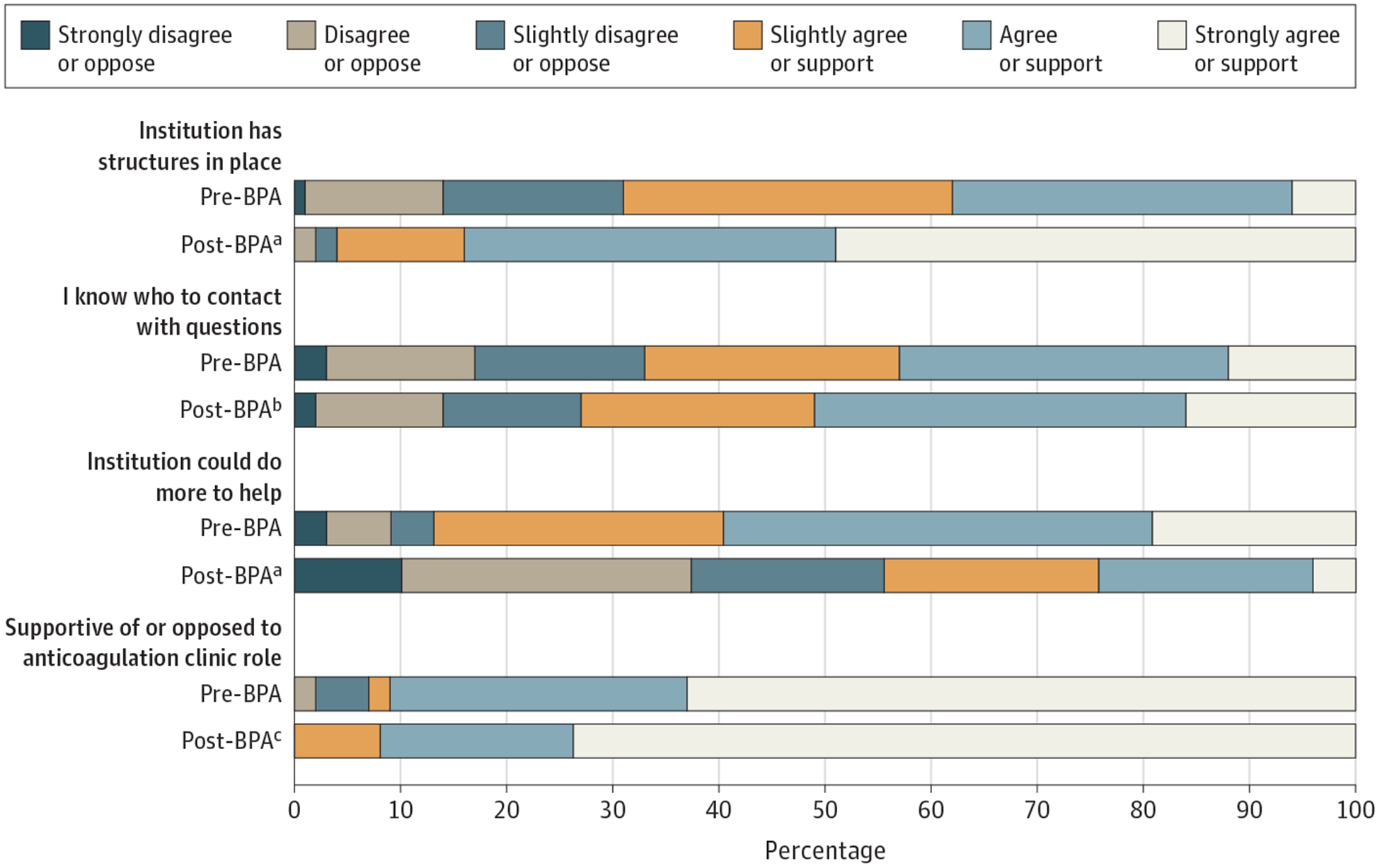
Results: A total of 2082 patients (mean [SD] age, 64.1 [11.9] years) and 144 clinicians were included in the analysis. The BPA was used broadly across the health system, resulting in anticoagulation clinic referral for 1389 patients (66.7%). Referral was more common for patients using anticoagulant vs antiplatelet medications (1041 of 1524 [68.3%] vs 346 of 556 [62.2%]; adjusted odds ratio [aOR], 1.51; 95% CI, 1.15-1.98) and for procedures ordered by gastroenterologists vs primary care clinicians (933 of 1241 [75.2%] vs 365 of 618 [59.1%]; aOR, 2.15; 95% CI, 1.46-3.17). Individual clinician behavior patterns explained 26.5% (95% CI, 18.7%-36.1%) of variation in anticoagulation clinic referrals. Implementation of the intervention was associated with high patient satisfaction and improvements in multidimensional measures of clinician satisfaction (clinician response rate, 44.2% [144 of 326]). In multivariable analysis, the odds of altered or canceled procedures because of medication mismanagement declined after implementation (8 of 50 [16.0%] vs 1 of 52 [1.9%]; aOR, 0.11; 95% CI, 0.01-0.96; P = .02).
Conclusions and relevance: A newly implemented BPA and anticoagulation clinic referral process was broadly adopted and used, had high satisfaction by patients and clinicians, and was associated with fewer disruptions to planned procedures caused by medication mismanagement.
Conflict of interest statement
Figures


References
-
- Doherty JU, Gluckman TJ, Hucker WJ, et al. 2017 ACC expert consensus decision pathway for periprocedural management of anticoagulation in patients with nonvalvular atrial fibrillation: a report of the American College of Cardiology Clinical Expert Consensus Document Task Force. J Am Coll Cardiol. 2017;69(7):871–898. doi: 10.1016/j.jacc.2016.11.024 - DOI - PubMed
Publication types
MeSH terms
Substances
Grants and funding
LinkOut - more resources
Full Text Sources