


Blood Metal Ion Release After Primary Total Knee Arthroplasty: A Prospective Study
- PMID: 32023362
- PMCID: PMC7189061
- DOI: 10.1111/os.12591
Blood Metal Ion Release After Primary Total Knee Arthroplasty: A Prospective Study
Abstract
Objectives: To investigate the course of in vivo blood metal ion levels in patients undergoing primary total knee arthroplasty (TKA) and to investigate potential risk factors associated with metal ion release in these patients.
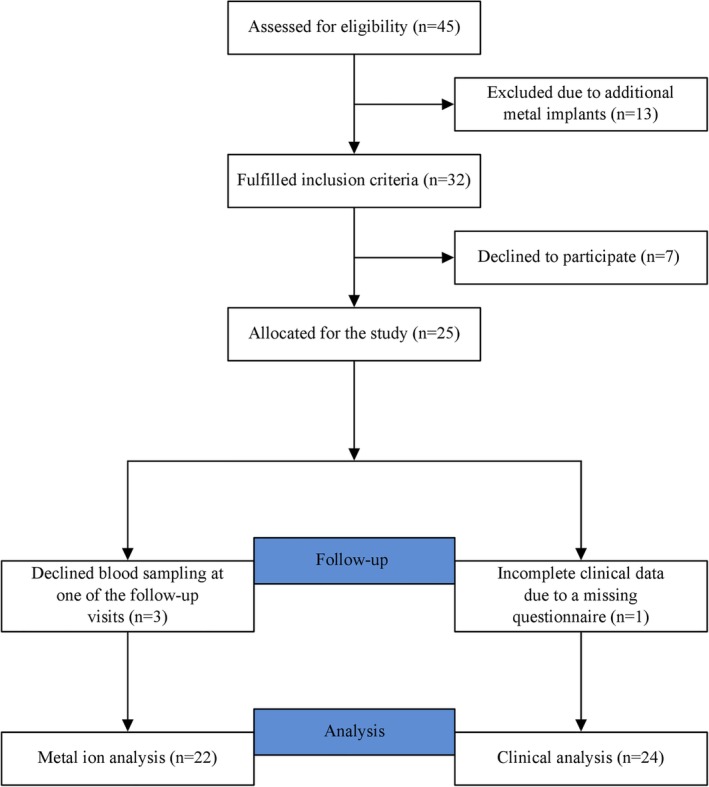
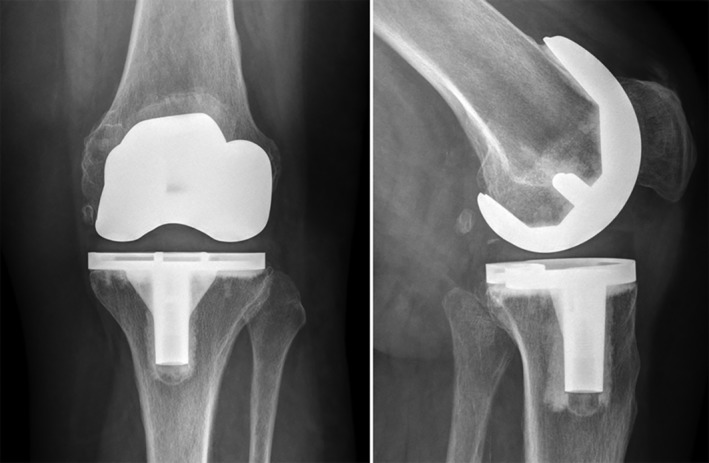
Methods: Twenty-five patients with indication for TKA were included in this prospective study. Whole blood metal ion analysis was performed pre-operatively and at 1 week, 6 weeks, 3 months, 6 months, and 12 months postoperatively. Clinical scores were obtained using the American Knee Society Score (AKSS) and the Oxford Knee Score (OKS) at each follow-up and patients' activity levels were assessed by measuring the mean annual walking cycles at 12 months follow-up. Anteroposterior and lateral radiographs of the operated knee were evaluated postoperatively and at 12-month follow-up with regard to implant position and radiological signs of implant loosening. Correlation analysis using multivariate linear regression was performed to investigate the influence of different variables (age, gender, functional scores, number of walking cycles, and body mass index [BMI]) on blood cobalt ion concentrations.
Results: Mean metal ion levels of cobalt, chromium, molybdenum, and titanium were 0.28 μg/L (SD, 0.14), 0.43 μg/L (SD, 0.49), 0.62 μg/L (SD, 0.45), and 1.96 μg/L (SD, 0.98), respectively at 12-month follow-up. Mean cobalt ion levels significantly increased 1-year after surgery compared to preoperative measurements. There was no statistically significant increase of mean metal ion levels of chromium, titanium, and molybdenum at 1-year follow-up. Overall, metal ion levels were low and no patient demonstrated cobalt ion levels above 1 μg/L. Postoperative radiographs demonstrated well-aligned TKAs in all patients and no signs of osteolysis or implant loosening were detected at 1-year follow-up. Both the AKSS and OKS significantly improved during the course of the study up to the final follow-up. Multivariate regression analysis did not show a statistically significant correlation between the tested variables and blood cobalt ion concentrations.
Conclusion: A statistically significant increase of mean cobalt ion concentration at 1-year follow-up was found in this cohort of patients with well-functioning TKA, although overall blood metal ion levels were relatively low. Despite low systemic metal ion concentrations seen in this cohort, the local effects of increased metal ion concentrations in the periprosthetic environment on the long-term outcome of TKA should be further investigated.
Keywords: Metal ions; Metal wear; Total knee arthroplasty (TKA).
© 2020 The Authors. Orthopaedic Surgery published by Chinese Orthopaedic Association and John Wiley & Sons Australia, Ltd.
Figures
References
-
- National Joint Registry 16th Annual Report 2019 ‐ National Joint Registry for England, Wales, Northern Ireland and the Isle of Man Available from: https://reports.njrcentre.org.uk/Portals/0/PDFdownloads/NJR%2016th%20Ann....
-
- Cadosch D, Chan E, Gautschi OP, Filgueira L. Metal is not inert: role of metal ions released by biocorrosion in aseptic loosening–current concepts. J Biomed Mater Res A, 2009, 91: 1252–1262. - PubMed
-
- Jiranek WA, Machado M, Jasty M, et al Production of cytokines around loosened cemented acetabular components. Analysis with immunohistochemical techniques and in situ hybridization. J Bone Joint Surg Am, 1993, 75: 863–879. - PubMed
-
- Matthews JB, Green TR, Stone MH, Wroblewski BM, Fisher J, Ingham E. Comparison of the response of three human monocytic cell lines to challenge with polyethylene particles of known size and dose. J Mater Sci Mater Med, 2001, 12: 249–258. - PubMed
MeSH terms
Substances
LinkOut - more resources
Full Text Sources
Other Literature Sources
Medical
