


Ketamine: Leading us into the future for development of antidepressants
- PMID: 32023492
- PMCID: PMC7890296
- DOI: 10.1016/j.bbr.2020.112532
Ketamine: Leading us into the future for development of antidepressants
Abstract
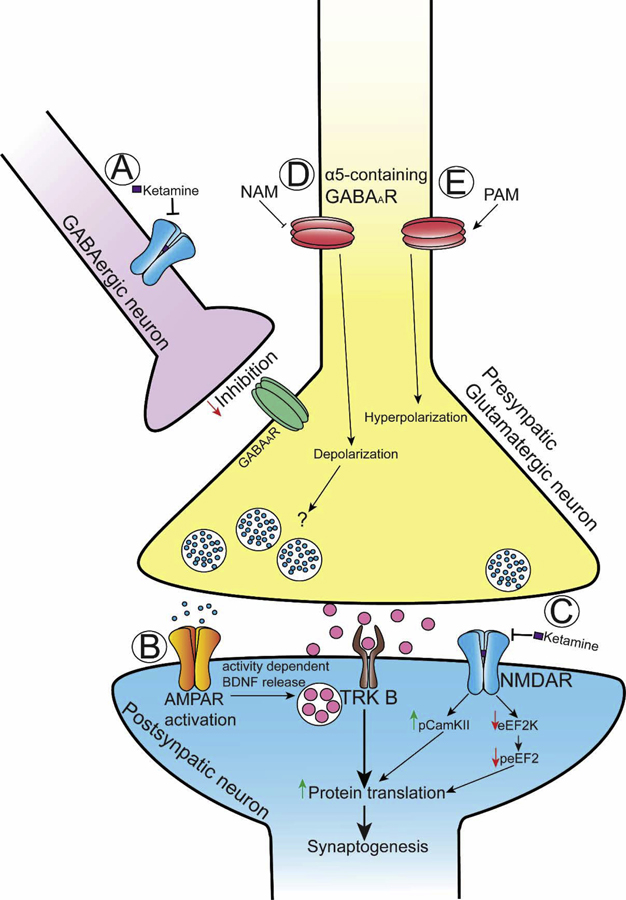
Numerous randomized double-blind clinical trials have consistently shown that that a single intravenous administration of a subanesthetic dose of ketamine to treatment-resistant depressed patients significantly improved depressive symptomatology rapidly, within two hours, with the effect lasting up to seven days. Despite its very promising effects, ketamine has long been associated with potential for abuse as it can cause psychotropic side effects, such as hallucinations, false beliefs, and severe impairments in judgment and other cognitive processes. Consequently, within the last two decades preclinical research has been carried out aimed at understanding its mechanisms of action and the brain circuits involved in ketamine's antidepressant effects, both of which are discussed in this review. Furthermore, with the hippocampus being a key target for ketamine's beneficial antidepressant effects, we and others have begun to examine behavioral and neurochemical effects of drugs that act selectively on the hippocampus due to the preferential location of their receptor targets. Such drugs are negative allosteric modulators (NAMs) and positive allosteric modulator (PAM) of the α5-GABAA receptor. Such compounds are discussed within the framework of how lessons learned with ketamine point to novel classes of drugs, targeting the GABAergic system, that can recapitulate the antidepressant effects of ketamine without its adverse effects.
Keywords: Depression; Ketamine; Negative allosteric modulators; Receptors; Ventral hippocampus; α5-containing GABA(A).
Copyright © 2020 Elsevier B.V. All rights reserved.
Conflict of interest statement
Disclosure statement
The authors report no conflicts of interest.
Figures
References
-
- Fekadu A, Wooderson SC, Markopoulo K, Donaldson C, Papadopoulos A, Cleare AJ, What happens to patients with treatment-resistant depression? A systematic review of medium to long term outcome studies, Journal of affective disorders 116(1–2) (2009) 4–11. - PubMed
-
- Kessler RC, Avenevoli S, McLaughlin KA, Green JG, Lakoma MD, Petukhova M, Pine DS, Sampson NA, Zaslavsky AM, Merikangas KR, Lifetime co-morbidity of DSM-IV disorders in the US National Comorbidity Survey Replication Adolescent Supplement (NCS-A), Psychological medicine 42(9) (2012) 1997–2010. - PMC - PubMed
-
- Mrazek DA, Hornberger JC, Altar CA, Degtiar I, A review of the clinical, economic, and societal burden of treatment-resistant depression: 1996–2013, Psychiatric services 65(8) (2014) 977–87. - PubMed
-
- Rush AJ, Limitations in efficacy of antidepressant monotherapy, The Journal of clinical psychiatry 68 Suppl 10 (2007) 8–10. - PubMed
-
- Katz MM, Tekell JL, Bowden CL, Brannan S, Houston JP, Berman N, Frazer A, Onset and early behavioral effects of pharmacologically different antidepressants and placebo in depression, Neuropsychopharmacology : official publication of the American College of Neuropsychopharmacology 29(3) (2004) 566–79. - PubMed
Publication types
MeSH terms
Substances
Grants and funding
LinkOut - more resources
Full Text Sources
Medical
Miscellaneous
