. 2020 Jan 31;21(3):940.
doi: 10.3390/ijms21030940.

TiO2 Nanomaterials Non-Controlled Contamination Could Be Hazardous for Normal Cells Located in the Field of Radiotherapy

Affiliations

TiO2 Nanomaterials Non-Controlled Contamination Could Be Hazardous for Normal Cells Located in the Field of Radiotherapy

Yidan Wang et al. Int J Mol Sci. .

Abstract

Among nanomaterials (NMs), titanium dioxide (TiO2) is one of the most manufactured NMs and can be found in many consumers' products such as skin care products, textiles and food (as E171 additive). Moreover, due to its most attractive property, a photoactivation upon non-ionizing UVA radiation, TiO2 NMs is widely used as a decontaminating agent. Uncontrolled contaminations by TiO2 NMs during their production (professional exposure) or by using products (consumer exposure) are rather frequent. So far, TiO2 NMs cytotoxicity is still a matter of controversy depending on biological models, types of TiO2 NMs, suspension preparation and biological endpoints. TiO2 NMs photoactivation has been widely described for UV light radiation exposure, it could lead to reactive oxygen species production, known to be both cyto- and genotoxic on human cells. After higher photon energy exposition, such as X-rays used for radiotherapy and for medical imaging, TiO2 NMs photoactivation still occurs. Importantly, the question of its hazard in the case of body contamination of persons receiving radiotherapy was never addressed, knowing that healthy tissues surrounding the tumor are indeed exposed. The present work focuses on the analysis of human normal bronchiolar cell response after co-exposition TiO2 NMs (with different coatings) and ionizing radiation. Our results show a clear synergistic effect, in terms of cell viability, cell death and oxidative stress, between TiO2 NMS and radiation.

Keywords: TiO2 nanoparticles; photocatalysis; radiation sensitivity.


Conflict of interest statement

The authors declare no conflict of interest. The funders had no role in the design of the study; in the collection, analyses, or interpretation of data; in the writing of the manuscript, or in the decision to publish the results

Figures
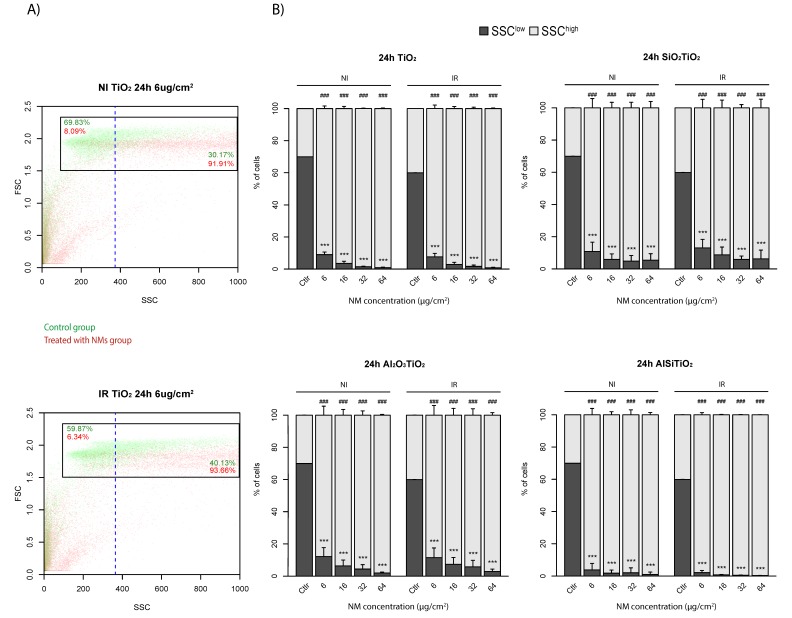
Figure 1
Figure 1
Internalization of nanomaterials (NMs) into 16HBE14o- cells. Cells are platted in 24 wells plates at 4.5 × 10⁴ cells per well, and maintained in control conditions (Ctlr), or in the presence of 6, 16, 32 or 64 μg/cm2 of the different type of TiO2. (A) Flow cytometry are performed 24 h later, and internalization is measured by the increase of SSC for TiO2, SiO2TiO2, Al2O3TiO2 and AlSiTiO2. A threshold is defined at 70% for non-irradiated cells, and 60% for irradiated cells regarding the pattern of FSC/SSC for the control groups, and (B) the results are reported for each type of NMs. (means ± S.E.M., n = 3, *** p < 0.001 (Welch t-test), as compared to the percentage of SSClow of the control group, ### p < 0.001 (Welch t-test), as compared to the percentage of SSChigh of the control group).
Figure 2
Figure 2
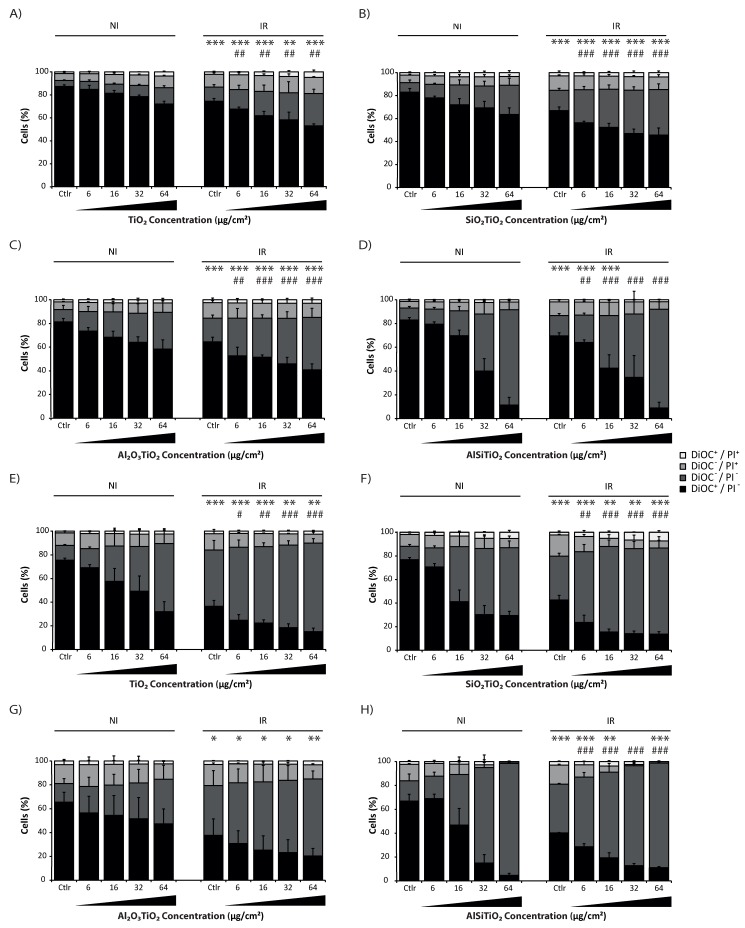
Cell death assay performed 72 h and 7 days after TiO2 treatment combined or not with 4 Gy irradiation. Human bronchial epithelial 16HBE14o- cells are maintained in control conditions (Ctlr) or treated with 6, 16, 32 or 64 μg/cm2 of (A,E) titanium dioxide (TiO2), (B,F) Silica coated titanium dioxide (SiO2TiO2), (C,G) Aluminum coated titanium dioxide (Al2O3TiO2) or (D,H) double silica and aluminum coated titanium dioxide (AlSiTiO2), and irradiated or not. Cells are maintained in culture for 72 h (AD) or 7 days (EH) after treatment and then co-stained for the cytofluorometric detection of cell death with DiOC6(3) and propidium iodide. Representative dot plots and quantitative data are reported (means ± S.D. n = 3, except for A) n = 2). * p < 0.05, ** p < 0.01, *** p < 0.001 (Student’s t-test), as compared with cells maintained in same conditions but non-irradiated. # p < 0.05, ## p < 0.01 and ### p < 0.001 (Student’s t-test), as compared with IR cells maintained in Ctlr condition.
Figure 3
Figure 3
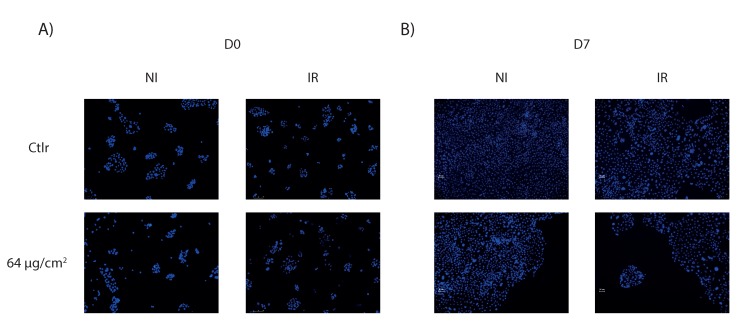
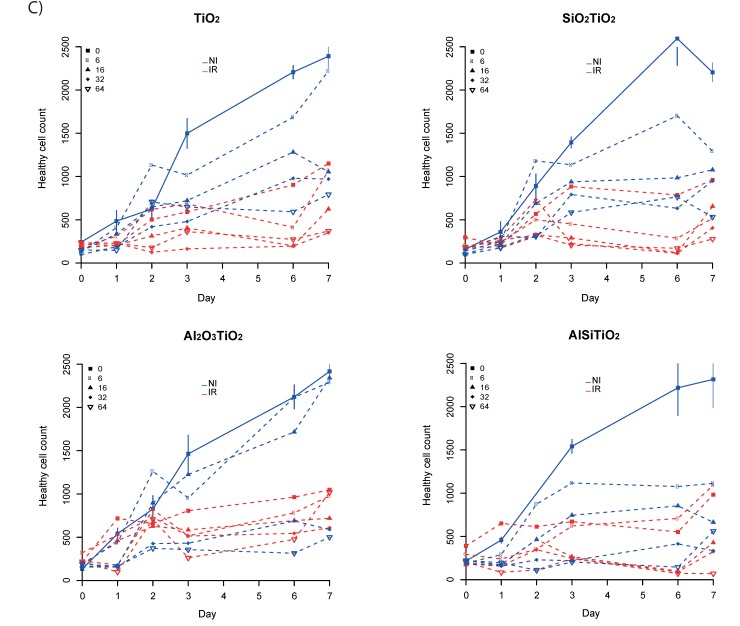
Cell growth after treatment by TiO2 NMs followed by microscopy. 16HBE14o- cells are platted in six wells plates at 2.5 × 10⁴ and treated 24 h after with no NMs, 6, 16, 32 or 64 μg/cm2, combined or not with 4 Gy irradiation. Microscopy pictures are taken immediately (10× magnification) (A) at day 0 until (B) day 7 after treatment on fixed cells, stained with Hoechst 33342. (C) The average of the cell number is obtained for each type of TiO2 until day 7 (the standard deviation is only shown for the non-irradiated control group for figure readability).
Figure 3
Figure 3
Cell growth after treatment by TiO2 NMs followed by microscopy. 16HBE14o- cells are platted in six wells plates at 2.5 × 10⁴ and treated 24 h after with no NMs, 6, 16, 32 or 64 μg/cm2, combined or not with 4 Gy irradiation. Microscopy pictures are taken immediately (10× magnification) (A) at day 0 until (B) day 7 after treatment on fixed cells, stained with Hoechst 33342. (C) The average of the cell number is obtained for each type of TiO2 until day 7 (the standard deviation is only shown for the non-irradiated control group for figure readability).
Figure 4
Figure 4
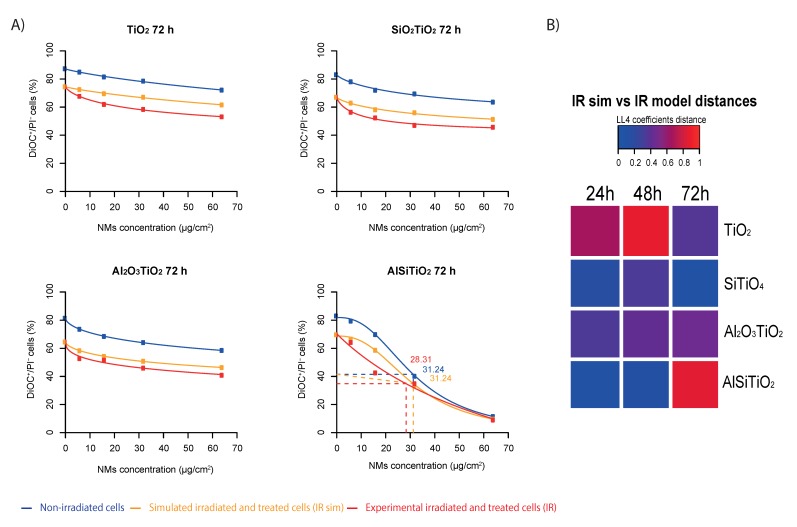
Synergy study between each type of TiO2 and 4 Gy irradiation. (A) Log-logistic model were built (i) to simulate the theoretical effect between each type of NMs and 4 Gy irradiation, and (ii) to fit the real effect obtained experimentally. The dotted lines: in the case of AlSiTiO2, the synergistic effect was detectable until around 30 µg/cm2. (B) Heat map representing a higher or lower effect of experimental toxicity of NMs combined with 4 Gy irradiation versus the theoretical toxicity for 24, 48 and 72 h after treatment.
Figure 5
Figure 5
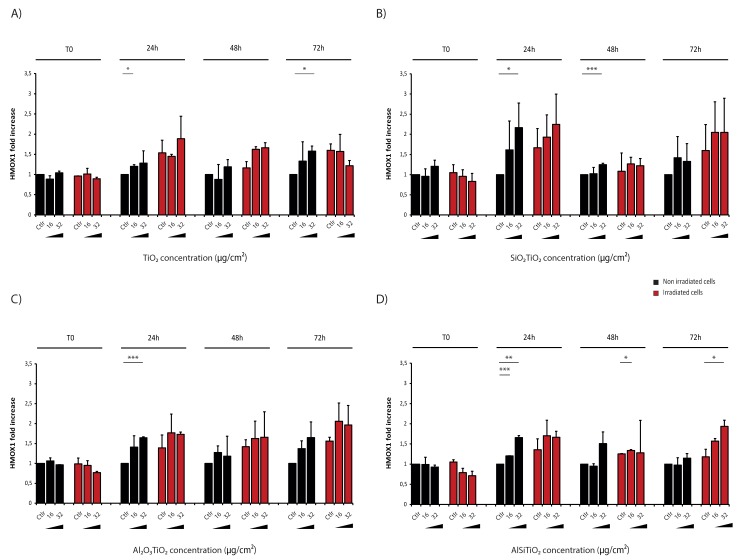
HMOX1 detection by quantitative real time polymerase chain reaction. Human bronchial epithelial 16HBE cells were maintained in control conditions (Ctlr) or treated with 16 or 32 g/cm of (A) titanium dioxide (TiO2), (B) silica coated titanium dioxide (SiO2TiO2), (C) aluminum coated titanium dioxide (Al2O3TiO2) or (D) double silica and aluminum coated titanium dioxide (AlSiTiO2), and 4 Gy irradiated or not. ARN extractions were performed immediately (T0), 24 h, 48 h or 72 h after treatment and quantitative RT-PCR were realized to detect HMOX1 gene expression. Representative dot plots normalized by the value of the untreated non-irradiated control for each time point are shown (means ± S.D., n = 2). * p < 0.05, ** p < 0.01, *** p < 0.001 (Student’s t-test), as compared with the control group corresponding.

References

    1. Baan R., Straif K., Grosse Y., Secretan B., El Ghissassi F., Cogliano V., WHO International Agency for Research on Cancer Monograph Working Group Carcinogenicity of carbon black, titanium dioxide, and talc. Lancet. Oncol. 2006;7:295–296. doi: 10.1016/S1470-2045(06)70651-9. - DOI - PubMed
    1. Luo Z., Wang Z., Xu B., Sarakiotis I.L., Du Laing G., Yan C. Measurement and characterization of engineered titanium dioxide nanoparticles in the environment. Appl. Phys. Eng. 2014;15:593–605. doi: 10.1631/jzus.A1400111. - DOI
    1. Piccinno F., Gottschalk F., Seeger S., Nowack B. Industrial production quantities and uses of ten engineered nanomaterials in Europe and the world. J. Nanoparticle. Res. 2012;14:1109–1119. doi: 10.1007/s11051-012-1109-9. - DOI
    1. Auffan M., Rose J., Wiesner M.R., Bottero J.Y. Chemical stability of metallic nanoparticles: A parameter controlling their potential cellular toxicity in vitro. Env. Pollut. 2009;157:1127–1133. doi: 10.1016/j.envpol.2008.10.002. - DOI - PubMed
    1. Ponce A. Nanomaterials and workplace health & safety What are the issues for workers? [(accessed on 28 January 2020)];2013 Available online: http://www.etui.org/Publications2/Guides/Nanomaterials-and-workplace-hea....