


Lipidomic Analysis Reveals Specific Differences between Fibroblast and Keratinocyte Ceramide Profile of Patients with Psoriasis Vulgaris
- PMID: 32023992
- PMCID: PMC7037443
- DOI: 10.3390/molecules25030630
Lipidomic Analysis Reveals Specific Differences between Fibroblast and Keratinocyte Ceramide Profile of Patients with Psoriasis Vulgaris
Abstract
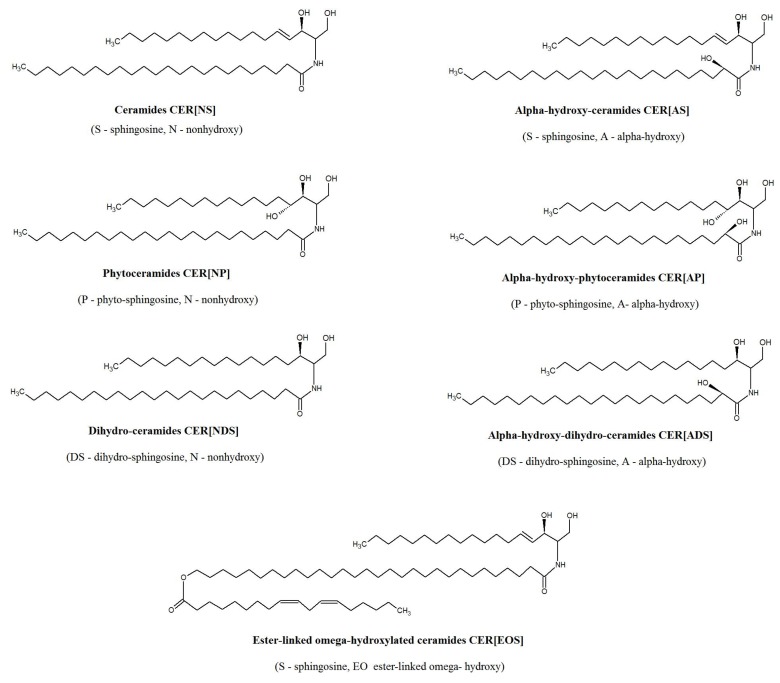
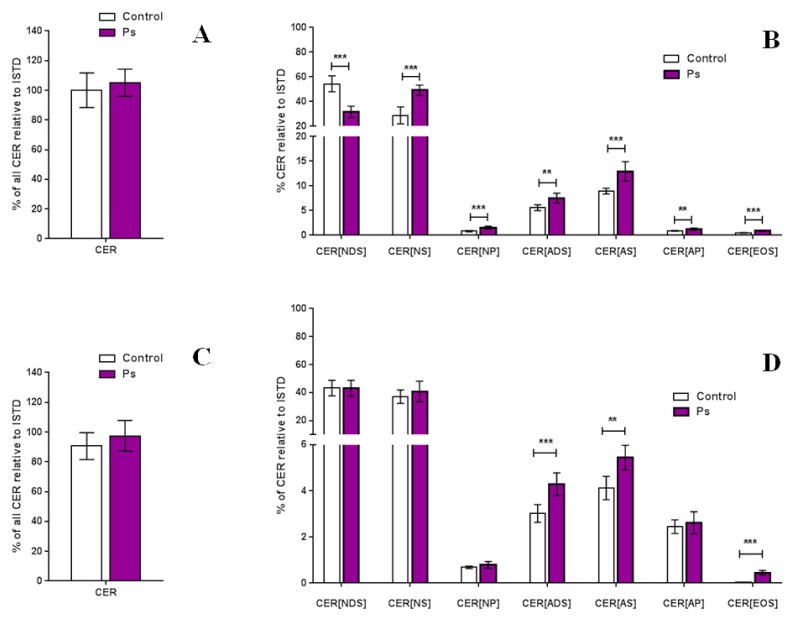
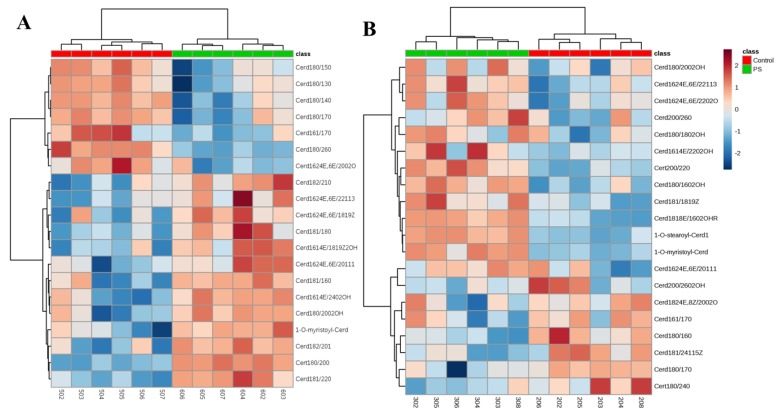
Ceramides are important lipid metabolites for primal skin functions. There is increasing evidence that alteration of the profile and metabolism of ceramides is associated with skin diseases, such as psoriasis vulgaris. Most studies have reported alteration in ceramide content in the stratum corneum, but these have been scarcely reported for other skin layers. In the present work, we aimed to explore changes in the ceramide profile of fibroblasts and keratinocytes in patients with psoriasis vulgaris and healthy subjects. Using the reversed-phase liquid chromatography-quadrupole-time-of-flight-tandem-mass spectrometry (RPLC-QTOF-MS/MS) platform, we identified ceramide containing non-hydroxy fatty acid ([N]), α-hydroxy fatty acid ([A]), and esterified ω-hydroxy fatty acid ([EO]) and 3 sphingoid bases, dihydrosphingosine ([DS]), sphingosine ([S]), and phytosphingosine ([P]). We found that in the keratinocytes of patients with psoriasis, CER[NS], CER[NP], CER[AS], CER[ADS], CER[AP] and CER[EOS] tended to be expressed at higher relative levels, whereas CER[NDS] tended to be expressed with lower levels than in healthy subjects. In the case of fibroblasts, significant differences were observed, mainly in the three ceramide classes (CER[AS], CER[ADS] and CER[EOS]), which were expressed at significantly higher levels in patients with psoriasis. The most significant alteration in the fibroblasts involved elevated levels of CER[EOS] that contained ester-linked fatty acids. Our findings provide insights into the ceramide profile in the dermis and epidermis of patients with psoriasis and contribute for the research in this field, focusing on the role of keratinocyte-fibroblast crosstalk in the development of psoriasis vulgaris.
Keywords: ceramides; fibroblasts; keratinocytes; lipidomics; psoriasis vulgaris; skin.
Conflict of interest statement
The authors declare no conflict of interest.
Figures


References
-
- Pilgram G.S., Vissers D.C., van der Meulen H., Pavel S., Lavrijsen S.P., Bouwstra J.A., Koerten H.K. Aberrant lipid organization in stratum corneum of patients with atopic dermatitis and lamellar ichthyosis. J. Invest. Dermatol. 2001;117:710–717. doi: 10.1046/j.0022-202x.2001.01455.x. - DOI - PubMed
-
- Koyano S., Hatamochi A., Yamazaki S., Ishikawa J., Kitahara T., Narita H., Kondo N., Masukawa Y. Psoriasis patients have abnormal ceramide profile in stratum corneum. Nishinihon. J. Dermatol. 2010;72:494–499. doi: 10.2336/nishinihonhifu.72.494. - DOI
MeSH terms
Substances
Grants and funding
LinkOut - more resources
Full Text Sources
Medical
Research Materials
Miscellaneous
