


Changes in Physical Activity, Physical Fitness and Well-Being Following a School-Based Health Promotion Program in a Norwegian Region with a Poor Public Health Profile: A Non-Randomized Controlled Study in Early Adolescents
- PMID: 32023995
- PMCID: PMC7037455
- DOI: 10.3390/ijerph17030896
Changes in Physical Activity, Physical Fitness and Well-Being Following a School-Based Health Promotion Program in a Norwegian Region with a Poor Public Health Profile: A Non-Randomized Controlled Study in Early Adolescents
Abstract
The purpose of this study was to examine the changes in physical activity (PA), physical fitness and psychosocial well-being in early adolescents following implementation of a school-based health promotion program in secondary schools.
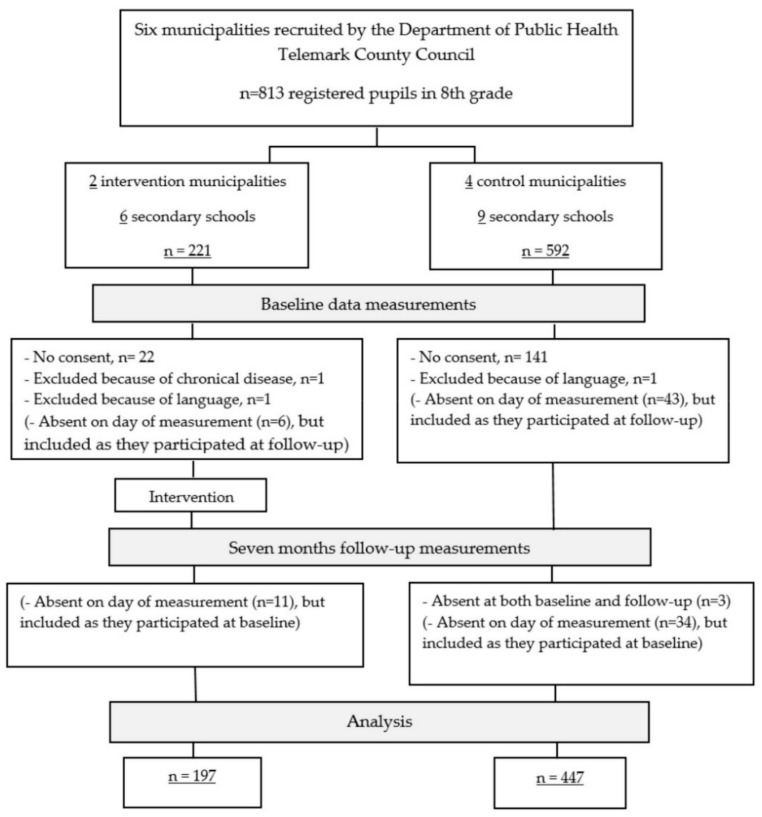
Methods: Six municipalities in Telemark County, Norway, were recruited into intervention (6 schools) or control groups (9 schools). A total of 644 pupils participated in the study (response rate: 79%). The schools in the intervention group implemented the Active and Healthy Kids program, where the PA component consisted of (1) 120 min/week of physically active learning (PAL) and (2) 25 min/week of physical active breaks. Furthermore, both the intervention and control schools carried out 135 min/week of physical education. The primary outcome was PA. Secondary outcomes were sedentary time, physical fitness, subjective vitality and health-related quality of life (HRQoL) in five domains: physical health, psychological well-being, parent, peers and school.
Results: There was a group x time effect on school-based PA (p < 0.05), but not total PA, as well as on physical fitness (p < 0.05) and vitality (p < 0.01). In girls, there also was a group x time effect on three out of the five domains on HRQoL (p < 0.05).
Conclusions: A multi-component, school-based health-promotion program with emphasis on the use of PAL led to positive changes in school-based PA levels. Furthermore, positive changes were seen in physical fitness, vitality and HRQoL among early adolescents in a county with a poor public health profile. This might have implications for the development and promotion in schools of general health and well-being throughout adolescence.
Keywords: adolescents; intervention; physically active academic lessons; school-based physical activity; well-being.
Conflict of interest statement
The authors declare no conflict of interest.
References
-
- Biddle S.J., Ciaccioni S., Thomas G., Vergeer I. Physical activity and mental health in children and adolescents: An updated review of reviews and an analysis of causality. Psychol. Sport Exerc. 2019;42:146–155. doi: 10.1016/j.psychsport.2018.08.011. - DOI
-
- Reneflot A., Aarø L., Aase H., Reichborn-Kjennerud T., Tambs K., Øverland S. Psykisk helse i Norge. Norwegian Institute of Public Health (NIPH); Oslo, Norway: 2018.
Publication types
MeSH terms
LinkOut - more resources
Full Text Sources
Medical
