. 2020 Feb 2;12(2):168.
doi: 10.3390/v12020168.

The First Non-LRV RNA Virus in Leishmania

Affiliations

The First Non-LRV RNA Virus in Leishmania

Danyil Grybchuk et al. Viruses. .

Abstract

In this work, we describe the first Leishmania-infecting leishbunyavirus-the first virus other than Leishmania RNA virus (LRV) found in trypanosomatid parasites. Its host is Leishmaniamartiniquensis, a human pathogen causing infections with a wide range of manifestations from asymptomatic to severe visceral disease. This virus (LmarLBV1) possesses many characteristic features of leishbunyaviruses, such as tripartite organization of its RNA genome, with ORFs encoding RNA-dependent RNA polymerase, surface glycoprotein, and nucleoprotein on L, M, and S segments, respectively. Our phylogenetic analyses suggest that LmarLBV1 originated from leishbunyaviruses of monoxenous trypanosomatids and, probably, is a result of genomic re-assortment. The LmarLBV1 facilitates parasites' infectivity in vitro in primary murine macrophages model. The discovery of a virus in L.martiniquensis poses the question of whether it influences pathogenicity of this parasite in vivo, similarly to the LRV in other Leishmania species.

Keywords: Bunyavirales; Leishmania martiniquensis; leishbunyavirus.


Conflict of interest statement

The authors declare no conflicts of interest. The funders had no role in the design of the study; in the collection, analyses, or interpretation of data; in the writing of the manuscript, or in the decision to publish the results.

Figures
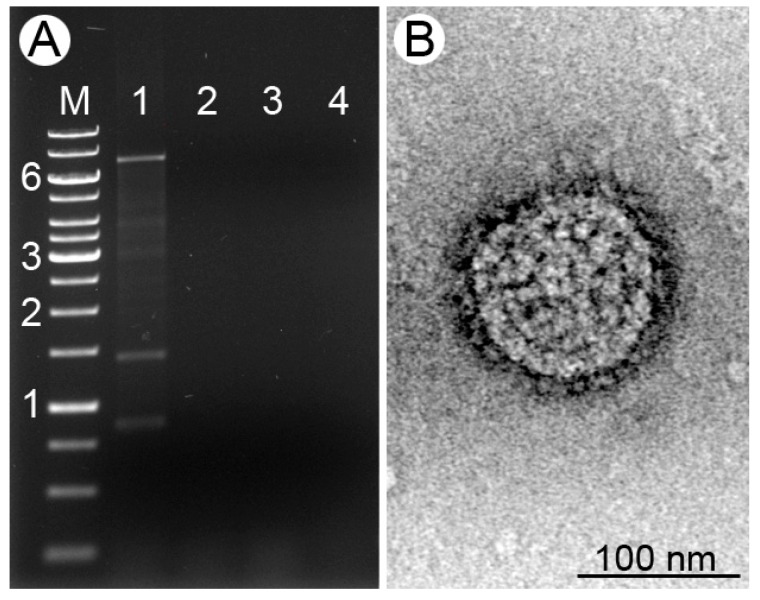
Figure 1
Figure 1
(A) Screening of double-stranded RNAs (dsRNAs) in Leishmania (Mundinia) spp. M, GeneRuler 1-kb DNA ladder. Indicated sizes are in kilobases: 1, L. (M.) martiniquensis MHOM/MQ/92/MAR1; 2, L. (M.) enriettii MCAV/BR/45/LV90; 3, L. (M.) macropodum MMAC/AU/2004/AM-2004; 4, L. (M.) orientalis MHOM/TH/2007/PCM2. (B) Negative-stain transmission electron micrographs of the virus particle isolated from L. (M.) martiniquensis. Scale bar is 100 nm.
Figure 2
Figure 2
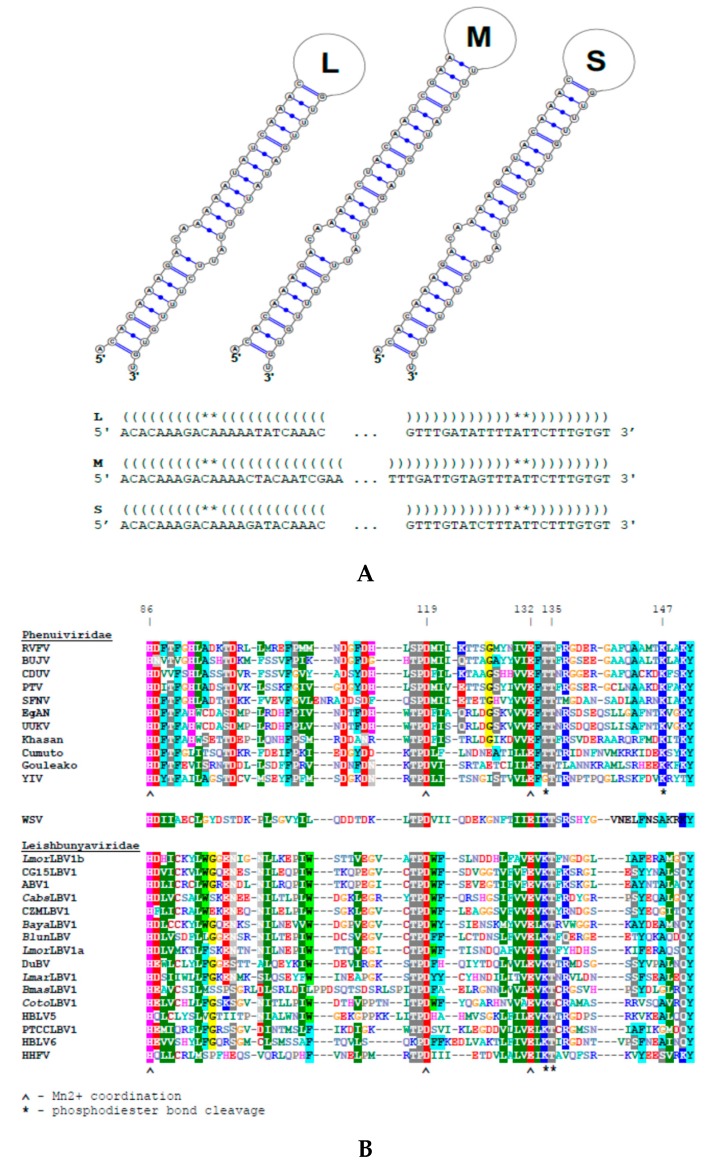
Structural features of LmarLBV1. (A) Secondary structures and complementary sequences on 5′ and 3′ ends of the LmarLBV1 L, M, and S RNA segments predicted by IPknot. (and) depicting complementary nucleotides forming the stem, *-non-complementary nucleotides forming a bulge. (B) Amino acid alignment of the N-terminal endonuclease domain of RDRP of Leishbunyaviridae and Phenuiviridae. Functionally important residues are marked with arrowheads. Numbering of positions in alignment are indicated as in LmarLBV1 polymerase protein. Shading: ≥80% identity within Phenui and Leishbunyaviruses + Wuhan Spider virus (LBV+WSV).
Figure 3
Figure 3
RDRP-based maximum likelihood reconstruction of leishbunyaviruses’ phylogeny. Double-crossed branch is at 50% of its original lengths. Branch supports are Bayesian posterior probability and maximum likelihood bootstrap, respectively. Black circles indicate maximal (1/100) statistical supports. The scale bar indicates the number of substitutions per site. The tree was rooted with the sequences of Phenuiviridae. Lesihmania martiniquensis leishbunyavirus 1 (LmarLBV1) described here is highlighted in black. Abbreviations and GenBank accession numbers are in Table S2 [32].
Figure 4
Figure 4
LmarLBV1 facilitates Leishmania infection in vitro. (A) Establishment of isogenic, virus-depleted line of L. (M.) martiniquensis MHOM/MQ/92/MAR1. The treatment with ribavirin was stopped after four weeks (asterisk), but the viral load remained low in LmarLBV1-depleted parasites. (B) Macrophage infection in vitro. The average number of parasite per well was calculated for the wild type and in LmarLBV1-depleted L. (M.) martiniquensis infecting non-stimulated, classically (LPS/IFN-γ) or alternatively (IL-4) stimulated primary murine macrophages. Data are summarized from two independent biological replicates (three technical replicates each). The error bars indicate standard deviations. N.S. = not statistically significant. p ≤ 0.05.
Figure 5
Figure 5
A schematic phylogenetic tree of the family Trypanosomatidae (modified from [13]), demonstrating the distribution of leishbunyaviruses (triangles) and leishmaniaviruses (circles) over the genera of these flagellates. Viruses identified in metatranscriptomes of trypanosomatid-infected insects [38] are shown in grey.

References

    1. Lefkowitz E.J., Dempsey D.M., Hendrickson R.C., Orton R.J., Siddell S.G., Smith D.B. Virus taxonomy: The database of the International Committee on Taxonomy of Viruses (ICTV) Nucleic Acids Res. 2018;46:D708–D717. doi: 10.1093/nar/gkx932. - DOI - PMC - PubMed
    1. Wichgers Schreur P.J., Kormelink R., Kortekaas J. Genome packaging of the Bunyavirales. Curr. Opin. Virol. 2018;33:151–155. doi: 10.1016/j.coviro.2018.08.011. - DOI - PubMed
    1. Elliott R.M. Molecular biology of the Bunyaviridae. J. Gen. Virol. 1990;71:501–522. doi: 10.1099/0022-1317-71-3-501. - DOI - PubMed
    1. Sun Y., Li J., Gao G.F., Tien P., Liu W. Bunyavirales ribonucleoproteins: The viral replication and transcription machinery. Crit. Rev. Microbiol. 2018;44:522–540. doi: 10.1080/1040841X.2018.1446901. - DOI - PubMed
    1. Gerlach P., Malet H., Cusack S., Reguera J. Structural insights into Bunyavirus replication and its regulation by the vRNA promoter. Cell. 2015;161:1267–1279. doi: 10.1016/j.cell.2015.05.006. - DOI - PMC - PubMed

Publication types

Substances

LinkOut - more resources