Review
. 2020 Feb 2;9(2):345.
doi: 10.3390/cells9020345.

New Insight into Plant Signaling: Extracellular ATP and Uncommon Nucleotides

Affiliations
Review

New Insight into Plant Signaling: Extracellular ATP and Uncommon Nucleotides

Małgorzata Pietrowska-Borek et al. Cells. .

Abstract

New players in plant signaling are described in detail in this review: extracellular ATP (eATP) and uncommon nucleotides such as dinucleoside polyphosphates (NpnN's), adenosine 5'-phosphoramidate (NH2-pA), and extracellular NAD+ and NADP+ (eNAD(P)+). Recent molecular, physiological, and biochemical evidence implicating concurrently the signaling role of eATP, NpnN's, and NH2-pA in plant biology and the mechanistic events in which they are involved are discussed. Numerous studies have shown that they are often universal signaling messengers, which trigger a signaling cascade in similar reactions and processes among different kingdoms. We also present here, not described elsewhere, a working model of the NpnN' and NH2-pA signaling network in a plant cell where these nucleotides trigger induction of the phenylpropanoid and the isochorismic acid pathways yielding metabolites protecting the plant against various types of stresses. Through these signals, the plant responds to environmental stimuli by intensifying the production of various compounds, such as anthocyanins, lignin, stilbenes, and salicylic acid. Still, more research needs to be performed to identify signaling networks that involve uncommon nucleotides, followed by omic experiments to define network elements and processes that are controlled by these signals.

Keywords: adenosine 5′-phosphoramidate; adenosine 5′-tetraphosphate; diadenosine 5′,5′′′-tetraphosphate; dinucleoside polyphosphates; eATP; eNAD(P)+.


Conflict of interest statement

The authors declare no conflict of interest.

Figures
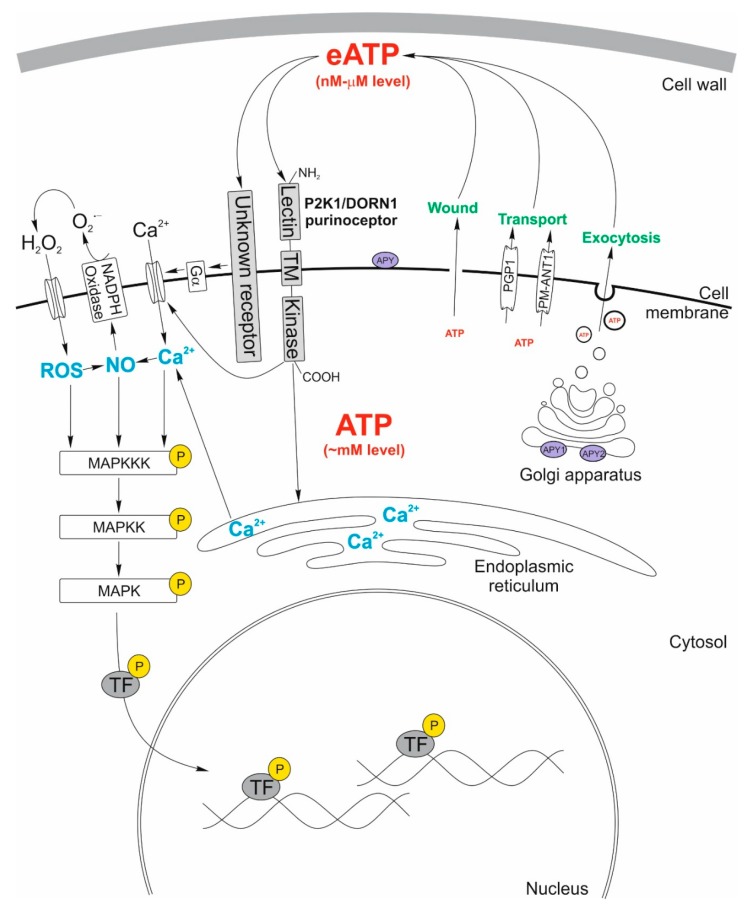
Figure 1
Figure 1
Model of changes occurring in the plant cell triggered by the extracellular ATP (eATP). In this model, three possible ways of ATP release into the extracellular matrix are demonstrated. It considers the wounded cell membrane, exocytosis, and two transporters: the p-glycoprotein (PGP1) belonging to the ATP-binding cassette ABC transporters, and the plasma membrane-localized nucleotide transporters (PM-ANT1). Two apyrases, APY1, and APY2, localized in the Golgi apparatus membrane of Arabidopsis thaliana regulate the concentration of eATP. Additionally, the hypothesized apyrase (APY) located at the extracellular surface of the plasma membrane can decrease eATP concentration directly in the extracellular matrix. The released eATP acts as a signaling molecule triggering elevation of the cytosolic Ca2+ level by activation of the P2K1 receptor, which in turn activates the Ca2+ channel. The hypothetical non-P2K1 receptor, whose binding with eATP leads to activation of the Gα subunit of the heterotrimeric G-protein, activates the cell membrane Ca2+ channel. High cytosolic Ca2+ concentration causes an increase in production of nitric oxide (NO), reactive oxygen species (ROS), and mitogen-activated protein kinases (MAPKs), which finally leads to various physiological responses. The ROS boosted production is due to the activation of the RBOHD subunit of the plasma membrane-localized NADPH oxidase. The contribution of the transcription factors in the regulation of gene expression is of high importance.
Figure 2
Figure 2
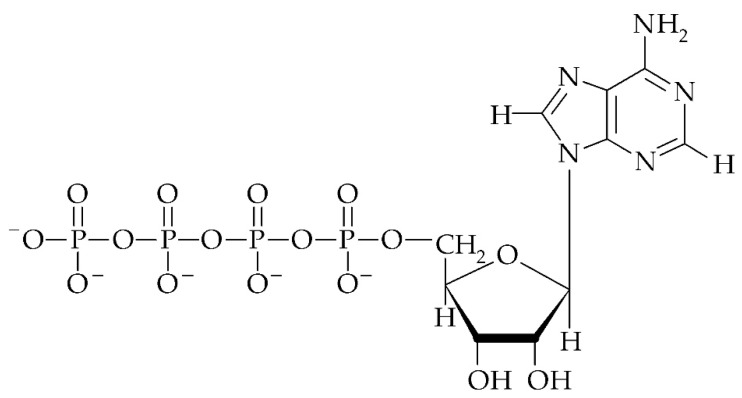
Structure of adenosine 5′-tetraphosphate (p4A).
Figure 3
Figure 3
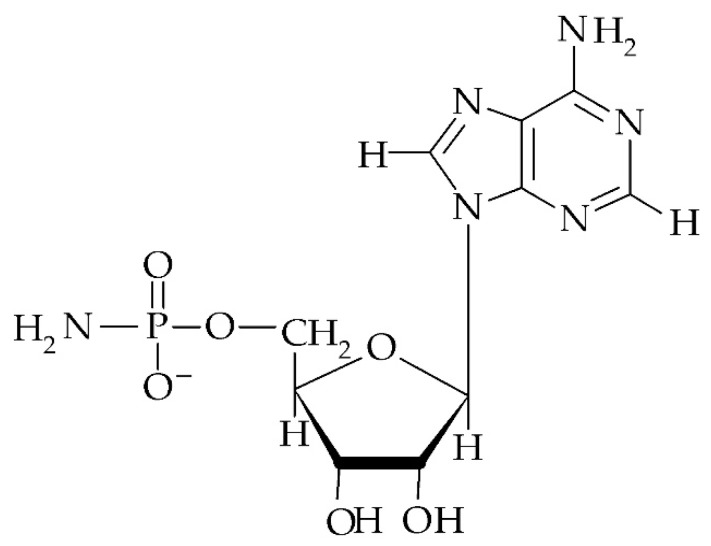
Structure of adenosine 5′-phosphoramidate (NH2-pA).
Figure 4
Figure 4
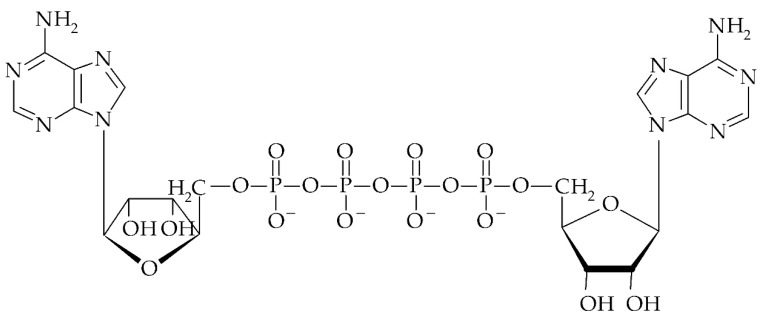
Structure of diadenosine 5′, 5′′′-tetraphosphate (Ap4A).
Figure 5
Figure 5
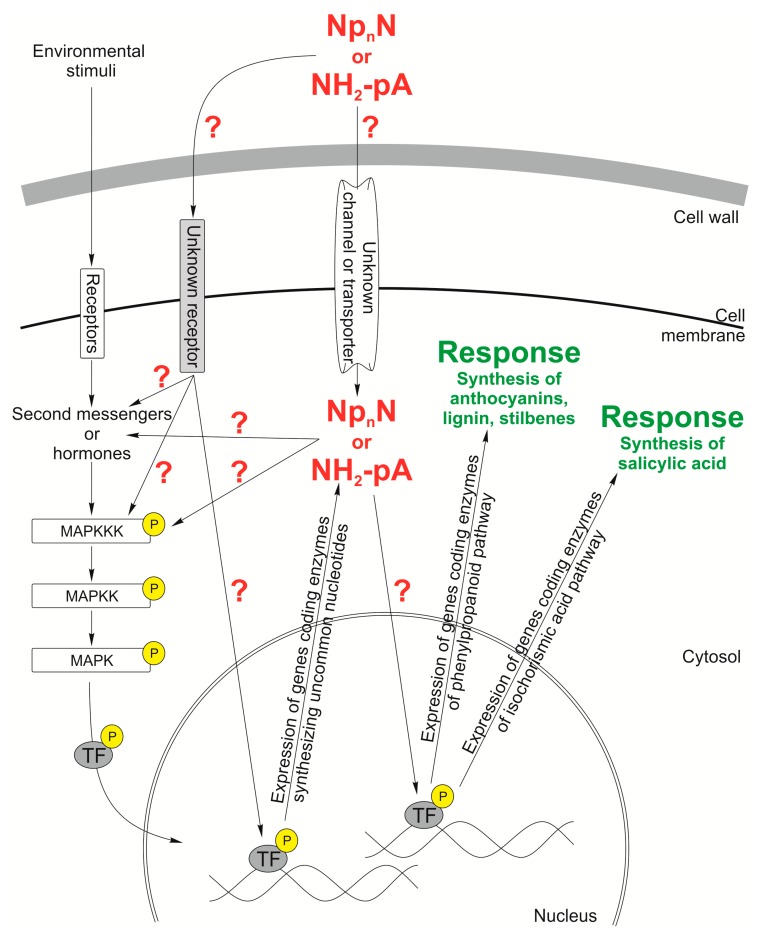
Hypothetical working model of NpnN’ and NH2-pA signaling network in a plant cell. Dinucleoside polyphosphate (NpnN) and adenosine 5′-phosphoramidate (NH2-pA) trigger induction of the phenylpropanoid and the isochorismic acid pathways yielding metabolites protecting plant against various types of stresses. Plant cells respond to environmental stimuli by intensification of the production of various compounds, such as anthocyanins, lignin, stilbenes, and salicylic acid. Question marks indicate the hypothetical components of the signaling network.

References

    1. Edel K.H., Marchadier E., Brownlee C., Kudla J., Hetherington A.M. The evolution of calcium-based signalling in plants. Curr. Biol. 2017;27:667–679. doi: 10.1016/j.cub.2017.05.020. - DOI - PubMed
    1. Del Rio L.A. ROS and RNS in plant physiology: An overview. J. Exp. Bot. 2015;66:2827–2837. doi: 10.1093/jxb/erv099. - DOI - PubMed
    1. Pietrowska-Borek M., Chadzinikolau T., Borek S. Cyclic nucleotides and nucleotide cyclases in plants under stress. In: Ahmad P., Wani M.R., Azooz M.M., Tran L.S.P., editors. Improvement of Crops in the Era of Climatic Changes. Springer Science and Business Media; New York, NY, USA: 2014. pp. 119–151.
    1. Isner J.C., Maathuis F.J.M. cGMP signalling in plants: From enigma to main stream. Funct. Plant Biol. 2016;45:93–101. doi: 10.1071/FP16337. - DOI - PubMed
    1. Świeżawska B., Duszyn M., Jaworski K., Szmidt-Jaworska A. Downstream targets of cyclic nucleotides in plants. Front. Plant Sci. 2018;9:1428. doi: 10.3389/fpls.2018.01428. - DOI - PMC - PubMed

Publication types

MeSH terms

Substances

LinkOut - more resources