. 2020 May;31(9-10):553-564.
doi: 10.1089/hum.2019.339. Epub 2020 Mar 5.

Tracking Adeno-Associated Virus Capsid Evolution by High-Throughput Sequencing

Affiliations

Tracking Adeno-Associated Virus Capsid Evolution by High-Throughput Sequencing

Gustavo de Alencastro et al. Hum Gene Ther. 2020 May.

Abstract

Despite early successes using recombinant adeno-associated virus (rAAV) vectors in clinical gene therapy trials, limitations remain making additional advancements a necessity. Some of the challenges include variable levels of pre-existing neutralizing antibodies and poor transduction in specific target tissues and/or diseases. In addition, readministration of an rAAV vector is in general not possible due to the immune response against the capsid. Recombinant adeno-associated virus (AAV) vectors with novel capsids can be isolated in nature or developed through different directed evolution strategies. However, in most cases, the process of AAV selection is not well understood and new strategies are required to define the best parameters to develop more efficient and functional rAAV capsids. Therefore, the use of barcoding for AAV capsid libraries, which can be screened by high-throughput sequencing, provides a powerful tool to track AAV capsid evolution and potentially improve AAV capsid library screens. In this study, we examined how different parameters affect the screen of two different AAV libraries in two human cell types. We uncovered new and unexpected insights in how to maximize the likelihood of obtaining AAV variants with the desired properties. The major findings of the study are the following. (1) Inclusion of helper-virus for AAV replication can selectively propagate variants that can replicate to higher titers, but are not necessarily better at transduction. (2) Competition between AAVs with specific capsids can take place in cells that have been infected with different AAVs. (3) The use of low multiplicity of infections for infection results in more variation between screens and is not optimal at selecting the most desired capsids. (4) Using multiple rounds of selection can be counterproductive. We conclude that each of these parameters should be taken into consideration when screening AAV libraries for enhanced properties of interest.

Keywords: AAV libraries; capsid evolution; high-throughput sequencing.


Conflict of interest statement

M.A.K. has commercial affiliations and stock and/or equity in companies with technology broadly related to this article. All other authors declare no conflicts of interest.

Figures
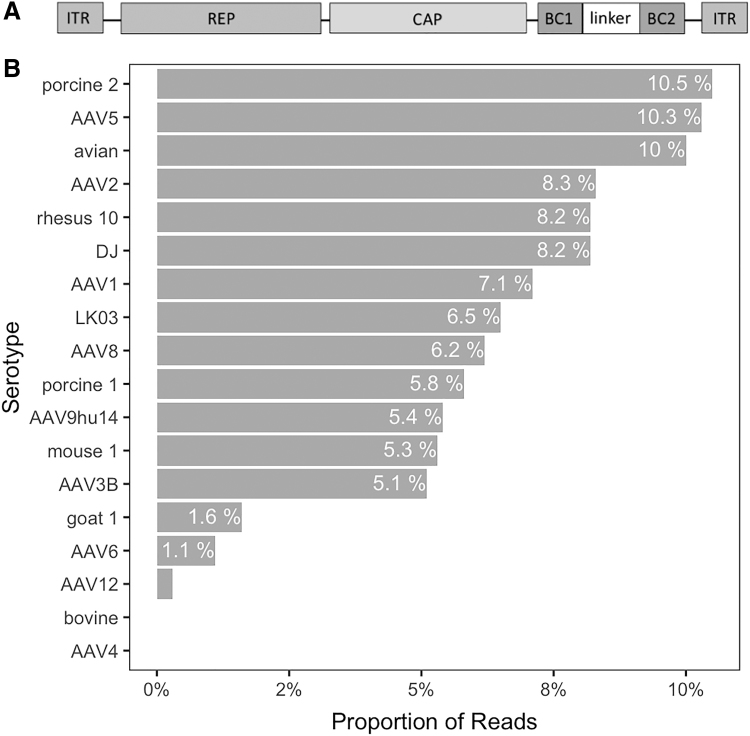
Figure 1.
Figure 1.
Features of the 18 parental capsid pool. (A) Scheme of the AAV vectors containing the 18 different AAV capsids attached to unique barcode sequences. Each barcode contains 12 unique nucleotides and are separated by a 20 nucleotide linker (BC1-linker-BC2). The same cloning scheme was used to build the 10 parental capsid library, where the shuffled capsid sequences were cloned downstream of REP followed by unique barcode sequences. (B) Starting proportion of each BC/capsid in the 18 AAV capsid pool determined by high-throughput sequencing of barcodes (adapted from Pekrun et al.). AAV, adeno-associated virus.
Figure 2.
Figure 2.
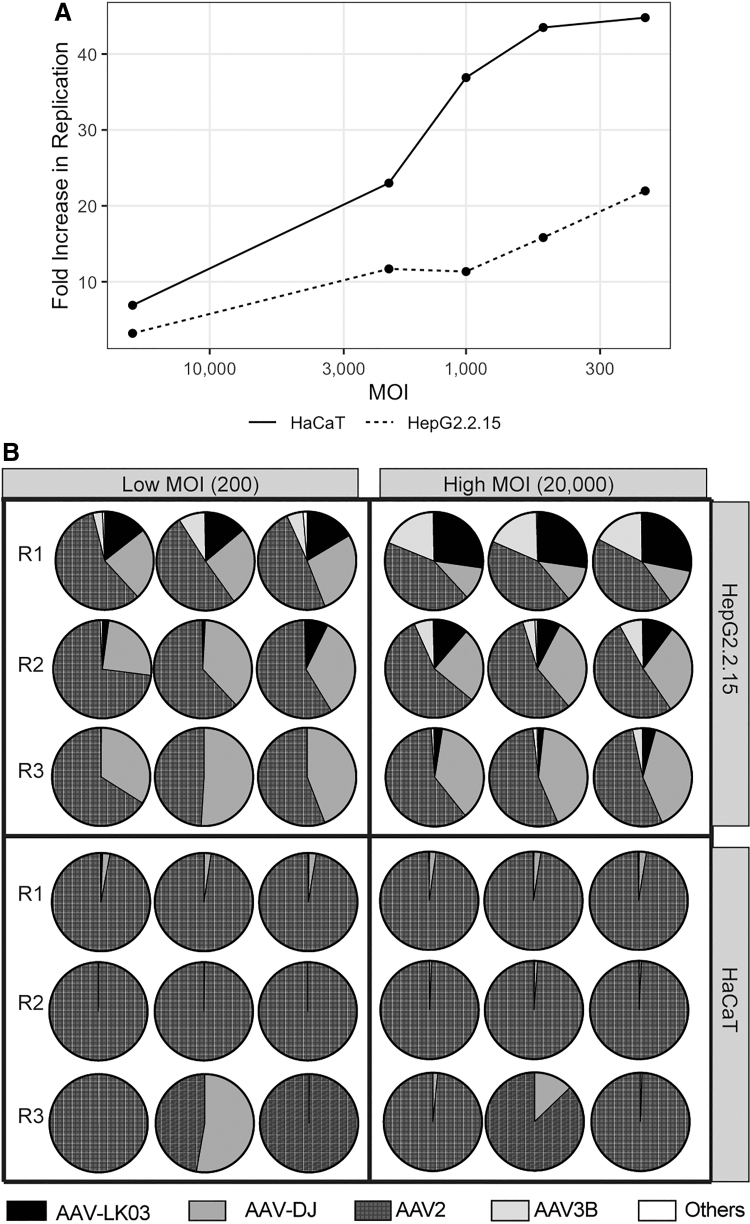
AAV transduction in HepG2.2.15 and HaCaT cells. (A) Lower MOIs induce higher levels of AAV replication in HepG2.2.15 and HaCaT cells. Five different MOIs were analyzed in both cell lines. Fold increase in replication was calculated in relation to the number of input AAV by qPCR. (B) High MOI produces more consistent results among triplicates. Analysis was conducted in triplicate in HepG2.2.15 and HaCaT cell for three rounds of selection (R1, R2, and R3). Two MOIs were used (200 and 20,000) and screening was performed in the presence of a helper virus (Ad5). MOI, multiplicity of infection; qPCR, quantitative polymerase chain reaction.
Figure 3.
Figure 3.
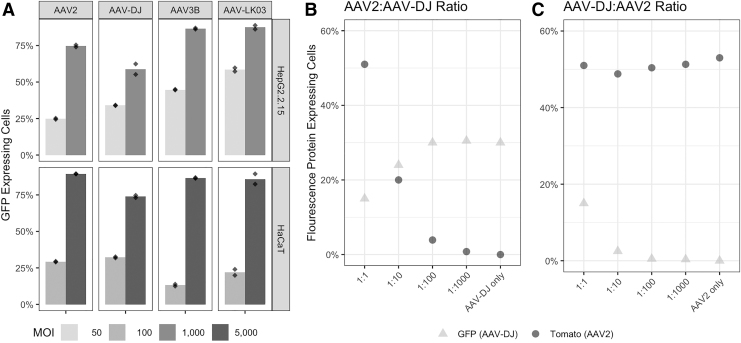
(A) Analysis of the most and least prevalent AAV serotypes from rounds 1–3 of selection in HepG2.2.15 and HaCaT cells. Cells were transduced in duplicate with two different MOIs (50 and 1,000 for HepG2.2.15 cells and 100 and 5,000 for HaCaT cells) and analyzed by flow cytometry analysis after 48 h. Dots represent each replicate. (B) and (C) AAV2 competes with AAV-DJ for transduction in HaCaT cells. HaCaT cells were transduced with different combinations of both AAV2 (Tomato) and AAV-DJ (GFP) and analyzed by flow cytometry after 48 h. (B) Increasing amounts of AAV-DJ were mixed with AAV2 (left to right). GFP signal increases and Tomato signal decreases with increasing amounts of AAV-DJ. (C) Increasing amounts of AAV2 were mixed with AAV-DJ (left to right). The signals of GFP and Tomato are less affected, indicating less competition.
Figure 4.
Figure 4.
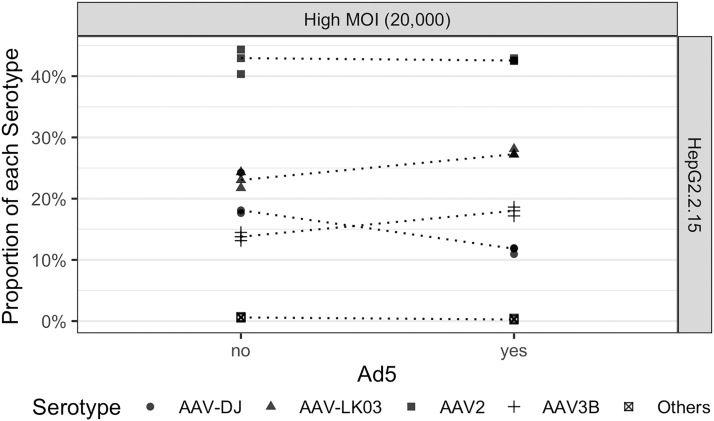
Transduction of HepG2.2.15 cells with and without replication (Ad5) maintained AAV diversity when using a high MOI (20,000). Experiment was performed in triplicate and samples analyzed after 72 h of transduction. Dots represent each replicate. Dotted lines indicates the same serotype.
Figure 5.
Figure 5.
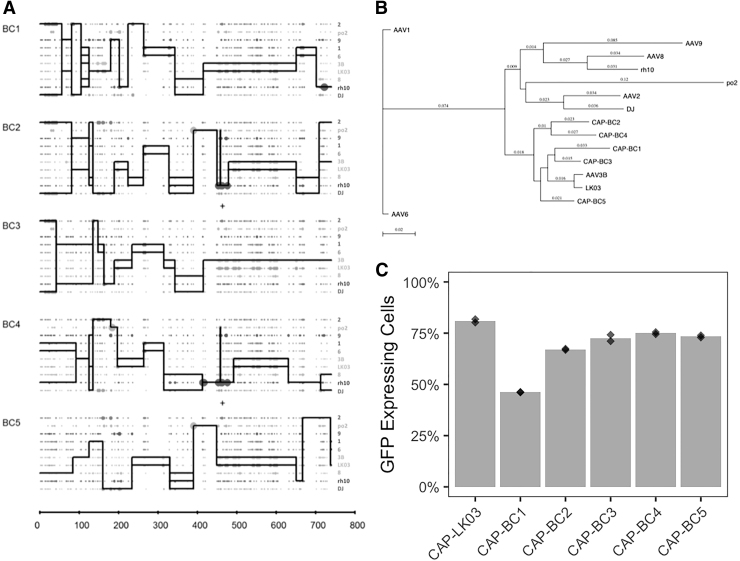
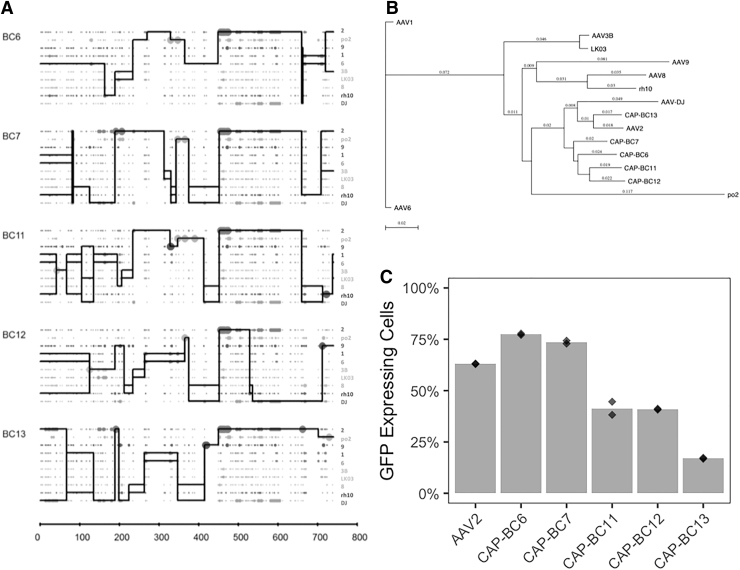
AAV chimeric capsids selected in HepG2.2.15 cells without the use of replication. (A) Crossover analysis and (B) phylogenetic tree of the five new AAV chimeric capsids demonstrate amino acid similarities among the original serotypes present in the 10 parental AAV library. Abbreviations: 2 (AAV2), po2 (AAVporcine2), 9 (AAV9), 1 (AAV1), 6 (AAV6), 3B (AAV3B), LK03 (AAV-LK03), 8 (AAV8), rh10 (AAVrh10), and DJ (AAV-DJ). (C) Transduction analysis in HepG2.2.15 cells was performed in duplicate using the new AAV chimeric capsids and AAV-LK03 (the most efficient parental serotype for HepG2.2.15 transduction; Fig. 3A) (MOI:100). Dots represent each replicate.
Figure 6.
Figure 6.
AAV chimeric capsids selected in HaCaT cells without the use of replication. (A) Crossover analysis and (B) phylogenetic tree of the five new AAV chimeric capsids demonstrate amino acid similarities among the original serotypes present in the 10 parental AAV library. Abbreviations: 2 (AAV2), po2 (AAVporcine2), 9 (AAV9), 1 (AAV1), 6 (AAV6), 3B (AAV3B), LK03 (AAV-LK03), 8 (AAV8), rh10 (AAVrh10), and DJ (AAV-DJ). (C) Transduction analysis in HaCaT cells was performed in duplicate using the new AAV chimeric capsids and AAV2 (the most efficient parental serotype for HaCaT transduction; Fig. 3A) (MOI:100). Dots represent each replicate.

References

    1. Grimm D, Lee JS, Wang L, et al. . In vitro and in vivo gene therapy vector evolution via multispecies interbreeding and retargeting of adeno-associated viruses. J Virol 2008;82:5887–5911 - PMC - PubMed
    1. Lisowski L, Dane AP, Chu K, et al. . Selection and evaluation of clinically relevant AAV variants in a xenograft liver model. Nature 2014;506:382–386 - PMC - PubMed
    1. Paulk NK, Pekrun K, Zhu E, et al. . Bioengineered AAV capsids with combined high human liver transduction in vivo and unique humoral seroreactivity. Mol Ther 2018;26:289–303 - PMC - PubMed
    1. Munch RC, Muth A, Muik A, et al. . Off-target-free gene delivery by affinity-purified receptor-targeted viral vectors. Nat Commun 2015;6:6246. - PubMed
    1. Deverman BE, Pravdo PL, Simpson BP, et al. . Cre-dependent selection yields AAV variants for widespread gene transfer to the adult brain. Nat Biotechnol 2016;34:204–209 - PMC - PubMed

Publication types

LinkOut - more resources