Review
doi: 10.1128/JCM.01580-19.
Print 2020 Mar 25.
Diagnostic Testing for Crimean-Congo Hemorrhagic Fever
Affiliations
- PMID: 32024724
- PMCID: PMC7098759
- DOI: 10.1128/JCM.01580-19
Item in Clipboard
Review
Diagnostic Testing for Crimean-Congo Hemorrhagic Fever
J Clin Microbiol.
.
Abstract
Crimean-Congo hemorrhagic fever is the most geographically widespread tick-borne virus, with infection resulting in mortality in up to 30% of cases. Clinical diagnosis alone is difficult due to the nonspecific nature of symptoms; therefore, laboratory diagnostics should be utilized for patients with residence in or travel to regions of endemicity in whom the disease is suspected. This minireview provides an overview of laboratory tests available for Crimean-Congo hemorrhagic fever (CCHF) and their utility in diagnosis with a focus on diagnosing CCHF in humans.
Keywords: Crimean-Congo hemorrhagic fever virus.
Copyright © 2020 American Society for Microbiology.
Figures
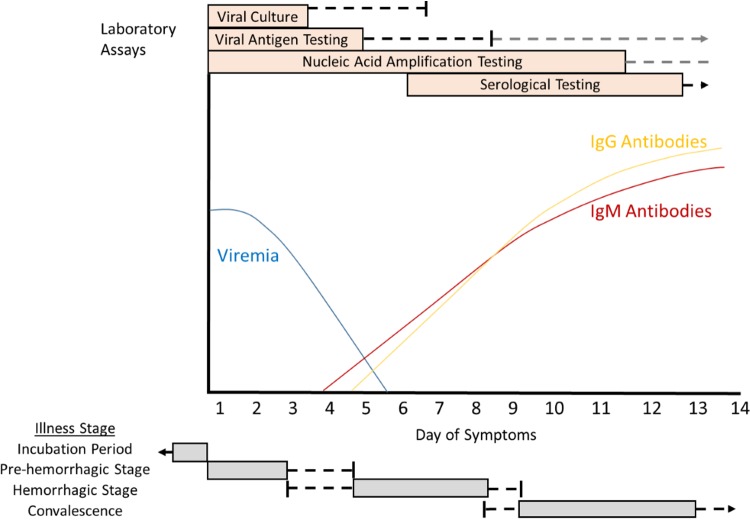
Cartoon overview of diagnostic testing for acute illness due to Crimean-Congo hemorrhagic fever virus in a non-fatal human infection. Patients with fatal CCHFV infections may have prolonged viremia and may not develop antibodies to CCHFV. The period of greatest assay utility is shown in the orange box. Black lines indicate the outer limits of utility in patients who recover, gray lines indicate periods of uncertain positivity or documented positivity among fatal cases, and black arrows indicate persistent assay positivity. The typical periods of each stage are outlined in gray boxes, with ranges outlined by black lines.
References
-
- Abudurexiti A, Adkins S, Alioto D, Alkhovsky SV, Avšič-Županc T, Ballinger MJ, Bente DA, Beer M, Bergeron É, Blair CD, Briese T, Buchmeier MJ, Burt FJ, Calisher CH, Cháng C, Charrel RN, Choi IR, Clegg JCS, de la Torre JC, de Lamballerie X, Dèng F, Di Serio F, Digiaro M, Drebot MA, Duàn X, Ebihara H, Elbeaino T, Ergünay K, Fulhorst CF, Garrison AR, Gāo GF, Gonzalez J-PJ, Groschup MH, Günther S, Haenni A-L, Hall RA, Hepojoki J, Hewson R, Hú Z, Hughes HR, Jonson MG, Junglen S, Klempa B, Klingström J, Kòu C, Laenen L, Lambert AJ, Langevin SA, Liu D, Lukashevich IS, et al. . 2019. Taxonomy of the order Bunyavirales: update 2019. Arch Virol 164:1949–1965. doi:10.1007/s00705-019-04253-6. - DOI - PMC - PubMed
-
- World Health Organization. 2013. Crimean-Congo haemorrhagic fever (CCHF). World Health Organization, Geneva, Switzerland: https://www.who.int/en/news-room/fact-sheets/detail/crimean-congo-haemor....
-
- Spengler JR, Estrada-Peña A, Garrison AR, Schmaljohn C, Spiropoulou CF, Bergeron É, Bente DA. 2016. A chronological review of experimental infection studies of the role of wild animals and livestock in the maintenance and transmission of Crimean-Congo hemorrhagic fever virus. Antiviral Res 135:31–47. doi:10.1016/j.antiviral.2016.09.013. - DOI - PMC - PubMed
Publication types
MeSH terms
Grants and funding
LinkOut - more resources
Full Text Sources